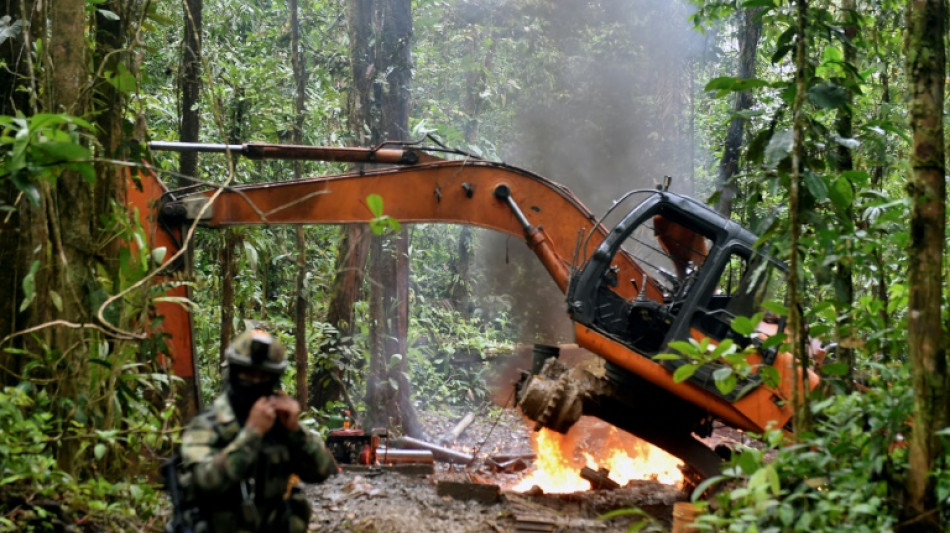
Colombia's war on illegal gold mines also hits outlaw armed groups / Photo: DANIEL MUNOZ - AFP

 Ed Sheeran returns to stage after Palestinian controversy

 Asian Games to open in Japan after troubled build-up

 Drone owners rush to offload devices ahead of Beijing ban

 Trump's beef policies irk Texas ranchers, testing their loyalty

 Nvidia, OpenAI CEOs to attend Xi dinner at White House

 Anthropic picks Accenture for in-house AI safety evaluation

 Balogun returns as Monaco beat Lens to continue strong Ligue 1 start

 'Pause' on overt repression in Venezuela, but reforms still needed: HRW

 Global stocks mixed as yen falls despite Bank of Japan rate hike

 Cuba hit with seventh major blackout of the year

 Murray out with concussion so Wentz will start for Vikings

 UN chief 'deeply regrets' US visa refusal to Abbas for annual meeting

 England quick Carse to face no charges over alleged nightclub assault

 Mancini brings nine newcomers into the first squad of his Italy comeback

 Czechs level Davis Cup tie against USA as South Korea eye Finals

 New France boss Zidane confirms Mbappe as captain after naming first squad

 California governor signs order to explore AI 'kill switch'

 Head leads run spree as Australia win Zimbabwe ODI series

 In-form Raphinha wants to finish career at Barcelona

 Warren Buffett steps down as Berkshire Hathaway chairman

 Carrick confident Man Utd can 'work through' tough time

 Mbappe ends Nike partnership to join Swiss brand On

 Liverpool boss Iraola puts Bournemouth love affair on hold

 'A disaster' if Man City do not win says Maresca after flawless start

 Kerry James Marshall: American 'blackness' painter celebrated in Europe

From the army helicopter circling overhead, Colombian security forces are able to spot several illegal gold mines in the jungle below.
The armed forces land suddenly to be confronted by angry workers, but they brush them off and destroy the machinery used to extract gold.
The operation is both a blow to illegal mining and a strike at armed groups that profit from illicit mines in this conflict-ridden country.
More than 100 soldiers, police and anti-riot officers arrive onboard four aircraft in the southeastern Triangulo del Telembi region.
Their mission is to destroy bulldozers to prevent villagers from mining for gold, an illegal activity that helps fund the National Liberation Army (ELN) rebels and dissidents of the now-defunct Revolutionary Armed Forces of Colombia (FARC) guerrillas who made peace with the state in 2016, laying down their arms to form a communist political party.
Illegal mining for gold does not just provide resources for armed groups, it is also responsible for environmental damage through the use of mercury, which pollutes water sources.
AFP was present to witness the spectacular operation in this region that borders Ecuador and where gold exploitation leads to mercury pollution of water sources.
Eight bulldozers, either hidden in the vegetation or sitting next to craters, are found and destroyed with explosives.
The heavy machinery was responsible for the destruction of at least five square kilometers of jungle.
According to a United Nations report in 2021, illegal mining directly led to the destruction of more than 640 square kilometers (about 250 square miles) of vegetation in Colombia.
"Illegal armed groups enrich themselves from this gold extraction," police special commando unit chief Hugo Nelson Gallego said.
Although they may not own the machinery themselves, these groups "impose a tax" on those using the bulldozers to extract gold.
- 'Predatory activity' -
Dozens of young people, mostly black, throw stones at the security forces in an attempt to protect the machinery. Some even tried to put out the flames.
Riot police respond with tear gas to avoid an armed "confrontation" with civilians, said Gallego.
Without the tear gas to clear a field, the civilians might prevent the helicopters from landing.
Impoverished families and children watch from their makeshift wooden homes.
Colombia began operations against such illegal mining in 2012. Since then, authorities say they have destroyed more than 800 pieces of machinery.
Leftist President Gustavo Petro, who assumed office in August, has vowed to continue the operations against illegal mining of gold, platinum, silver and other minerals as long as "the protagonists of this predatory activity continue to destroy the environment."
- Widespread mercury contamination -
From the air, brown patches among the green vegetation attest to the environmental damage left behind by illegal mining.
Extracting gold involves cutting down trees and removing the subsoil.
Turquoise pools reveal the use of mercury, a chemical element that pollutes water and is used to separate small golden nuggets from worthless sediment.
Miners "dump it into the river... and that contaminates the whole area," said general Javier Africano, the anti drug trafficking and transnational threats commander.
According to studies, mercury can cause genetic damage and provoke malformations in humans.
Authorities believe mercury is smuggled into Colombia from neighboring Brazil, Ecuador and Venezuela.
The production and use of mercury have been restricted since 2018, but Colombia is the country with the highest level of mercury pollution per capita in the world, according to official data.
"To extract one gram of gold they are using about five grams of mercury," said Gallego.
"That little amount pollutes 600,000 liters of water, which in turn take 30 years to recover."
- Gold hard to trace -
Illegal mining and drug trafficking are the two main sources of income for Colombia's armed groups that have waged a near-six-decade conflict against the security forces.
Authorities say gold is almost as profitable as drugs due to the difficulty in tracing its source.
Some 85 percent of gold exported by Colombia is illegally extracted, according to official calculations.
"It is probably going to the US and Europe," said Africano.
The army estimates that the Triangulo de Telembi operation will have cost rebels close to $800,000.
In 2022, such operations deprived criminal gangs of $14 million.
Colombia is the world's largest producer of cocaine and authorities work hard to try to seize the drug, "but gold is moved in a much easier way," said Carlos Romero, a soldier.
Gold can also be made into jewelry, making it harder for authorities to detect its illegal origin.
At airports, for example, a person can go with "their chains, their watch and pass through metal detectors without any problems because these are jewelry," Romero said.
M.Gameiro--PC



