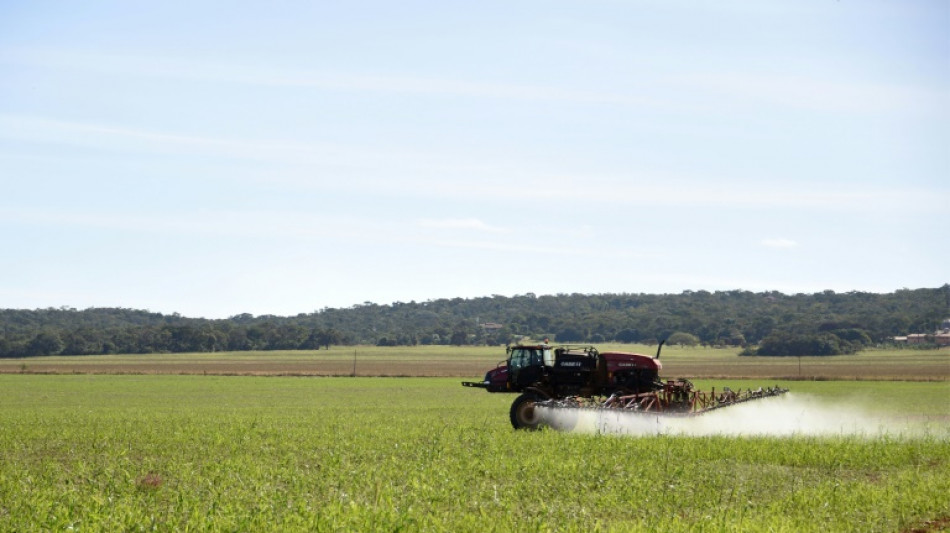
Emissions from fertilisers could be slashed by 2050: study / Photo: EVARISTO SA - AFP

 Ed Sheeran returns to stage after Palestinian controversy

 Asian Games to open in Japan after troubled build-up

 Drone owners rush to offload devices ahead of Beijing ban

 Trump's beef policies irk Texas ranchers, testing their loyalty

 Nvidia, OpenAI CEOs to attend Xi dinner at White House

 Anthropic picks Accenture for in-house AI safety evaluation

 Balogun returns as Monaco beat Lens to continue strong Ligue 1 start

 'Pause' on overt repression in Venezuela, but reforms still needed: HRW

 Global stocks mixed as yen falls despite Bank of Japan rate hike

 Cuba hit with seventh major blackout of the year

 Murray out with concussion so Wentz will start for Vikings

 UN chief 'deeply regrets' US visa refusal to Abbas for annual meeting

 England quick Carse to face no charges over alleged nightclub assault

 Mancini brings nine newcomers into the first squad of his Italy comeback

 Czechs level Davis Cup tie against USA as South Korea eye Finals

 New France boss Zidane confirms Mbappe as captain after naming first squad

 California governor signs order to explore AI 'kill switch'

 Head leads run spree as Australia win Zimbabwe ODI series

 In-form Raphinha wants to finish career at Barcelona

 Warren Buffett steps down as Berkshire Hathaway chairman

 Carrick confident Man Utd can 'work through' tough time

 Mbappe ends Nike partnership to join Swiss brand On

 Liverpool boss Iraola puts Bournemouth love affair on hold

 'A disaster' if Man City do not win says Maresca after flawless start

 Kerry James Marshall: American 'blackness' painter celebrated in Europe

The production and use of nitrogen fertilisers accounts for five percent of global greenhouse gas emissions, which can be massively reduced with a few available interventions, a new study said Thursday.
Nitrogen fertilisers -- produced and used across the world -- are crucial for global food security.
But their harmful emissions contributing to global warming exceed the aviation sector, and are on par with the iron and steel, cement and plastics industries.
Most existing research has focused on emissions associated with the production of fertilisers, but Thursday's study showed that the majority -- two thirds -- come from the use of the fertilisers in croplands.
"There is the perception that the petrochemical industry has been causing the emissions producing the fertilisers, but actually that doesn't seem to be the case. That was very surprising for us," co-author Andre Cabrera Serrenho from Cambridge University told AFP.
The findings are important because they show "where we should prioritise action to reduce emissions," he added.
Carbon emissions could be reduced by up to 80 percent by 2050 while still producing enough food to feed a growing global population, said the study published Thursday in the journal Nature Food.
"The interventions we propose in our study do not imply loss in crop productivity, and they consider the future growing demand for food to feed a growing global population," Serrenho confirmed.
- Boost efficiency, use less -
Emissions associated with production are mostly associated with ammonia, a key ingredient in most fertilisers.
Making ammonia not only uses a lot of energy, but also requires hydrogen production, which causes emissions.
Some factories in China, for example, use coal to make hydrogen. Hydrogen can be made from water using electricity generated by renewables, which would greatly reduce emissions, though it is often a lot more expensive.
And since many factories producing ammonia for fertilisers, especially in Asia, are relatively new, they are less likely to covert technologies to be more environmentally friendly.
Switching to renewable energy in factories is another way to help reduce that carbon footprint.
But Serrenho said the main way to reduce emissions linked to fertilisers is on the use side, by increasing their efficiency and thus reducing their use.
"We are currently really inefficient in the way we use fertilisers," he said. "We put much more fertilisers in croplands than the amount of nitrogen that actually crops need to grow."
The main emissions in the use phase come from the degradation of fertiliser by bacteria that exist in the soil and produce nitrous oxide, one of the most powerful greenhouse gases.
Carbon dioxide and methane are also emitted in the use phase, but simply using less fertiliser could help to slash those harmful emissions.
But convincing farmers to use fertilisers more efficiently -- for example, applying them daily in smaller quantities instead of spraying in large doses them once a season -- will require policy shifts.
"If we could have more economic incentives to farmers to change practices to reduce emissions, that seems to be the most obvious place to start," Serrenho said.
F.Ferraz--PC



