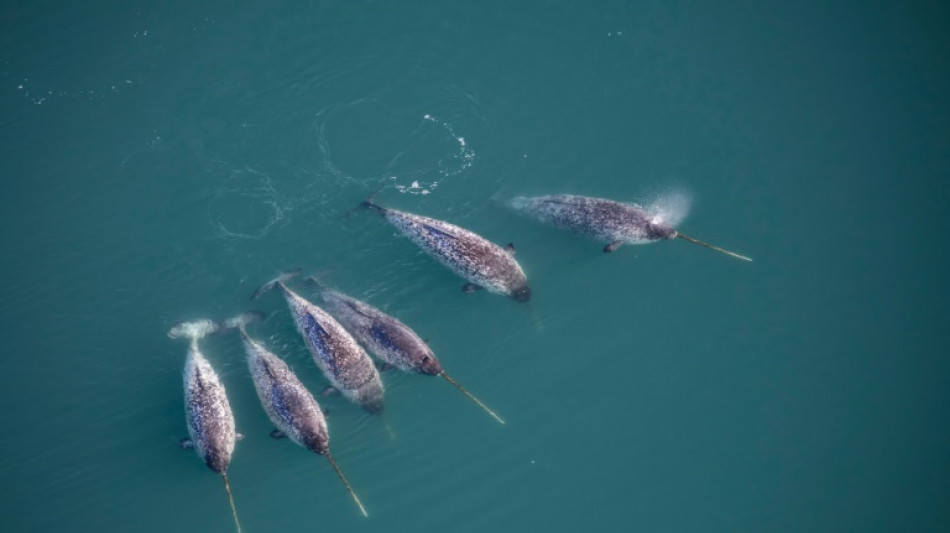
Narwhals' hungry summers as climate warms / Photo: Carsten Egevang - Groenlands Naturinstitut/AFP

 Ed Sheeran returns to stage after Palestinian controversy

 Asian Games to open in Japan after troubled build-up

 Drone owners rush to offload devices ahead of Beijing ban

 Trump's beef policies irk Texas ranchers, testing their loyalty

 Nvidia, OpenAI CEOs to attend Xi dinner at White House

 Anthropic picks Accenture for in-house AI safety evaluation

 Balogun returns as Monaco beat Lens to continue strong Ligue 1 start

 'Pause' on overt repression in Venezuela, but reforms still needed: HRW

 Global stocks mixed as yen falls despite Bank of Japan rate hike

 Cuba hit with seventh major blackout of the year

 Murray out with concussion so Wentz will start for Vikings

 UN chief 'deeply regrets' US visa refusal to Abbas for annual meeting

 England quick Carse to face no charges over alleged nightclub assault

 Mancini brings nine newcomers into the first squad of his Italy comeback

 Czechs level Davis Cup tie against USA as South Korea eye Finals

 New France boss Zidane confirms Mbappe as captain after naming first squad

 California governor signs order to explore AI 'kill switch'

 Head leads run spree as Australia win Zimbabwe ODI series

 In-form Raphinha wants to finish career at Barcelona

 Warren Buffett steps down as Berkshire Hathaway chairman

 Carrick confident Man Utd can 'work through' tough time

 Mbappe ends Nike partnership to join Swiss brand On

 Liverpool boss Iraola puts Bournemouth love affair on hold

 'A disaster' if Man City do not win says Maresca after flawless start

 Kerry James Marshall: American 'blackness' painter celebrated in Europe

Narwhals may not be much good at hunting in summer, according to new research that warns the unicorn-tusked whales may be dangerously reliant on their ice-bound winter habitat that could "disappear" with climate change.
Scientists studying the mammals in the fjords off the eastern coast of Greenland during the summer found narwhals were largely unsuccessful at capturing prey.
"(This) suggests that they could actually rely on the wintering grounds to build up sufficient body reserves and energy stores to sustain year-round activities," said Philippine Chambault of the University of California Santa Cruz, co-author of the study published in the journal Biology Letters on Wednesday.
Nicknamed the "unicorns of the sea" because of their long head tusks, narwhals live in the Arctic waters off Canada, Norway, Greenland and Russia.
Although they are not endangered, there are growing concerns about the whales as the planet warms and ice melts in their Arctic habitat.
Researchers believe most narwhals spend their winters feasting on fish and squid under sea ice off the coast of Greenland, but Chambault said this cold-water habitat may essentially "disappear" because of climate change, with expected increases in ocean temperatures driving ice melt and potentially causing prey to relocate.
While the exact causes of the low summer feeding rate are not yet clear, researchers said it could be due to a decline or relocation of squid and cod, lower energy needs, or even because they are picky eaters.
Narwhal eating habits are hard to track because they dive deep, up to one kilometre (3,000 feet) and stay in the open water.
The researchers were able to study the foraging behaviours of 14 narwhals using so-called stomach temperature pills that could detect when the whales swallowed cold prey and icy water.
They also used acoustic tags tuned to the sound waves or "buzzes" emitted when narwhals narrow-in on their prey.
- Empty stomachs -
More than two-thirds of the hunting dives recorded over roughly 1,000 hours were deemed unsuccessful due to the presence of buzzes without an accompanying stomach temperature drop, said the study.
The researchers said the small sample size and limits to the detection capabilities of the equipment meant the feeding rates could be underestimated.
But they also worked with local indigenous Inuit communities to test their findings.
Inuit hunters examined the stomach contents of the narwhals caught during summer hunting season, confirming that the whales' stomachs were in fact "pretty empty", Chambault told AFP.
Diet limitation is just one factor complicating the species' survival.
Their preference for cold water and a strong tendency to remain within or near where they were born mean they are particularly sensitive to climate change.
This means they might "show very little flexibility to changing habitats," Chambault said.
A.S.Diogo--PC



