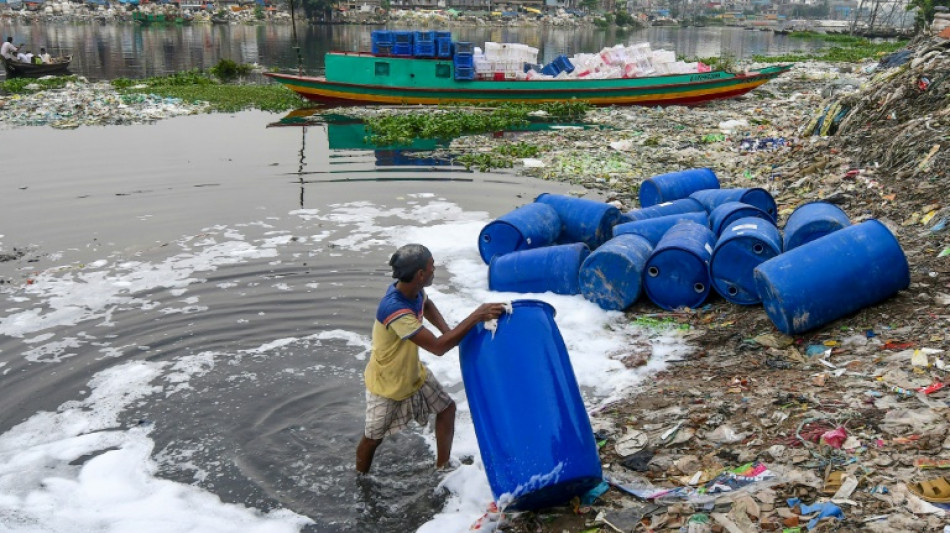
Global wildlife contaminated by 'forever chemicals' / Photo: Munir Uz zaman - AFP/File

 Ed Sheeran returns to stage after Palestinian controversy

 Asian Games to open in Japan after troubled build-up

 Drone owners rush to offload devices ahead of Beijing ban

 Trump's beef policies irk Texas ranchers, testing their loyalty

 Nvidia, OpenAI CEOs to attend Xi dinner at White House

 Anthropic picks Accenture for in-house AI safety evaluation

 Balogun returns as Monaco beat Lens to continue strong Ligue 1 start

 'Pause' on overt repression in Venezuela, but reforms still needed: HRW

 Global stocks mixed as yen falls despite Bank of Japan rate hike

 Cuba hit with seventh major blackout of the year

 Murray out with concussion so Wentz will start for Vikings

 UN chief 'deeply regrets' US visa refusal to Abbas for annual meeting

 England quick Carse to face no charges over alleged nightclub assault

 Mancini brings nine newcomers into the first squad of his Italy comeback

 Czechs level Davis Cup tie against USA as South Korea eye Finals

 New France boss Zidane confirms Mbappe as captain after naming first squad

 California governor signs order to explore AI 'kill switch'

 Head leads run spree as Australia win Zimbabwe ODI series

 In-form Raphinha wants to finish career at Barcelona

 Warren Buffett steps down as Berkshire Hathaway chairman

 Carrick confident Man Utd can 'work through' tough time

 Mbappe ends Nike partnership to join Swiss brand On

 Liverpool boss Iraola puts Bournemouth love affair on hold

 'A disaster' if Man City do not win says Maresca after flawless start

 Kerry James Marshall: American 'blackness' painter celebrated in Europe

From pandas to sea lions to tigers, hundreds of wildlife species across the globe are contaminated by potentially harmful "forever chemicals", according to a review of hundreds of peer-reviewed studies.
Over 300 wildlife species showed traces of the nearly indestructible synthetic chemicals, according to a report from the Environmental Working Group's (EWG) PFAS Project Lab released on Wednesday.
The mapping of over 125 peer-reviewed scientific studies is the first global scoping of the problem in wildlife, the authors said.
An in-depth investigation in Europe, where more data is available than in other parts of the world, on Thursday revealed so-called perfluoroalkyl and polyfluoroalkyl substances (PFAS) in 17,000 sites across the continent.
More than 2,000 are classified as hazardous to human health.
"No matter the country or continent, if species are tested for PFAS contamination, these harmful chemicals show up," said EWG.
Blank spots on the global map -- notably in Africa and South America -- are likely due to a lack of data, according to the report.
Non-degradable repellent PFAS, also known as "forever chemicals", were introduced in the 1940s. The best known is the Teflon used for non-stick cookware.
Persistent chemicals pollution is present in air, water and soil, and has been shown to pose health risks -- including cancer -- to humans.
The European survey was the result of a months-long investigation by 18 European newsrooms collectively called "The Forever Pollution Project."
- 'Planetary boundaries' -
Their analysis concluded that Europe is far more contaminated by PFAS than previously understood, and that it will cost tens of billions of euros (dollars) to rid nature of these hazardous chemicals.
"They don't degrade in the environment and are very mobile, so they can be detected in water, air, rain, otters and cod, boiled eggs and human beings," the researchers said.
Their investigation found 20 producers of PFAS in Europe and 232 industrial manufacturers -- predominantly in Germany -- where PFAS turned up in plastics, pesticides and water-proof textiles.
The map also reveals over 2,100 "hotspots" where the concentration of PSAS reached the more than 100 nanograms per litre of water -- the health hazard threshold for human health.
Some "forever chemicals" are known to cause cancer and reproductive problems, but little is known about their combined effect.
A study published Wednesday in Environmental Health Perspectives found that exposure to multiple PFAS found in the environment can lead to developmental disorders, cardiovascular disease and many types of cancer.
"Most people carry a mixture of the chemicals in their blood," the study noted.
PFAS emissions are not regulated at a US- or EU-wide level, but the European investigation uncovered an "extensive lobbying process to water down the proposed EU-wide bans."
Last year a peer-reviewed study found that widespread concentration of synthetic chemical pollutants has already spilled deep into the danger zone.
To see an interactive map on the global scale of PFAS click, use this URL: https://www.ewg.org/interactive-maps/pfas_in_wildlife/map/
A.P.Maia--PC



