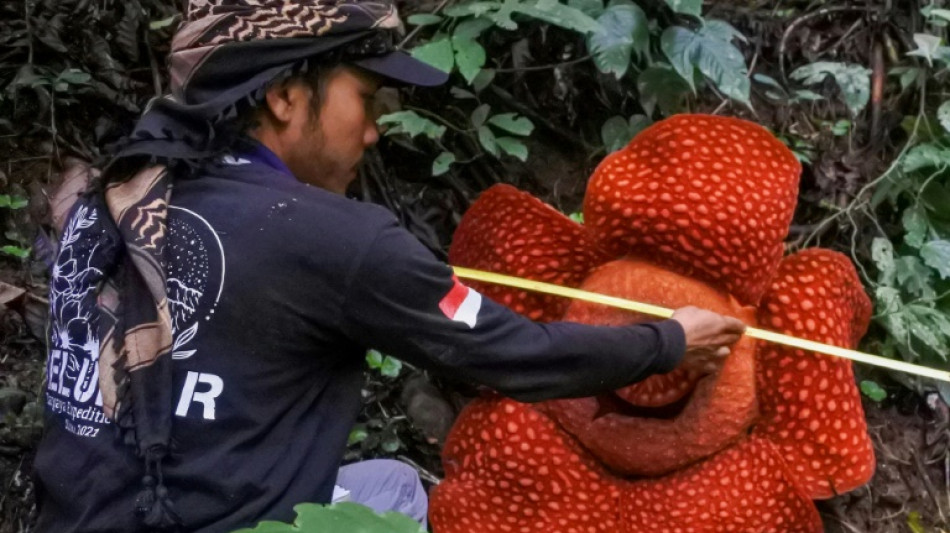
Most species of 'world's largest flower' risk extinction: study / Photo: KARIADIL HAREFA - AFP/File

 Equitas Small Finance Bank rebounds after naming interim chief executive

 Titan quarterly profit seen rising as jewellery business drives growth

 Kuwait finance minister holds economic cooperation talks at COMCEC

 Abdul El-Sayed declares victory in Michigan Senate contest

 Democrats capture US Congress in sweeping midterm victory

 Manchester United rallies past Roma as PSG dominates in Champions League

 Qatar sees tentative opening for renewed regional diplomacy

 Qatar Tourism joins Pacific Asia Travel Association at London travel market

 Abdul El-Sayed Wins Michigan Senate Seat in Historic Election

 Qatar media bodies discuss support for humanitarian initiatives

Most species of the famously large Rafflesia flower, which has long captured the imagination with its enormous speckled red petals, are now at risk of extinction, new research warned Wednesday.
Rafflesia is actually a parasite, and lives on tropical vines across parts of Southeast Asia, producing blooms that are among the largest in the world.
It is something of an enigma, with its flowers emerging unpredictably, and botanists have had limited success propagating it outside its natural environment.
One species of the flower is currently classed as "critically endangered", according to the International Union for Conservation of Nature.
To better understand the plant and its conservation status, an international group of botanists examined 42 known Rafflesia species and their habitats -- primarily Brunei, Indonesia, Malaysia, the Philippines and Thailand.
Based on the rapid disappearance of its forest habitats, as well as insufficient conservation strategies and protection plans, the plant is at far greater risk than previously known, they said.
"We estimate that 60 percent of Rafflesia species face a severe risk of extinction," the researchers wrote in the study, published Wednesday in the peer-reviewed Plants, People, Planet journal.
Some species risk going extinct before they are even known to science, the study said, urging more research into the unusual plant.
"We urgently need a joined-up, cross-regional approach to save some of the world's most remarkable flowers, most of which are now on the brink of being lost," said Chris Thorogood, deputy director of Oxford University's Botanical Garden and a study author.
The research points out that the plant is believed to grow in fairly limited areas, making it particularly vulnerable to habitat destruction.
It also highlights several bright spots in conservation efforts, including successful propagation at a botanical garden in Indonesia's West Java, and sustainable ecotourism around the plant in West Sumatra.
Last year, nations pledged to protect 30 percent of the world's land and seas by 2030 in a landmark deal to slow the disappearance of species and ecosystems.
Repeated studies have warned that the twin threats of climate change and environmental destruction caused by humans are dramatically reducing biodiversity worldwide.
E.Raimundo--PC



