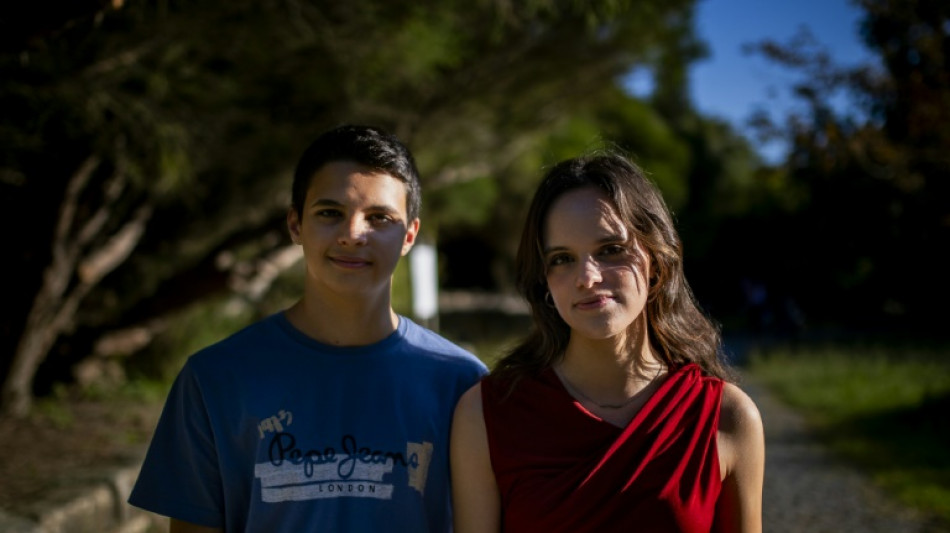
Six young people sue 32 European states over climate change / Photo: CARLOS COSTA - AFP

 Equitas Small Finance Bank rebounds after naming interim chief executive

 Titan quarterly profit seen rising as jewellery business drives growth

 Kuwait finance minister holds economic cooperation talks at COMCEC

 Abdul El-Sayed declares victory in Michigan Senate contest

 Democrats capture US Congress in sweeping midterm victory

 Manchester United rallies past Roma as PSG dominates in Champions League

 Qatar sees tentative opening for renewed regional diplomacy

 Qatar Tourism joins Pacific Asia Travel Association at London travel market

 Abdul El-Sayed Wins Michigan Senate Seat in Historic Election

 Qatar media bodies discuss support for humanitarian initiatives

Six Portuguese youths are taking 32 nations to the European Court of Human Rights this month for not doing enough to stop global warming, the latest bid to secure climate justice through the courts.
The move was sparked by the massive wildfires that struck Portugal in 2017, killing over 100 people and charring swathes of the country.
Aged 11 to 24, the young people say they are suffering from anxiety over their health and "having to live with a climate that is getting hotter and hotter" with more natural disasters.
Some claim allergies and breathing problems both during the fires and after, conditions at risk of persisting if the planet keeps warming.
Underscoring the potential impact of the case in terms of forcing countries to act, the Strasbourg-based court's Grand Chamber will examine the arguments on September 27, something that is reserved for exceptional cases.
The youths argue that excessive carbon emissions are infringing in particular the right to life and the right to the respect of private and family life.
"This is truly a David and Goliath case," said Gearoid O Cuinn, director of the Global Legal Action Network (GLAN), which is supporting the youths' case.
"Never before have so many countries had to defend themselves in front of any court anywhere in the world," he said.
Activists are increasingly turning to courts to force greater efforts by governments to tackle climate change, amid warnings the world is falling short of the 2015 Paris Agreement goals for limiting warming to 1.5 degrees Celsius above mid-19th century levels.
In August, a court in the US state of Montana ruled in favour of a group of youths who accused it of violating their rights to a clean environment.
- 'Game changer' -
An ECHR ruling, expected in several months, in favour of the plaintiffs would be binding on the 46 member states of the Council of Europe and potentially constitute legal jurisprudence on climate cases.
Nations would have to "rapidly accelerate their climate mitigation efforts", said Gerry Liston, a GLAN lawyer assisting the youths.
"In legal terms, it would be a game changer."
But first, the court will rule on the admissibility of the case, since the Portuguese youths filed directly to the ECHR without first seeking recourse in domestic courts.
They argue that trying to file separate cases in all 32 countries would be an "excessive and disproportionate burden" on an issue requiring urgent attention.
An ECHR source confirmed that it was a "unique case" in terms of the number of nations targeted by a single complaint.
The court has not previously ruled on member obligations with regards to climate change.
The youths say governments are contributing to warmer temperatures with carbon emissions that are provoking heat waves and wildfires in their country in particular.
"Governments around the world have the power to stop this, and Europe's governments are choosing not to stop this," said Catarina dos Santos Mota, one of the young Portuguese.
Two other climate cases involving France and Switzerland were examined by the ECHR in March, though no rulings have yet been issued.
According to the UN Environment Programme, the number of legal cases worldwide linked to climate challenges doubled between 2017 and 2022.
X.Matos--PC



