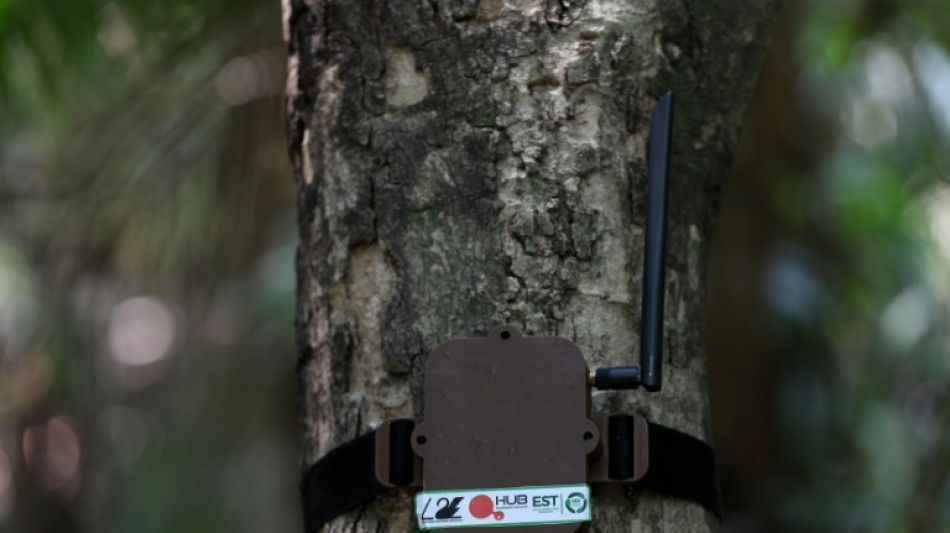
Tree-hugging AI to the rescue of Brazilian Amazon / Photo: MICHAEL DANTAS - AFP

 Indonesia accepts Malaysia's help to tackle wildfires

 Indians living in Japan on stand-by to house Asian Games athletes

 Trump signs bill authorizing sweeping Russia sanctions

 Protesters form human chain at Kennedy Center after Trump threat

 Death toll from attack at police HQ in Pakistan rises to 31

 Trump says Denmark to give US 'permanent control' over Greenland security

 Kennedy Center: future unclear for iconic Washington arts hub

 Trump claims 'infinite' Greenland security deal with Denmark

 Helicopters battle wildfire threatening Ecuador's capital

 Brentford batter Chelsea to undo Alonso's promising start

 Kane hits Bundesliga century as Bayern rout Union

 Trump says CNN, MS NOW, Politico banned from White House

 Hushing and hedging: US companies retreat on climate

 Springboks to face Fiji before 2027 Rugby World Cup

 Nigeria miners struggled to breathe in cell before 37 died: survivors

 McIlroy on the charge at PGA Championship as Reed withdraws

 McIlroy on the charge at PGA Championship

 Crisis-wracked Volkswagen warns of 10-bn-euro hit to profits

 Costa Rica's Grynspan tops third informal poll for UN chief: diplomat

 Stock markets retreat after central bank rate hikes

 Russia labels director of Cannes Grand Prix winner a 'foreign agent'

 Macron warns of Russian 'hybrid' threat after meeting presidential hopefuls

 UN holds third informal poll for new chief

 Kulusevski return can spark Spurs: De Zerbi

 Shakira to cap off world tour with Madrid 12-gig run

Small, artificially intelligent boxes tied to tree trunks in the Brazilian Amazon are the latest weapon in the arsenal of scientists and environmentalists battling destructive jungle invaders.
The boxes, named "curupiras" after a folkloric forest creature who preys on hunters and poachers, sport sensors and software trained "to recognize the sounds of chainsaws and tractors, or anything that could cause deforestation," project manager Thiago Almeida told AFP.
"We recorded the sound of chainsaws and tractors in the forest... then, all the collected sounds were passed on to the AI team to train (the program) so that... it would only recognize these sounds and not the characteristic sounds of the forest, such as animals, vegetation and rain," he explained.
Once identified, details of the threat can then be relayed to a central point and agents deployed to deal with it.
"The advantage of this system is that it can detect an attack... or a threat in real time," said researcher Raimundo Claudio Gomes of the Amazonas State University behind the project.
Unlike satellite data, which reveal deforestation only after the fact, the curupiras can detect "when the destruction starts," he added.
The sensors look like small internet modems but are in fact wireless and can relay data up to one kilometer (0.6 miles) via satellite to others in a network.
The project has just completed its pilot phase with ten prototype boxes fixed to trees in a densely forested area near Manaus, the capital city of Brazil's northern Amazonas state.
The boxes were named after Curupira, a creature in some Indigenous folklore that has feet turned backwards to confuse the hunters it pursues.
Early results from the project, financed by Brazilian company Hana Electronics, have been "very promising," said Gomes.
The team is now looking for more funding to add hundreds more sensors to the system, including ones that will be able to detect smoke and heat from forest fires.
President Luiz Inacio Lula da Silva has promised to end illegal deforestation in the Amazon by 2030.
His far-right predecessor Jair Bolsonaro had presided over an increase of more than 75 percent in average annual Amazon deforestation compared to the previous decade.
Gomes said that unlike audio sensor-based systems already used in other countries, the Manaus project is comparatively inexpensive as it does not require large antennas for data transmission.
Each sensor costs about $200-$300 to manufacture.
S.Pimentel--PC