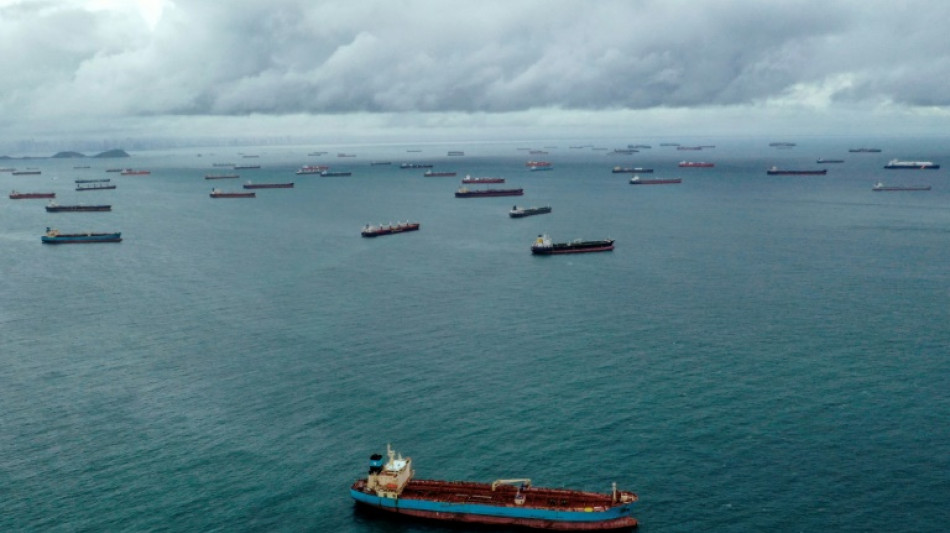
Decarbonising shipping to cost over $100 bn per year: UN / Photo: Luis ACOSTA - AFP/File

 Equitas Small Finance Bank rebounds after naming interim chief executive

 Titan quarterly profit seen rising as jewellery business drives growth

 Kuwait finance minister holds economic cooperation talks at COMCEC

 Abdul El-Sayed declares victory in Michigan Senate contest

 Democrats capture US Congress in sweeping midterm victory

 Manchester United rallies past Roma as PSG dominates in Champions League

 Qatar sees tentative opening for renewed regional diplomacy

 Qatar Tourism joins Pacific Asia Travel Association at London travel market

 Abdul El-Sayed Wins Michigan Senate Seat in Historic Election

 Qatar media bodies discuss support for humanitarian initiatives

The UN called for rapid decarbonisation of the shipping industry on Wednesday, warning that the price tag could top $100 billion a year as the sector's emissions continue to swell.
The UN's trade and development agency UNCTAD highlighted the vital role shipping plays in the global economy, with over 80 percent of all traded goods in the world moved by sea.
But it also accounts for nearly three percent of all greenhouse gas emissions globally.
At a time when industries are under pressure to reduce their carbon footprint to avert catastrophic climate change, emissions from the global maritime fleet has increased by 20 percent in the past decade.
"We call for global action to decarbonise shipping," UNCTAD chief Rebeca Grynspan told reporters, presenting an annual report on the industry.
"Balancing environmental sustainability, regulatory compliance and economic demands is vital for a prosperous, equitable and resilient future for maritime transport," she said.
The agency is calling for a rapid shift towards cleaner fuels across a shipping industry, where nearly 99 percent of the global fleet remains reliant on conventional fuels.
"Fuel transition in shipping is still in its infancy," Shamika Sirimanne, head of UNCTAD's technology and logistics division, told reporters.
UNCTAD cited some promising developments, including that 21 percent of vessels currently on order are designed for alternative fuels.
But the agency stressed the need to step up the pace, while acknowledging that "the transition comes with substantial costs".
The UNCTAD report found that up to $28 billion would be required annually to decarbonise ships by 2050.
And even more investments -- as much as $90 billion -- would be needed each year to develop the necessary infrastructure for 100 percent carbon neutral fuels by then, it said.
In addition, full decarbonisation could raise annual fuel expenses by as much as 100 percent, potentially taking a heavy toll on small island developing states and other poor countries that rely heavily on maritime transport.
The International Maritime Organization clinched a deal in July to cut the shipping industry's total annual emissions by at least 20 percent by 2030 and by at least 70 percent by 2040 compared to 2008 levels.
The revised strategy also aims for the industry to reach net-zero emissions "close to" 2050. That compared with the prior target for a 50-percent reduction by mid-century.
B.Godinho--PC



