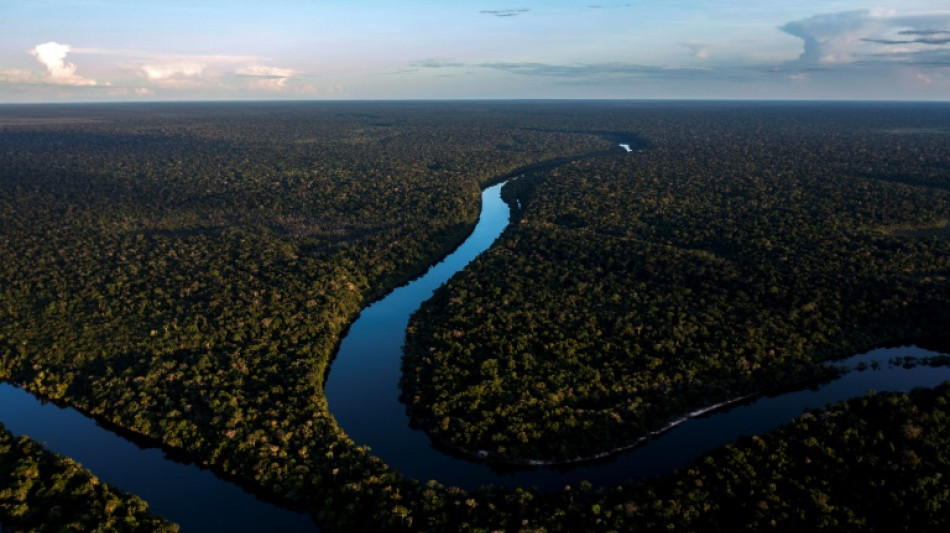
Forests could absorb much more carbon, but does it matter? / Photo: MAURO PIMENTEL - AFP/File

 Indonesia accepts Malaysia's help to tackle wildfires

 Indians living in Japan on stand-by to house Asian Games athletes

 Trump signs bill authorizing sweeping Russia sanctions

 Protesters form human chain at Kennedy Center after Trump threat

 Death toll from attack at police HQ in Pakistan rises to 31

 Trump says Denmark to give US 'permanent control' over Greenland security

 Kennedy Center: future unclear for iconic Washington arts hub

 Trump claims 'infinite' Greenland security deal with Denmark

 Helicopters battle wildfire threatening Ecuador's capital

 Brentford batter Chelsea to undo Alonso's promising start

 Kane hits Bundesliga century as Bayern rout Union

 Trump says CNN, MS NOW, Politico banned from White House

 Hushing and hedging: US companies retreat on climate

 Springboks to face Fiji before 2027 Rugby World Cup

 Nigeria miners struggled to breathe in cell before 37 died: survivors

 McIlroy on the charge at PGA Championship as Reed withdraws

 McIlroy on the charge at PGA Championship

 Crisis-wracked Volkswagen warns of 10-bn-euro hit to profits

 Costa Rica's Grynspan tops third informal poll for UN chief: diplomat

 Stock markets retreat after central bank rate hikes

 Russia labels director of Cannes Grand Prix winner a 'foreign agent'

 Macron warns of Russian 'hybrid' threat after meeting presidential hopefuls

 UN holds third informal poll for new chief

 Kulusevski return can spark Spurs: De Zerbi

 Shakira to cap off world tour with Madrid 12-gig run

Protecting forests globally could vastly increase the amount of carbon they sequester, a new study finds, but given our current emissions track, does it really matter?
For Thomas Crowther, an author of the assessment, the answer is a resounding yes.
"I absolutely see this study as a cause for hope," the professor at ETH Zurich said.
"I hope that people will see the real potential and value that nature can bring to the climate change topic."
But for others, calculating the hypothetical carbon storage potential of global forests is more an academic exercise than a useful framework for forest management.
"I am a forester by trade, so I really like to see trees grow," said Martin Lukac, professor of ecosystem science at University of Reading.
However, he considers forest carbon potential calculations like these "dangerous," warning they "distract from the main challenge and offer false hope."
Crowther has been here before: in 2019 he produced a study on how many trees the Earth could support, where to plant them and how much carbon they could store.
"Forest restoration is the best climate change solution available today," he argued.
That work caused a firestorm of criticism, with experts unpicking everything from its modelling to the claim that reforestation was the "best" solution available.
Nodding to the furore, Crowther and his colleagues have now vastly expanded their data set and used new modelling approaches for the study published Monday in the journal Nature.
They use ground-sourced surveys and data from three models based on high-resolution satellite imagery.
The modelling approach is "as good as it currently gets," acknowledged Lukac, who was not involved in the work.
- 'Achieve climate targets' -
The study estimates forests are storing 328 gigatons of carbon less than they would if untouched by human destruction.
Estimates of the world's remaining carbon "budget" to keep warming below the 1.5C range from around 250-500 gigatons.
Much of the forest potential -- 139 gigatons -- could be captured by just leaving existing forests to reach full maturity, the study says.
Another 87 gigatons could be regained by reconnecting fragmented forests.
The remainder is in areas used for agriculture, pasture or urban infrastructure, which the authors acknowledge is unlikely to be reversed.
Still, they say their findings present a massive opportunity.
"Forest conservation, restoration and sustainable management can help achieve climate targets by mitigating emissions and enhancing carbon sequestration," the study says.
Modelling and mapping the world's forests is a tricky business.
There's the scale of the problem, but also the complexity of what constitutes a forest.
Trees, of course, but the carbon storage potential of a woodland or jungle is also in its soil and the organic matter littering the forest floor.
- Trees versus emissions? -
Ground-level surveys can offer granular data, but are difficult to extrapolate.
And satellite imagery covers large swathes of land, but can be confounded by something as simple as the weather, said Nicolas Younes, research fellow at the Australian National University.
"Most of the places where there is potential for carbon storage are tropical countries... these are places where there is persistent cloud cover, therefore satellite imagery is very hard to validate," he told AFP.
Younes, an expert on forest remote sensing, warns the complexity of the study's datasets and modelling risks introducing errors, though the resulting estimates remain "very valuable".
"It will not show us the exact truth for every pixel on Earth, but it is useful."
One objection to quantifying forest carbon potential is that conditions are far from static, with accelerating climate change, forest fires and pest vulnerability all playing a role.
And, for Lukac, whatever potential forests have is irrelevant to the urgency of cutting emissions.
The study's estimated 328 gigatons "would be wiped (out) in 30 years by current emissions," he said.
Crowther, who advises a project to plant a trillion trees globally, rejects an either-or between forest protection and emissions reduction.
"We urgently need both," he said.
J.Oliveira--PC



