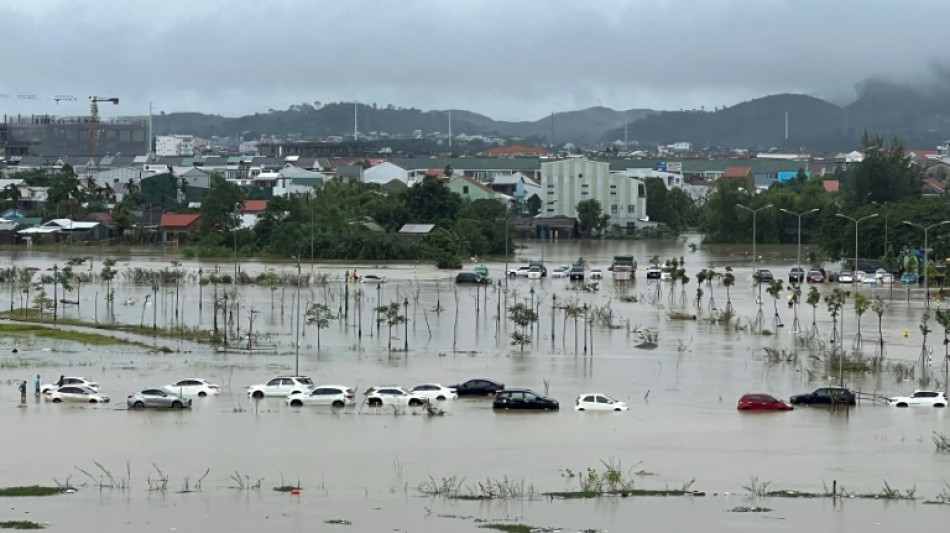
Rich nations 'likely' met $100 bn climate finance goal: OECD / Photo: Hai Duong - AFP

 Indonesia accepts Malaysia's help to tackle wildfires

 Indians living in Japan on stand-by to house Asian Games athletes
 Trump signs bill authorizing sweeping Russia sanctions

 Protesters form human chain at Kennedy Center after Trump threat

 Death toll from attack at police HQ in Pakistan rises to 31

 Trump says Denmark to give US 'permanent control' over Greenland security

 Kennedy Center: future unclear for iconic Washington arts hub

 Trump claims 'infinite' Greenland security deal with Denmark

 Helicopters battle wildfire threatening Ecuador's capital

 Brentford batter Chelsea to undo Alonso's promising start

 Kane hits Bundesliga century as Bayern rout Union

 Trump says CNN, MS NOW, Politico banned from White House

 Hushing and hedging: US companies retreat on climate

 Springboks to face Fiji before 2027 Rugby World Cup

 Nigeria miners struggled to breathe in cell before 37 died: survivors

 McIlroy on the charge at PGA Championship as Reed withdraws

 McIlroy on the charge at PGA Championship

 Crisis-wracked Volkswagen warns of 10-bn-euro hit to profits

 Costa Rica's Grynspan tops third informal poll for UN chief: diplomat

 Stock markets retreat after central bank rate hikes

 Russia labels director of Cannes Grand Prix winner a 'foreign agent'

 Macron warns of Russian 'hybrid' threat after meeting presidential hopefuls

 UN holds third informal poll for new chief

 Kulusevski return can spark Spurs: De Zerbi

 Shakira to cap off world tour with Madrid 12-gig run

Wealthy nations likely met their goal of providing $100 billion in annual climate finance to poorer nations last year -- two years later than promised and only a fraction of the "extensive needs", the OECD said Thursday.
The OECD report comes ahead of the UN's COP28 climate negotiations later this month in Dubai, where finance will be a major sticking point.
The Organisation for Economic Co-operation and Development is tasked with monitoring official figures on the pledge to help developing countries fund their energy transitions and resilience in the face of accelerating climate impacts.
In 2009, richer countries promised to reach $100 billion annually in funding for these priorities by 2020.
Failure to meet the target on time has damaged trust in international climate negotiations.
In the most up to date figures, the OECD said richer countries reached $89.6 billion in total funding for 2021.
"Based on preliminary and as yet unverified data, the goal looks likely to have already been met as of 2022," said OECD Secretary-General Mathias Cormann in the foreword to the latest report.
But he added experts estimate that developing countries will need to spend about a trillion dollars a year by 2025 for climate investments, rising to roughly $2.4 trillion each year between 2026 and 2030.
"Although public finance can only contribute a share of these extensive needs," Cormann said, international donors would be crucial in helping to boost overall funding.
He said that currently finance from rich countries was not effective enough in attracting additional private sector investments and funding.
Finance focused on adaptation that countries must embark on to prepare themselves for an array of increasing climate impacts was also lagging, he said.
Adaptation measures can include building coastal defences, or helping farmers become more resilient to increasingly ferocious floods, droughts and other climate extremes.
- Action is 'stalling' -
Many developing economies least to blame for the greenhouse gases that stoke global warming are among the most exposed to the costly and destructive effects of worsening weather extremes and rising seas.
World leaders meeting at the climate talks in the United Arab Emirates will face a tough reckoning over financial solidarity between rich polluters and vulnerable nations, as a failure to cut planet-heating emissions threatens the Paris Agreement's global warming limits.
Adaptation is a key priority for developing countries and wealthy governments have promised to double adaptation finance by 2025, to $40 billion a year.
But as the world warms, climate change impacts increase and so too do the costs of preparing for them.
Earlier this month, a report by the UN Environment Programme (UNEP) projected that overall annual funding that developing countries need to adapt to climate impacts this decade had increased to as much as $387 billion.
At the time, UN Secretary-General Antonio Guterres warned action was "stalling" even as the need to protect people increases.
L.Carrico--PC



