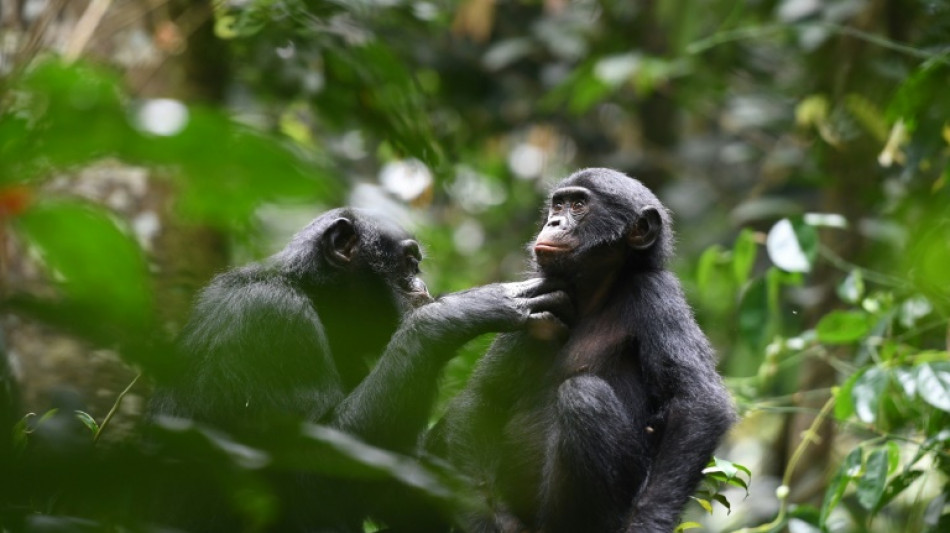
Good neighbors: Bonobo study offers clues into early human alliances / Photo: Martin SURBECK - Kokolopori Bonobo Research Project/AFP

 Indonesia accepts Malaysia's help to tackle wildfires

 Indians living in Japan on stand-by to house Asian Games athletes

 Trump signs bill authorizing sweeping Russia sanctions

 Protesters form human chain at Kennedy Center after Trump threat

 Death toll from attack at police HQ in Pakistan rises to 31

 Trump says Denmark to give US 'permanent control' over Greenland security

 Kennedy Center: future unclear for iconic Washington arts hub

 Trump claims 'infinite' Greenland security deal with Denmark

 Helicopters battle wildfire threatening Ecuador's capital

 Brentford batter Chelsea to undo Alonso's promising start

 Kane hits Bundesliga century as Bayern rout Union

 Trump says CNN, MS NOW, Politico banned from White House

 Hushing and hedging: US companies retreat on climate

 Springboks to face Fiji before 2027 Rugby World Cup

 Nigeria miners struggled to breathe in cell before 37 died: survivors

 McIlroy on the charge at PGA Championship as Reed withdraws

 McIlroy on the charge at PGA Championship

 Crisis-wracked Volkswagen warns of 10-bn-euro hit to profits

 Costa Rica's Grynspan tops third informal poll for UN chief: diplomat

 Stock markets retreat after central bank rate hikes

 Russia labels director of Cannes Grand Prix winner a 'foreign agent'

 Macron warns of Russian 'hybrid' threat after meeting presidential hopefuls

 UN holds third informal poll for new chief

 Kulusevski return can spark Spurs: De Zerbi

 Shakira to cap off world tour with Madrid 12-gig run

Human society is founded on our ability to cooperate with others beyond our immediate family and social groups.
And according to a study published Thursday in the journal Science, we're not alone: bonobos team up with outsiders too, in everything from grooming to food sharing, even forming alliances against sexual aggressors.
Lead author Liran Samuni of the German Primate Center in Gottingen told AFP that studying the primates offered a "window into our past," possibly signaling an evolutionary basis for how our own species began wider-scale collaborative endeavors.
Bonobos (Pan paniscus) are our closest living relatives, alongside chimpanzees (Pan troglodytes), and the two species are also very closely related to each other.
But while encounters between chimpanzee groups are inherently hostile and often result in lethal violence, interactions between bonobo parties hadn't been as well examined.
That's because bonobos, an endangered species, are notoriously difficult to study in their natural habitat -- and they live only in remote regions of the Democratic Republic of the Congo.
With research on chimps dominating the literature, some scientists assumed hostility against outsiders was innate to human nature -- something we had perhaps trained ourselves to get past by inventing new social norms, even as that trait lurked deep inside.
- Female coalitions against sexual aggression -
In the new paper, Samuni teamed up with Martin Surbeck, a professor at Harvard who founded the Kokolopori Bonobo Reserve, to carry out a long-term study over two years.
"The first thing they do... is try to run away from you," Surbeck told AFP, explaining it took a long time for the bonobos to overcome their inherent fears of humans and behave normally.
Days began at 4:00 am and involved researchers trekking through the dark forest until they reached bonobo nests, then waiting for sunrise so they could follow the apes throughout the day, aided by indigenous Mongandu trackers.
Samuni and Surbeck focused on two small bonobo groups of 11 and 20 adults respectively, and found to their surprise they spent 20 percent of their total time together -- feeding, resting, traveling and more.
"Every individual is different," said Samuni. "There are those that are more introverts, extroverts, there are those that are more pro-social than others."
The team found that cooperation between the groups was driven largely by a select few who were more helpful within their own group. These individuals tended to connect with similar "pro-social" bonobos from the other group, creating a system of mutual benefit, or "reciprocal altruism."
The positive interactions occurred despite a low level of genetic relatedness between the groups, and despite the fact that reciprocity -- such as paying back a gift of fruit -- often took place much later, in future encounters.
Intriguingly, females, both within and from different groups, were found to form coalitions -- sometimes to chase an individual from a feeding tree, at other times to prevent a coercive sexual advance from a male.
"We don't see sexual coercion in bonobos, which is a common phenomenon in chimpanzees," said Surbeck. "One aspect of that might be due to those female coalitions, that help the females to maintain reproductive autonomy."
- Are we more like chimps or bonobos? -
The authors suggest their research offers an "alternative scenario" to the idea human cooperation is against our nature, or that we broadened cooperation with outsiders by first merging our extended families.
But "this does not mean that reconstructions of ancestral hominin species should be based only on bonobos," Joan Silk, a scientist at Arizona State University wrote in a related commentary.
There are other ways in which chimpanzees seem closer to humans than bonobos -- for example they more often hunt animal prey and use tools. Male chimpanzees also form strong bonds with fellow males and support them in aggressive acts, while bonobo males form stronger ties to females.
Understanding the natural selection forces that created these differences "may help to elucidate how and why humans became such an unusual ape," she concluded.
C.Amaral--PC



