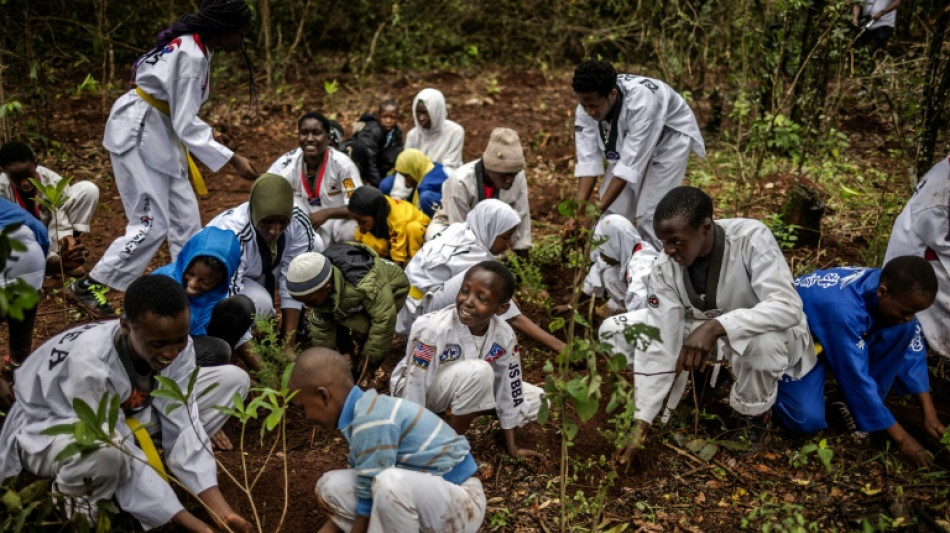
Planting trees in wrong places heats the planet: study / Photo: LUIS TATO - AFP

 Inter Milan and Italy icon Mazzola dies aged 83

 Saudi capital issues first air raid alert since renewed fighting in Yemen

 Martin edges title rival Marquez for Austrian MotoGP pole

 Indonesia accepts Malaysia's help to tackle wildfires

 Indians living in Japan on stand-by to house Asian Games athletes

 Trump signs bill authorizing sweeping Russia sanctions

 Protesters form human chain at Kennedy Center after Trump threat

 Death toll from attack at police HQ in Pakistan rises to 31

 Trump says Denmark to give US 'permanent control' over Greenland security

 Kennedy Center: future unclear for iconic Washington arts hub

 Trump claims 'infinite' Greenland security deal with Denmark

 Helicopters battle wildfire threatening Ecuador's capital

 Brentford batter Chelsea to undo Alonso's promising start

 Kane hits Bundesliga century as Bayern rout Union

 Trump says CNN, MS NOW, Politico banned from White House

 Hushing and hedging: US companies retreat on climate

 Springboks to face Fiji before 2027 Rugby World Cup

 Nigeria miners struggled to breathe in cell before 37 died: survivors

 McIlroy on the charge at PGA Championship as Reed withdraws

 McIlroy on the charge at PGA Championship

 Crisis-wracked Volkswagen warns of 10-bn-euro hit to profits

 Costa Rica's Grynspan tops third informal poll for UN chief: diplomat

 Stock markets retreat after central bank rate hikes

 Russia labels director of Cannes Grand Prix winner a 'foreign agent'

 Macron warns of Russian 'hybrid' threat after meeting presidential hopefuls

Planting trees in the wrong places can actually contribute to global warming, scientists said on Tuesday, but a new map identifies the best locations to regrow forests and cool the planet.
Trees soak up carbon dioxide and restoring areas of degraded woodlands or planting saplings to boost forest cover is one tool in the fight against climate change.
But in some cases, more trees means less sunlight is reflected back from the earth's surface and more heat is absorbed by the planet, according to a study in the journal Nature Communications.
"There are some places where putting trees back leads to net climate negative outcomes," Susan Cook-Patton, one of the study's co-authors, told AFP.
Scientists had already understood that restoring tree cover led to changes in albedo -- the amount of solar radiation bounced back off the planet's surface -- but didn't have the tools to account for it, she said.
Using new maps, researchers were able to consider, for the first time, the cooling effect from trees and the warming caused by decreased albedo.
They found that projects that didn't factor albedo into the equation overestimated the climate benefit of additional trees by between 20 to 80 percent.
But the maps also provide the tools to help policymakers identify where best to funnel scarce resources for maximum climate impact, said Cook-Patton, senior forest restoration scientist at The Nature Conservancy.
"There's also lots of places still where restoring tree cover is a great idea for climate change. We're just trying to help people find those spots," she said.
- Return on investment -
Albedo is highest in the frozen areas of the world, and mirror-like clean snow and ice with high levels of albedo reflect up to 90 percent of the sun's energy.
It is one of Earth's major cooling agents, along with lands and oceans that absorb excess heat and planet-warming greenhouse gas emissions.
Many countries have promised to plant billions of trees as a bulwark against global warming but not all efforts deliver for the planet equally, this study showed.
Moist, tropical environments like the Amazon and Congo Basin boasted high carbon storage and low changes in albedo, making them ideal locations for restoring forest cover.
The opposite was true in temperate grasslands and savanna, Cook-Patton said.
Even projects in the best locations were probably delivering 20 percent less cooling than estimated when changes to albedo were taken into account, she said.
But she stressed that restoring forests delivered undeniable benefits for people and the planet, such as supporting ecosystems and providing clean air and water, among many.
"We really don't want our work to be a critique of the movement writ large," she said.
"(But) we can't put trees everywhere. We don't have enough money or time or resources or people or seedlings.
"And so it's really about making the most of limited investments and getting the greatest climate return per hectare of investment," she added.
S.Pimentel--PC



