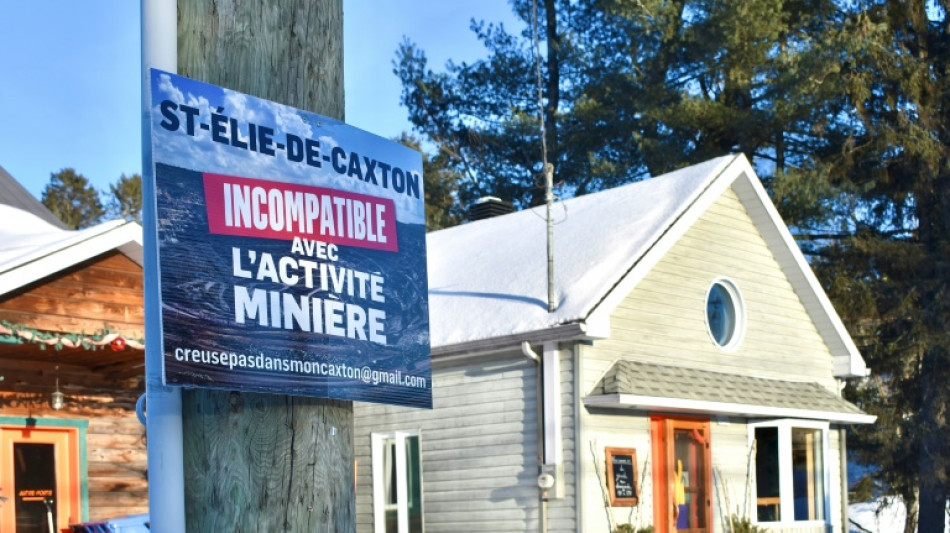
In Canada's Quebec, residents miffed over mining boom / Photo: Genevieve Normand - AFP

 Inter Milan and Italy icon Mazzola dies aged 83

 Saudi capital issues first air raid alert since renewed fighting in Yemen

 Martin edges title rival Marquez for Austrian MotoGP pole

 Indonesia accepts Malaysia's help to tackle wildfires

 Indians living in Japan on stand-by to house Asian Games athletes
 Trump signs bill authorizing sweeping Russia sanctions

 Protesters form human chain at Kennedy Center after Trump threat

 Death toll from attack at police HQ in Pakistan rises to 31

 Trump says Denmark to give US 'permanent control' over Greenland security

 Kennedy Center: future unclear for iconic Washington arts hub

 Trump claims 'infinite' Greenland security deal with Denmark

 Helicopters battle wildfire threatening Ecuador's capital

 Brentford batter Chelsea to undo Alonso's promising start

 Kane hits Bundesliga century as Bayern rout Union

 Trump says CNN, MS NOW, Politico banned from White House

 Hushing and hedging: US companies retreat on climate

 Springboks to face Fiji before 2027 Rugby World Cup

 Nigeria miners struggled to breathe in cell before 37 died: survivors

 McIlroy on the charge at PGA Championship as Reed withdraws

 McIlroy on the charge at PGA Championship

 Crisis-wracked Volkswagen warns of 10-bn-euro hit to profits

 Costa Rica's Grynspan tops third informal poll for UN chief: diplomat

 Stock markets retreat after central bank rate hikes

 Russia labels director of Cannes Grand Prix winner a 'foreign agent'

 Macron warns of Russian 'hybrid' threat after meeting presidential hopefuls

Canada's Quebec province is rich with minerals needed for everything from electric cars to cell phones, but residents living atop the potential windfall are worried their backyards will be dug up -- and they won't get a dime.
In recent months, tens of thousands of mining exploration permits have been issued in the province amid a global rush for critical and strategic minerals such as graphite, lithium, zinc, nickel and cobalt.
But under provincial mining exploration rules, subsoil in Quebec does not belong to landowners.
In Saint-Elie-de-Caxton, a town of 2,000 people about halfway between Montreal and Quebec City, residents are fed up. Signs around town proclaim "Saint-Elie, incompatible with mining activity" or "Don't Dig in my Caxton."
"We are at war, says Gilbert Guerin, spokesman for the "Don't Dig in my Caxton" committee, pointing to a map delineating exploration claims that have effectively parceled off the town for future mines.
In Quebec, it only takes a few clicks on a website and about Can$75 (US$55) to stake a mining claim covering up to 100 hectares (250 acres) -- an opportunity open to locals and foreigners alike.
"I bought here. I thought I would be sovereign in my own home, but I came to understand that what's underground did not belong to me," says Yvan Lafontaine, surveying his property in the neighboring village of Saint-Mathieu-du-Parc from atop an observation tower he had built.
When Lafontaine learned that a company had acquired the mining rights to the subsoil beneath his land, what the nature lover calls his little "paradise," he fought back by staking 12 claims surrounding the property.
Currently, more than 350,000 claims have been registered, covering 10 percent of Quebec. The southern areas of the province -- where most of the population lives -- is the most sought after.
According to an AFP analysis of government data, the number of claims issued significantly increased from September 2022 to the end of February 2024, with about 160,000 granted -- a 140 percent increase over the previous 18-month period.
- 'Wild West' -
For Saint-Elie resident Julie Hamelin, the mining exploration regulations in Quebec are "outdated."
"It's something out of the Wild West, this way of staking claims," she said, urging provincial authorities to protect inhabited lands from mining.
Guerin, a former civil servant, says he is worried about the "irreversible consequences" that a mining project would have, particularly on the region's groundwater.
To try to discourage mining companies from moving in, residents of Saint-Elie-de-Caxton spent thousands of dollars to buy up more than 220 exploration claims around the village.
Faced with growing public discontent, the Quebec government has announced it intends to modernize its mining law, and insisted in an email to AFP "that no exploration can be carried out without the consent of the owner of private land."
But mining companies definitely are eyeballing Quebec's potential for resources extraction.
"There is a lot of graphite in Quebec. It could be the most important reserve in the world," says Hugues Jacquemin, chief executive of Northern Graphite.
"We absolutely must develop this sector because it is essential for the manufacture of batteries and electric vehicles," he told AFP during a visit to a mine at Lac-des-Iles, 260 kilometers (160 miles) north of Montreal.
Canada is seeking to develop a battery supply chain independent from China, which has until now dominated the market in these critical minerals.
The development of the electric vehicle sector is a priority for both Quebec and Canada, which boasts of being one of the only countries in the world to have all of the necessary minerals to produce batteries.
But in Saint-Elie-de-Caxton and its surrounding areas, not all citizens are on board with the official plans.
"I don't think we should go in this direction," says Hamelin. "The solution is downscaling by using what we already have."
O.Salvador--PC



