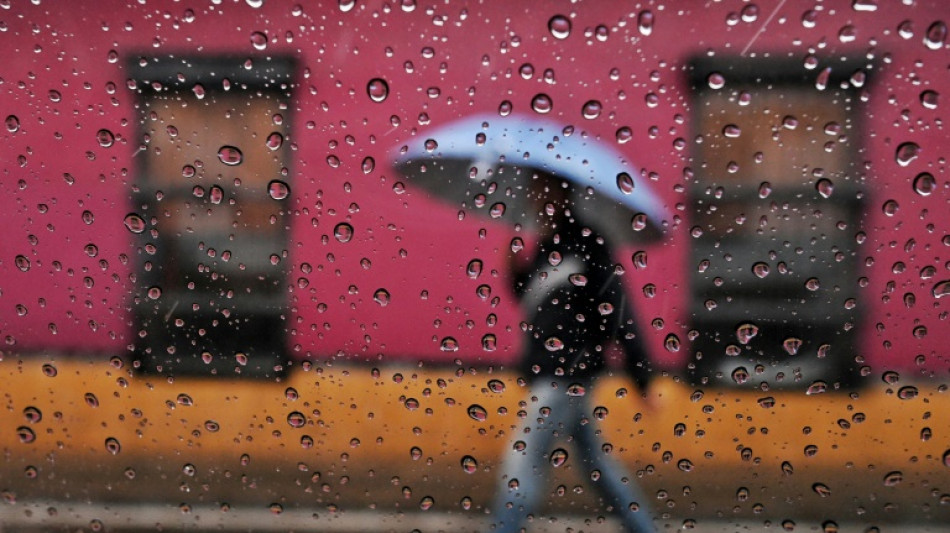
What looming La Nina means for global temperatures / Photo: Luis ROBAYO - AFP/File

 Inter Milan and Italy icon Mazzola dies aged 83

 Saudi capital issues first air raid alert since renewed fighting in Yemen

 Martin edges title rival Marquez for Austrian MotoGP pole

 Indonesia accepts Malaysia's help to tackle wildfires

 Indians living in Japan on stand-by to house Asian Games athletes

 Trump signs bill authorizing sweeping Russia sanctions

 Protesters form human chain at Kennedy Center after Trump threat

 Death toll from attack at police HQ in Pakistan rises to 31

 Trump says Denmark to give US 'permanent control' over Greenland security

 Kennedy Center: future unclear for iconic Washington arts hub

 Trump claims 'infinite' Greenland security deal with Denmark

 Helicopters battle wildfire threatening Ecuador's capital

 Brentford batter Chelsea to undo Alonso's promising start

 Kane hits Bundesliga century as Bayern rout Union

 Trump says CNN, MS NOW, Politico banned from White House

 Hushing and hedging: US companies retreat on climate

 Springboks to face Fiji before 2027 Rugby World Cup

 Nigeria miners struggled to breathe in cell before 37 died: survivors

 McIlroy on the charge at PGA Championship as Reed withdraws

 McIlroy on the charge at PGA Championship

 Crisis-wracked Volkswagen warns of 10-bn-euro hit to profits

 Costa Rica's Grynspan tops third informal poll for UN chief: diplomat

 Stock markets retreat after central bank rate hikes

 Russia labels director of Cannes Grand Prix winner a 'foreign agent'

 Macron warns of Russian 'hybrid' threat after meeting presidential hopefuls

El Nino, the natural weather phenomenon that contributed to 2023 being the hottest year on record, has recently subsided, paving the way for its opposing, cooling La Nina phase to begin.
But in the context of a warming planet due to human-caused climate change, scientists say that cooling effect may be miniscule.
Here is how the cycle called El Nino-Southern Oscillation (ENSO) works to affect global weather:
- El Nino -
El Nino can weaken consistent trade winds that blow east to west across the tropical Pacific, influencing weather by affecting the movement of warm water across this vast ocean.
This weakening warms the usually cooler central and eastern sides of the ocean, altering rainfall over the equatorial Pacific and wind patterns that change temperature and rain around the world.
The extra heat at the surface of the Pacific releases energy into the atmosphere that can temporarily drive up global temperatures, which is why El Nino years are often among the warmest on record.
It occurs every two to seven years, and lasts nine to 12 months.
The latest El Nino, which began in June 2023, peaked among the five strongest such events on record, according to the World Meteorological Organization (WMO).
It typically results in drier conditions across southeast Asia, Australia, southern Africa, and northern South America, and conversely much wetter conditions in the Horn of Africa and the southern United States.
While it is unclear what impact climate change may be having on ENSO, it is affecting how these events play out, said Michelle L'Heureux, lead ENSO forecaster for the US NOAA weather agency.
Climate change is making extreme events more frequent and intense, and when colliding with ENSO can cause its associated drier or wetter conditions to "become more amplified", she added.
The elevated global temperatures ENSO causes also served as a "portal" into the future of climate change, L'Heureux said.
"It gives you... a bit of a preview of what a warmer world looks like because it is giving you a temporary boost. So we're now at a new level we haven't seen before," she said.
- Neutral period -
Although El Nino has been dissipating, the first four months of 2024 have continued to break heat records -- unsurprisingly as the cycle typically drives up temperatures the year after it develops.
ENSO is "not an on-off switch", L'Heureux explained. "It takes a while for the global atmospheric circulation to adjust."
Scientists anticipate that the neutral period between the two cycles will begin between May and July.
Above-normal temperatures are forecast to persist through July across the northern and southern hemispheres, with just equatorial regions anticipated to see near-to-below normal temperatures, according to WMO.
The neutral period is not likely to last long, L'Heureux explained.
Typically, after a strong El Nino as the world just experienced, La Nina soon follows.
- La Nina -
La Nina sees the eastern Pacific Ocean cool for a period of about one to three years, generating the opposite effects to El Nino on global weather.
It leads to wetter conditions in parts of Australia, southeast Asia, India, southeast Africa and northern Brazil, while causing drier conditions in parts of South America.
It can also contribute to more severe Atlantic hurricanes, and NOAA has forecast an "extraordinary" storm season ahead this year.
La Nina tends to bring down global temperatures, although L'Heureux warned against hopes of relief in areas like southeast Asia that have recently be battered by scorching heatwaves.
"The world is warming and ENSO is acting secondary to that," she said.
"Even this year with La Nina potentially developing, we're still expecting basically a top-five global mean temperature record," she said.
NOAA says there is a 69 percent chance of La Nina beginning sometime between July and September.
L.Henrique--PC



