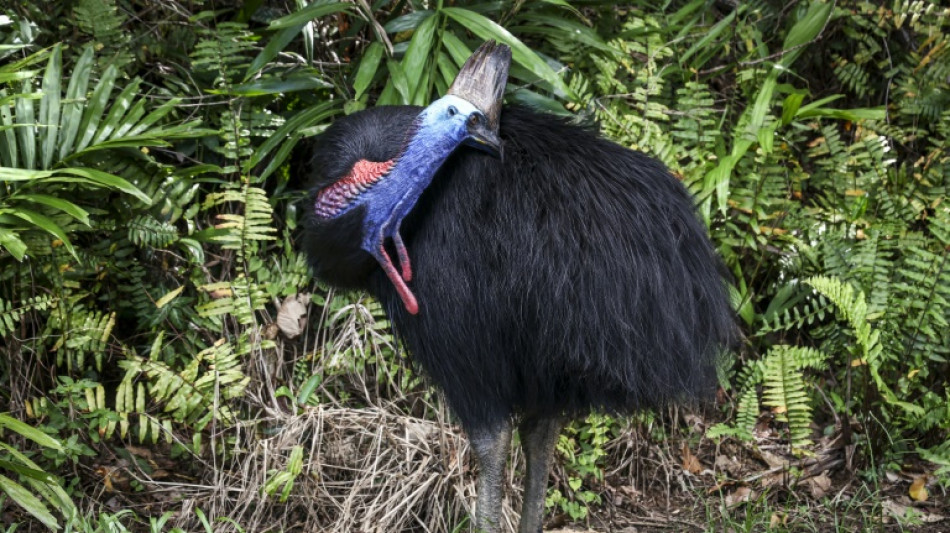
Australia's fearsome 'dinosaur bird' stares down extinction / Photo: DAVID GRAY - AFP

 Inter Milan and Italy icon Mazzola dies aged 83

 Saudi capital issues first air raid alert since renewed fighting in Yemen

 Martin edges title rival Marquez for Austrian MotoGP pole

 Indonesia accepts Malaysia's help to tackle wildfires

 Indians living in Japan on stand-by to house Asian Games athletes

 Trump signs bill authorizing sweeping Russia sanctions

 Protesters form human chain at Kennedy Center after Trump threat

 Death toll from attack at police HQ in Pakistan rises to 31

 Trump says Denmark to give US 'permanent control' over Greenland security

 Kennedy Center: future unclear for iconic Washington arts hub

 Trump claims 'infinite' Greenland security deal with Denmark

 Helicopters battle wildfire threatening Ecuador's capital

 Brentford batter Chelsea to undo Alonso's promising start

 Kane hits Bundesliga century as Bayern rout Union

 Trump says CNN, MS NOW, Politico banned from White House

 Hushing and hedging: US companies retreat on climate

 Springboks to face Fiji before 2027 Rugby World Cup

 Nigeria miners struggled to breathe in cell before 37 died: survivors

 McIlroy on the charge at PGA Championship as Reed withdraws

 McIlroy on the charge at PGA Championship

 Crisis-wracked Volkswagen warns of 10-bn-euro hit to profits

 Costa Rica's Grynspan tops third informal poll for UN chief: diplomat

 Stock markets retreat after central bank rate hikes

 Russia labels director of Cannes Grand Prix winner a 'foreign agent'

 Macron warns of Russian 'hybrid' threat after meeting presidential hopefuls

With legs like a velociraptor and a striking neon blue neck, the southern cassowary cuts a fearsome figure in the rainforests of northeast Australia.
It is best to admire these human-sized birdies -- and their rapier-sharp 10 centimetre (four inch) talons -- from afar.
"It's a modern-day dinosaur," said Peter Rowles, the rugged president of a community group protecting the endangered birds.
Fiercely territorial, when threatened they hiss and make a deep rumbling boom.
"When you first look at them eye to eye, that can be intimidating, because they've got big eyes, and they look straight at you and they do look a bit fierce," said Rowles.
These flightless birds are only found in Australia, New Guinea and some Pacific islands.
The Australian government lists them as endangered and estimates about 4,500 remain in the wild.
They are considered a "keystone species", meaning they play a vital role in maintaining biodiversity and helping spread seeds in the rainforest.
If cassowaries go extinct, the rainforests will suffer.
"We thought if we could save cassowaries, we also could save enough habitat to keep a lot of other species alive," Rowles explained.
His group is doing what it can to save these formidable birds, which stand 1.5 metres (five feet) tall and can weigh up to 75 kilos (165 pounds).
This includes making signs urging drivers to slow down, redesigning roads to better protect native habitats and running a cassowary hospital for injured birds.
The main threats to the cassowary are car strikes, clearing of native habitats, dog attacks and climate change.
"Cassowaries are not aggressive when they're treated well," said Rowles, with few recorded deaths caused by the species.
A young Australian boy was killed in 1926 after he chased the bird, who severed his jugular vein, while a Florida man perished in 2019 when his pet cassowary attacked.
- 'Naturally cranky birds' -
In the past 300 years, about 100 of Australia's unique flora and fauna species have been wiped off the planet.
This rate of extinction will likely increase, according to the World Wide Fund for Nature (WWF).
"There is so much that has to be done and resources are not available to have a significant impact," said Darren Grover, WWF Australia's acting chief conservation officer.
"We're looking at around 2,000 species on the Australian government's threatened species list and more and more species are added to that list yearly," he added.
Threats include climate change, habitat loss and invasive species, Grover said.
The Australian government has a national recovery plan underway to save the iconic cassowary bird -- as it does with many other species -- that includes working with Indigenous and conservation groups.
Much of the country's conservation efforts focus on protecting keystone species, a concept developed by zoologists in the 1960s.
Grover said this is the best approach when resources are limited, as it provides flow-on effects to other animals in that habitat.
But this strategy can only go so far, he warned: "I don't think we can ever do enough to save our wildlife in Australia."
"Cassowaries are amazing species and whenever you get to see them in the wild is fantastic," he said.
"But be careful because they are naturally cranky birds, they are big and powerful and we need to give them some space."
H.Portela--PC



