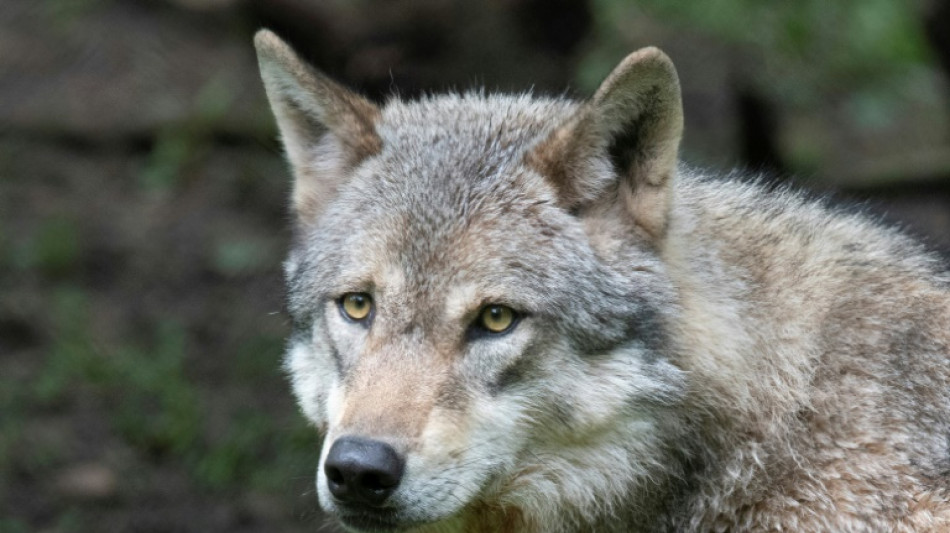
Protections drop for wolves in most of Europe / Photo: THOMAS KIENZLE - AFP

 Indians living in Japan on stand-by to house Asian Games athletes

 Trump signs bill authorizing sweeping Russia sanctions

 Protesters form human chain at Kennedy Center after Trump threat

 Death toll from attack at police HQ in Pakistan rises to 31

 Trump says Denmark to give US 'permanent control' over Greenland security

 Kennedy Center: future unclear for iconic Washington arts hub

 Trump claims 'infinite' Greenland security deal with Denmark

 Helicopters battle wildfire threatening Ecuador's capital

 Brentford batter Chelsea to undo Alonso's promising start

 Kane hits Bundesliga century as Bayern rout Union

 Trump says CNN, MS NOW, Politico banned from White House

 Hushing and hedging: US companies retreat on climate

 Springboks to face Fiji before 2027 Rugby World Cup

 Nigeria miners struggled to breathe in cell before 37 died: survivors

 McIlroy on the charge at PGA Championship as Reed withdraws

 McIlroy on the charge at PGA Championship

 Crisis-wracked Volkswagen warns of 10-bn-euro hit to profits

 Costa Rica's Grynspan tops third informal poll for UN chief: diplomat

 Stock markets retreat after central bank rate hikes

 Russia labels director of Cannes Grand Prix winner a 'foreign agent'

 Macron warns of Russian 'hybrid' threat after meeting presidential hopefuls

 UN holds third informal poll for new chief

 Kulusevski return can spark Spurs: De Zerbi

 Shakira to cap off world tour with Madrid 12-gig run

 Isolated Syrian-Druze city blames Damascus for shortages

Wolves became less protected in most of Europe on Friday as new conservation regulations came into force, except in three countries that objected to the move including the United Kingdom, the Council of Europe said.
The move allows hunting to resume under strict regulation, which activists fear could result in a large number of wolves being shot dead.
Activists have said the measure will upset the recovery made by the species over the past 10 years after near extinction a century ago, but farmers say their growing numbers are a threat to their livestock.
Members of the Bern Convention, tasked with the protection of wildlife in Europe and some African countries, in December agreed to lower the wolf's protection status from "strictly protected" to "protected".
The decision "was set to enter into force three months later, unless objected to by at least one-third of the parties to the convention," the Strasbourg-based Council of Europe said.
Of the 50 parties to the convention -- an international treaty of the Council of Europe -- at least 17 would have needed to protest.
Instead, "three parties formally lodged objections: the Czech Republic, Monaco, and the United Kingdom. As a result, the decision to modify the protection status of the wolf does not apply to these three parties," it said.
The new "protected" status "mandates regulation of the species' exploitation to prevent endangerment, implementing measures such as closed seasons and regulating the sale, keeping, transport, and offering for sale of live and dead animal," the Council of Europe said.
Grey wolves were virtually exterminated in Europe 100 years ago but their numbers have practically doubled to the current population of 20,300, mostly in the Balkans, Nordic countries, Italy and Spain.
The parties to the convention include 45 members of the Council of Europe, four African nations -- Burkina Faso, Morocco, Senegal and Tunisia -- and the European Union.
The European Union in September proposed the plan to lower the protection status of wolves as they increase in numbers and come into more frequent contact with human activity and livestock.
V.Dantas--PC