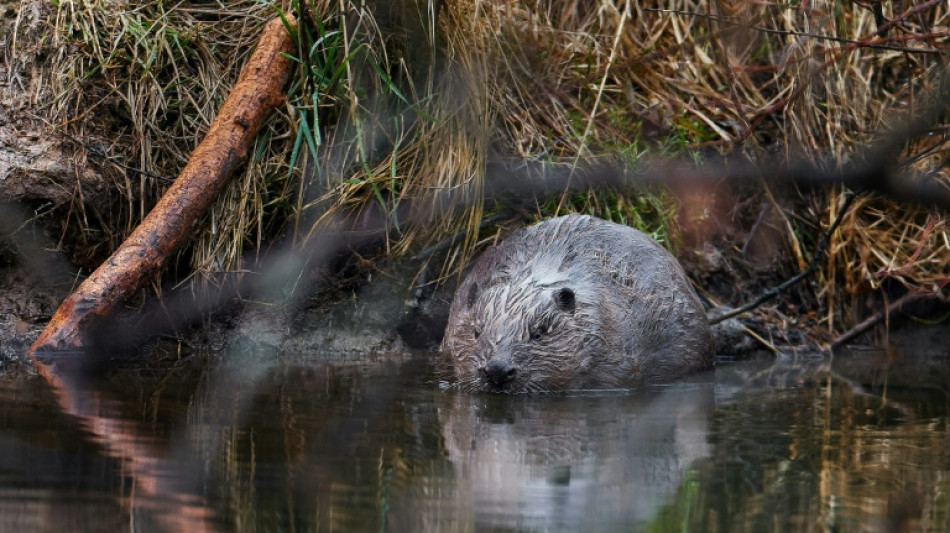
Many animal 'geomorphs' under threat, study warns / Photo: Bohumil FISER - AOPK CR/AFP/File

 Indians living in Japan on stand-by to house Asian Games athletes

 Trump signs bill authorizing sweeping Russia sanctions

 Protesters form human chain at Kennedy Center after Trump threat

 Death toll from attack at police HQ in Pakistan rises to 31

 Trump says Denmark to give US 'permanent control' over Greenland security

 Kennedy Center: future unclear for iconic Washington arts hub

 Trump claims 'infinite' Greenland security deal with Denmark

 Helicopters battle wildfire threatening Ecuador's capital

 Brentford batter Chelsea to undo Alonso's promising start

 Kane hits Bundesliga century as Bayern rout Union

 Trump says CNN, MS NOW, Politico banned from White House

 Hushing and hedging: US companies retreat on climate

 Springboks to face Fiji before 2027 Rugby World Cup

 Nigeria miners struggled to breathe in cell before 37 died: survivors

 McIlroy on the charge at PGA Championship as Reed withdraws

 McIlroy on the charge at PGA Championship

 Crisis-wracked Volkswagen warns of 10-bn-euro hit to profits

 Costa Rica's Grynspan tops third informal poll for UN chief: diplomat

 Stock markets retreat after central bank rate hikes

 Russia labels director of Cannes Grand Prix winner a 'foreign agent'

 Macron warns of Russian 'hybrid' threat after meeting presidential hopefuls

 UN holds third informal poll for new chief

 Kulusevski return can spark Spurs: De Zerbi

 Shakira to cap off world tour with Madrid 12-gig run

 Isolated Syrian-Druze city blames Damascus for shortages

More than a quarter of our planet's natural "geomorphs" -- animals such as beavers and hippos that, collectively, can reshape entire landscapes -- are threatened or have shrinking populations, a new study says.
The research, by Queen Mary University of London, found the scale of the impact these animals had on habitats -- by building dams, trampling new river courses, excavating earth and other activities -- rivals that caused by major floods.
Yet "more than a quarter (28 percent) of zoogeomorphic species are vulnerable to future population decline or regional or global extinction," the study's authors warned.
Their research, published mid-February, identified more than 600 species of land and freshwater animals that worked to redesign their ecosystems.
While beavers, of dam-building fame, and hippopotamuses and elephants, which in herds can flatten stretches of earth, are the best-known, there are many others -- often overlooked -- that could also be dubbed animal architects.
Among them are Brazilian termites, which have built high mounds connected by tunnels that cover an area larger than Iceland.
Others identified by the researchers included Australian marsupials, South American shrimp, Asian ants, as well as salmon, moles, earthworms and freshwater insects.
"What we tend to do is overlook the smaller animals that are less visible to us. Perhaps they're living underground or they're living underwater, but those animals can be really kind of important as well," one of the authors, Gemma Harvey, told AFP.
- 'Big cumulative effect' -
Harvey, a professor in biogeomorphology and landscape rewilding, said: "People can underestimate the effects of small animals, because individually their effects are small, but collectively they tend to be more abundant in the landscape so they can have a big cumulative effect."
She added that "it's the collective importance of the animals that is being discovered right now".
She noted the study did not look at marine ecosystems, and that "there will be many more animals that have not yet been studied or perhaps not even been discovered yet".
Of the more than 600 species identified in the research, 57 were classed as endangered, vulnerable or near-threatened on the International Union for the Conservation of Nature's Red List of Threatened Species.
Many others were at risk of declining populations.
"As we lose species from our landscapes, we lose those unique processes" of reshaping the habitats, Harvey said.
And the power these landscaping animals possess is staggering.
Harvey said her team's study estimated that the species they had identified together exerted 76,000 gigajoules of energy each year -- equivalent to that of "hundreds of thousands of extreme floods".
She said much was still unknown about the animals' geomorphing processes and she planned to further her research, notably by factoring in the effects of climate change.
"We're also interested in thinking kind of back in time in the past, about what we've already lost, you know, from our landscapes as species have become extinct or reduced a lot in terms of their population," she said.
F.Carias--PC



