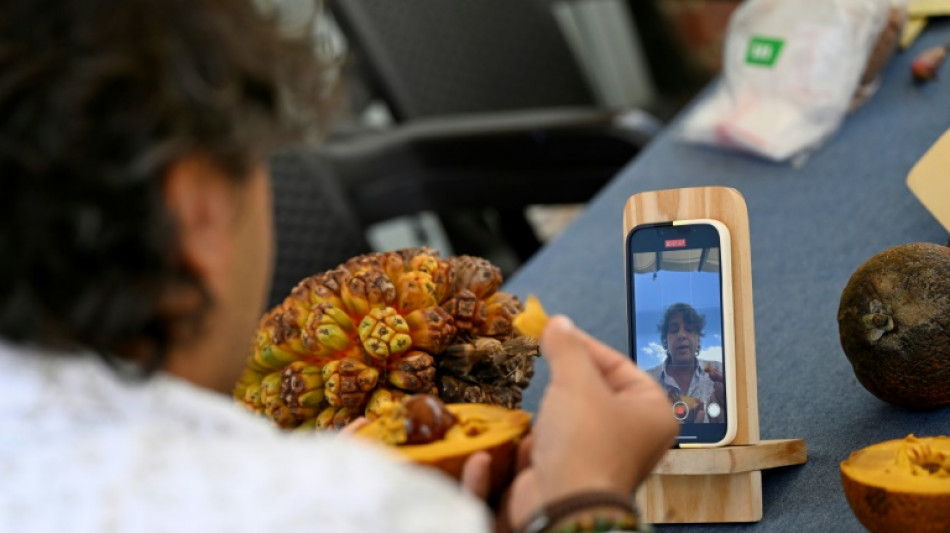
Colombia's 'Lord of the Fruit' fighting for native species / Photo: Pablo VERA - AFP

 Indians living in Japan on stand-by to house Asian Games athletes

 Trump signs bill authorizing sweeping Russia sanctions

 Protesters form human chain at Kennedy Center after Trump threat

 Death toll from attack at police HQ in Pakistan rises to 31

 Trump says Denmark to give US 'permanent control' over Greenland security

 Kennedy Center: future unclear for iconic Washington arts hub

 Trump claims 'infinite' Greenland security deal with Denmark

 Helicopters battle wildfire threatening Ecuador's capital

 Brentford batter Chelsea to undo Alonso's promising start

 Kane hits Bundesliga century as Bayern rout Union

 Trump says CNN, MS NOW, Politico banned from White House

 Hushing and hedging: US companies retreat on climate

 Springboks to face Fiji before 2027 Rugby World Cup

 Nigeria miners struggled to breathe in cell before 37 died: survivors

 McIlroy on the charge at PGA Championship as Reed withdraws

 McIlroy on the charge at PGA Championship

 Crisis-wracked Volkswagen warns of 10-bn-euro hit to profits

 Costa Rica's Grynspan tops third informal poll for UN chief: diplomat

 Stock markets retreat after central bank rate hikes

 Russia labels director of Cannes Grand Prix winner a 'foreign agent'

 Macron warns of Russian 'hybrid' threat after meeting presidential hopefuls

 UN holds third informal poll for new chief

 Kulusevski return can spark Spurs: De Zerbi

 Shakira to cap off world tour with Madrid 12-gig run

 Isolated Syrian-Druze city blames Damascus for shortages

Bent over his cellphone on the terrace of his Bogota apartment, Colombia's "Lord of the Fruit" describes the flavors, textures, and potential uses of rare species to thousands of social media followers.
Gian Paolo Daguer, a 47-year-old environmental engineer, is on a mission to save these natural delicacies from extinction in one of the most biodiverse countries in the world.
In one of the many videos on his Instagram page, Daguer extolls the virtues of the lucuma, a little-known tropical fruit he is introducing to the uninitiated.
The lucuma looks somewhat like a small coconut on the outside, with flesh that resembles yellowish avocado pulp.
"This is considered the queen of Peruvian fruits," says Daguer as he explains the lucuma's genealogy and geographic spread, then cuts it open and takes a bite.
"It is a fruit that is not very juicy... It can be eaten as a fresh fruit, but it is very dry. Nevertheless, it has a strong caramel-like flavor," he describes.
Like the lucuma, several fruit native to Colombia and the region are not widely eaten in a country where internationally popular species such as mango, papaya, watermelon and pineapple are better known.
Some local fruit are now at risk of extinction precisely because of their low profile.
"As our diet becomes more homogenized, we all eat the same thing all over the world, so these (native) species are taking a back seat," Carolina Castellanos, a biologist with the Humboldt Institute, a biodiversity research body in Bogota, told AFP.
"And that means that as we consume them less, they are also grown less... and it is easier for them to disappear," she said.
One endangered fruit in Daguer's collection is the "churumbelo," a berry native to Colombia's Boyaca department, where its natural environment is threatened by farming and mining.
"Its taste is sweet and refreshing, reminiscent of the flavor of a pear," said Daguer of the specimen that took him years to track down.
- Disappearing before they are found -
A 2022 study by the Humboldt Institute and other research bodies determined the country was host to at least 3,000 "edible" plant species.
But one in ten -- possibly more -- are threatened with extinction.
In 2024, Colombia lost a swath of forest roughly the size of Hong Kong to land clearing for farming and coca leaf growing, according to the environment ministry. Coca is the main ingredient in cocaine.
In increasing numbers, residential gardens and balconies countrywide are sporting fruit trees grown from seeds that Daguer sends to interested followers.
They pay only for the postage.
His "frutas_colombianas" (Colombian fruits) channel has more than 108,000 followers, and Daguer also curates a series of WhatsApp chats where biologists, farmers, and chefs share knowledge of rare fruit and arrange seed exchanges.
"This kind of learning is often not documented by science, but with this interest from the public, we all end up learning," Daguer, who since childhood has had a passion for discovering rare fruit, told AFP.
In fact, his work contributed to the first-time cataloging in 2024 of the quinguejo, a dark berry that grows in Nuqui -- a village in the country's remote northwest.
Daguer fears fruit may be disappearing from nature before they are even discovered.
"We definitely can't keep thinking that we can carry on destroying the ecosystems," he said.
Nature will need human help to recover, added the man dubbed "Lord of the Fruit" by his followers.
"And recovery is achieved by replanting."
Chef Antonuela Ariza, one of Daguer's collaborators, tries to do her part by adding rare fruit to the menu of her restaurant Mini-Mal in Bogota, to promote biodiversity.
Specialties include a mayonnaise made with camu-camu -- similar to a grape -- an Amazonian black chilli sauce, and a cocktail of copoazu, which is reminiscent of the cacao fruit.
"What we don't eat is lost," Ariza told AFP.
F.Carias--PC



