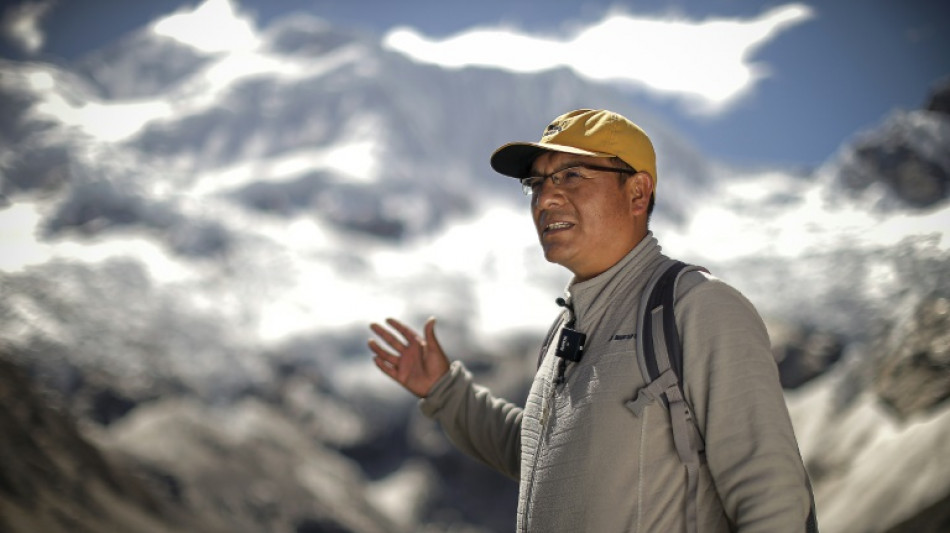
Peruvian farmer demands 'climate justice' from German energy giant / Photo: Luka GONZALES - AFP

 Manchester United rallies past Roma as PSG dominates in Champions League

 Qatar sees tentative opening for renewed regional diplomacy

 Qatar Tourism joins Pacific Asia Travel Association at London travel market

 Abdul El-Sayed Wins Michigan Senate Seat in Historic Election

 Qatar media bodies discuss support for humanitarian initiatives

 No. 22 UCLA defeats No. 5 Arizona 84-75 despite Kharchenkov's 38 points

 Vessel operator seeks witnesses after Vancouver grounding

 US Air Force deploys F-16 fighters to remote Aleutian base for readiness drill

 Bezos grant helps Seattle nonprofit move thousands of families toward housing

 Shrini Srivastava joins crew of Varanasi-Delhi Vande Bharat Sleeper service

 Nearly Half of Australian Workers Overqualified, Survey Finds

A Peruvian farmer taking a German energy giant to court says he is battling for "climate justice" and wants the company to pay for the consequences of rising temperatures.
Saul Luciano Lliuya, 44, argues that electricity producer RWE -- one of the world's top emitters of carbon dioxide -- must share the cost of protecting his hometown, Huaraz, from a swollen glacier lake that is at risk of overflowing from melting snow and ice.
He wants the German company to pay 17,000 euros ($18,400) towards flood defences for his community, arguing that the fossil fuels the firm has used to generate electricity make it partly responsible for the flood risk.
"The reality is the glaciers are melting and sadly the mountains are suffering, and that has consequences," he told reporters outside a regional court in the west German city of Hamm.
"It's a risk for me. It's a risk for the more than 50,000 people who live in the danger zone."
Lliuya first filed a lawsuit in 2015 but a court in the western German city of Essen, where RWE is headquartered, dismissed it the following year.
In 2017, however, the Hamm court allowed an appeal.
After a delay due to the Covid pandemic, hearings are scheduled from Monday to Wednesday.
Roda Verheyen, Lliuya's lawyer in the case, expects proceedings to conclude at the end of next year.
Monday's hearing was to consider if Lliuya's property in Peru's Ancash region is at substantial risk of flooding.
It will examine evidence collected by court-appointed experts who travelled to the area in 2022.
If confirmed, a subsequent hearing would look at the question of RWE's responsibility.
- 'Fair contribution' -
Lliuya bases his legal claim on a 2014 study that concluded RWE was responsible for 0.47 percent of all global carbon emissions since the start of the industrial era.
RWE, which has never operated in Peru, should pay that share of the 3.5 million euros it would cost to lower the waters of Lake Palcacocha, he says.
RWE was founded in 1898, and now uses a variety of power sources, including gas and coal as well as solar and wind.
Christoph Bals, head of policy at Germanwatch, an environmental campaign group supporting Lliuya in the case, said they came across his plight after being put in touch by a consultant advising Lliuya on how to manage the rising waters.
"They (the farmers in Huaraz) got talking and they said: 'It's not right. We have done nothing to contribute to climate change and now we’re paying for it'," Bals said outside court.
RWE says a court ruling in favour of Lliuya would set a precedent of holding people responsible under German law for actions that have environmental consequences abroad.
"We think that is legally inadmissible and the wrong way to address this issue socially and politically," a spokesman said.
Dismissing the case in 2015, the Essen court said that it was impossible to draw a link between particular emissions and particular damage.
The Hamm hearing might be the first stage towards overturning that opinion, at a time when 43 climate-damage cases are ongoing worldwide, according to not-for-profit research group Zero Carbon Analytics.
Freshfields Bruckhaus Deringer, the law firm representing RWE, says that there could be major implications.
"The sum in dispute may be less than 20,000 euros. But the precedent-setting potential is clear," it said.
C.Cassis--PC



