
-
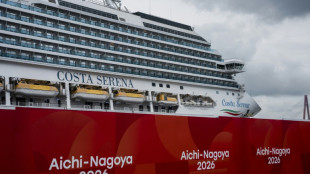 Indians living in Japan on stand-by to house Asian Games athletes
-
We don't want Games host Japan losing money, says Asian Olympic official

-
 Trump signs bill authorizing sweeping Russia sanctions
-
Ed Sheeran returns to stage after Palestinian controversy

-
 Protesters form human chain at Kennedy Center after Trump threat
-
Asian Games to open in Japan after troubled build-up

-
 Death toll from attack at police HQ in Pakistan rises to 31
-
Drone owners rush to offload devices ahead of Beijing ban

-
 Trump says Denmark to give US 'permanent control' over Greenland security
-
Trump's beef policies irk Texas ranchers, testing their loyalty

-
 Kennedy Center: future unclear for iconic Washington arts hub
-
Nvidia, OpenAI CEOs to attend Xi dinner at White House

-
 Trump claims 'infinite' Greenland security deal with Denmark
-
Anthropic picks Accenture for in-house AI safety evaluation

-
 Helicopters battle wildfire threatening Ecuador's capital
-
Balogun returns as Monaco beat Lens to continue strong Ligue 1 start

-
 Brentford batter Chelsea to undo Alonso's promising start
-
'Pause' on overt repression in Venezuela, but reforms still needed: HRW

-
 Kane hits Bundesliga century as Bayern rout Union
-
Global stocks mixed as yen falls despite Bank of Japan rate hike

-
 Trump says CNN, MS NOW, Politico banned from White House
-
Cuba hit with seventh major blackout of the year

-
 Hushing and hedging: US companies retreat on climate
-
Murray out with concussion so Wentz will start for Vikings

-
 Springboks to face Fiji before 2027 Rugby World Cup
-
UN chief 'deeply regrets' US visa refusal to Abbas for annual meeting

-
 Nigeria miners struggled to breathe in cell before 37 died: survivors
-
England quick Carse to face no charges over alleged nightclub assault

-
 McIlroy on the charge at PGA Championship as Reed withdraws
-
Mancini brings nine newcomers into the first squad of his Italy comeback

-
 McIlroy on the charge at PGA Championship
-
Czechs level Davis Cup tie against USA as South Korea eye Finals

-
 Crisis-wracked Volkswagen warns of 10-bn-euro hit to profits
-
New France boss Zidane confirms Mbappe as captain after naming first squad

-
 Costa Rica's Grynspan tops third informal poll for UN chief: diplomat
-
California governor signs order to explore AI 'kill switch'

-
 Stock markets retreat after central bank rate hikes
-
Head leads run spree as Australia win Zimbabwe ODI series

-
 Russia labels director of Cannes Grand Prix winner a 'foreign agent'
-
In-form Raphinha wants to finish career at Barcelona

-
 Macron warns of Russian 'hybrid' threat after meeting presidential hopefuls
-
Warren Buffett steps down as Berkshire Hathaway chairman

-
 UN holds third informal poll for new chief
-
Carrick confident Man Utd can 'work through' tough time

-
 Kulusevski return can spark Spurs: De Zerbi
-
Mbappe ends Nike partnership to join Swiss brand On

-
 Shakira to cap off world tour with Madrid 12-gig run
-
Liverpool boss Iraola puts Bournemouth love affair on hold

-
 Isolated Syrian-Druze city blames Damascus for shortages
-
'A disaster' if Man City do not win says Maresca after flawless start

'Unprecedented' mass bleaching drains life from Australian reef
An "unprecedented" mass bleaching event has been recorded off Australia's western coast, scientists said Wednesday, turning huge chunks of a celebrated reef system a sickly dull white.
A months-long marine heatwave had "cooked" the sprawling Ningaloo Reef, ocean scientist Kate Quigley said, part of a world heritage-listed marine park renowned for vibrant corals and migrating whale sharks.
Although environment officials were still verifying the scale of damage, data collected by Quigley and a team of scientists found it was on track to be the reef's worst mass-bleaching event in years.
"Warm oceans have just cooked the corals this year," Quigley told AFP.
"It wouldn't be amiss to throw in the word 'unprecedented'.
"It has gone deep, it's not just the top of the reef that is bleaching. Many different species of coral are bleaching."
Branching through shallow waters along Australia's western coast, the 300-kilometre (185-mile) Ningaloo Reef is one of the largest "fringing reefs" in the world.
The unfolding mass bleaching looked to be the worst since 2011, Quigley said.
Ocean waters lapping Western Australia have been as much as three degrees warmer than average over recent summer months, the government weather bureau said.
Rising temperatures shot past the "bleaching threshold" sometime in mid-January, according to monitoring by the US National Oceanic and Atmospheric Administration.
Bleaching occurs when warm waters trigger a biological response forcing coral to expel the colourful algae embedded in their tissues.
"Bleaching is a sickness, but it does not mean outright death," said Quigley, a research scientist with environmental charity the Minderoo Foundation.
"But if it is bad enough, the corals will die."
- 'Just shocking' -
Government data showed smaller patches of coral bleaching had also been spotted at the northern tip of the more famous Great Barrier Reef on Australia's east coast.
Quigley said the Ningaloo Reef and the Great Barrier Reef were shaped by different weather patterns -- and it was rare to see bleaching on both at the same time.
"What we're seeing is the level of ocean warming is so great, it's overriding the local conditions in some places.
"It's just shocking. When we take a national snapshot it's extremely concerning."
The Great Barrier Reef, a popular tourist drawcard, has suffered five mass bleachings over the past eight years.
Quigley said the extent of damage on the Great Barrier Reef was not currently widespread enough to be considered "mass bleaching".
Global average temperatures were the hottest on record in 2024, with prolonged heatwaves in many of the planet's oceans causing alarm.
A prolonged global episode of heat-related bleaching impacted almost 80 percent of the world's coral reefs betwen 2023 and 2024, a leading US science agency found in October.
Warming seas, overfishing and pollution are threatening coral reef systems the world over, warned a major UN report in December.
Australia sits on bulging deposits of coal, gas, metals and minerals, with mining and fossil fuels stoking decades of near-unbroken economic growth.
But it is increasingly suffering from more intense heatwaves, bushfires and drought, which scientists have linked to climate change.
A.Seabra--PC



