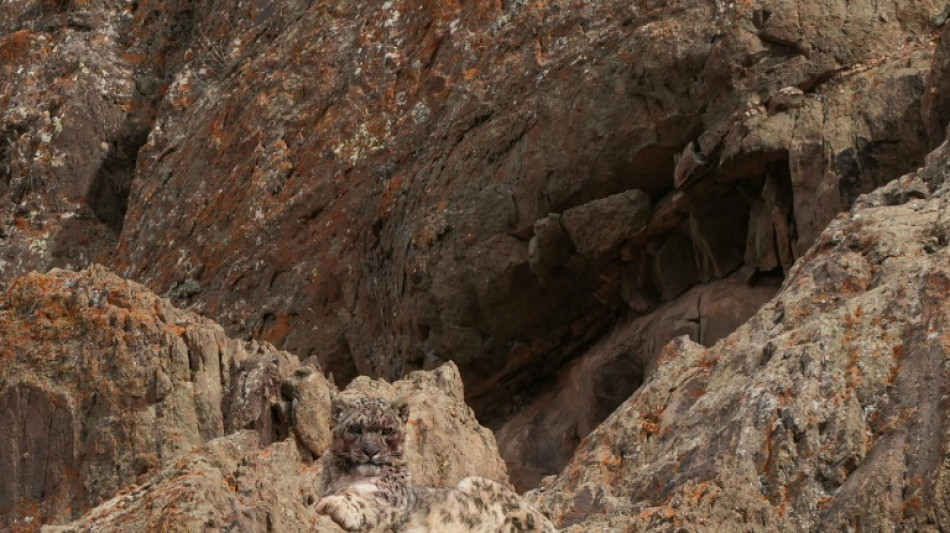
Landmark Nepal survey estimates nearly 400 elusive snow leopards / Photo: Mohd Arhaan ARCHER - AFP

 Greenland parliament approves security agreement with United States

 Qatar envoy meets incoming UN General Assembly president

 Trump Signals Willingness to Work With Democrats After Midterm Defeat

 Galloway accuser could not foresee publishing-sector fallout, lawyer argues

 New York City Center revives In the Heights as a timely community story

 Godzilla Minus Zero shifts focus toward postwar human drama

 Mehbooba Mufti urges dialogue and renewed Central Asia links for Kashmir

 Seacliff Healthcare Seeks Specialist GP in Thirroul

 US stocks fall before midterm Election Day as technology shares weaken

 BLS Polymers makes strong market debut at ₹248 per share

 Petrol and diesel prices remain broadly steady across major Indian cities

 Reliance shares remain in focus after near-12% surge

 2026 Arizona Midterms: Key Races, Ballot Measures, and Voter Deadlines

 Coal India prepares possible $1 billion Mahanadi Coalfields listing

Nepal's first nationwide survey of the threatened snow leopard estimated nearly 400 of the elusive big cats in the Himalayan nation, wildlife officials said Tuesday.
Habitat loss, climate change and poaching have greatly impacted snow leopard populations across Asia, listed as a "vulnerable" species by the International Union for Conservation of Nature (IUCN).
But the survey offers a rare shot of hope, confirming numbers lie at the upper end of the previous estimates.
With thick grey fur dotted with dark spots, and large paws that act as natural snow shoes, the species are difficult to spot and quick to hide, making field research challenging.
"This is a historic step in Nepal's snow leopard conservation journey," Haribhadra Acharya, senior ecologist at the Department of National Parks and Wildlife Conservation, told AFP.
"This is the first time we are getting authentic data with the great effort of researchers," he said.
An estimated total of 397 snow leopards were counted, determined through motion-sensor camera and genetic analysis in seven key areas.
It offers the most comprehensive national estimate of snow leopards -- also known as the "ghosts of mountains" -- previously estimated by the IUCN to be in the range of 301-400.
Snow leopards are the least studied of the big cats globally due to their low population density and remote mountain habitats they inhabit.
"Nepal has only two percent of the size of the snow leopard habitats globally, (yet) we host 10 percent of the total estimated population", Ghana S Gurung, country representative of WWF Nepal, told AFP.
"More importantly, we are the second smallest country in terms of snow leopard habitat size after Bhutan, (but) we hold the fourth largest population," he added.
- 'Increased human activity' -
The Snow Leopard Trust, a US-based conservation group, says the exact total number is not known but that "there may be as few as 3,920 and probably no more than 6,390" across 12 countries in Asia.
Although conservationists have welcomed the new population estimate, many remain concerned about the threats posed by climate change and infrastructure development.
"New road construction, installation of transmission lines, and increased human activity in search of herbs are disrupting snow leopards' habitats in the Himalayas," said Acharya, one of the lead researchers.
Experts say the increasing avalanches in the mountains -- where climate change is exacerbating extremes of weather patterns -- are another threat.
Nepal has been praised worldwide for its efforts to protect wildlife which have helped several species, including tigers and rhinos, to return from the brink of local extinction.
The country's conservation efforts have helped to triple its tiger population to 355 since 2010 and to increase one-horned rhinoceros from around 100 in the 1960s to 752 in 2021.
N.Esteves--PC



