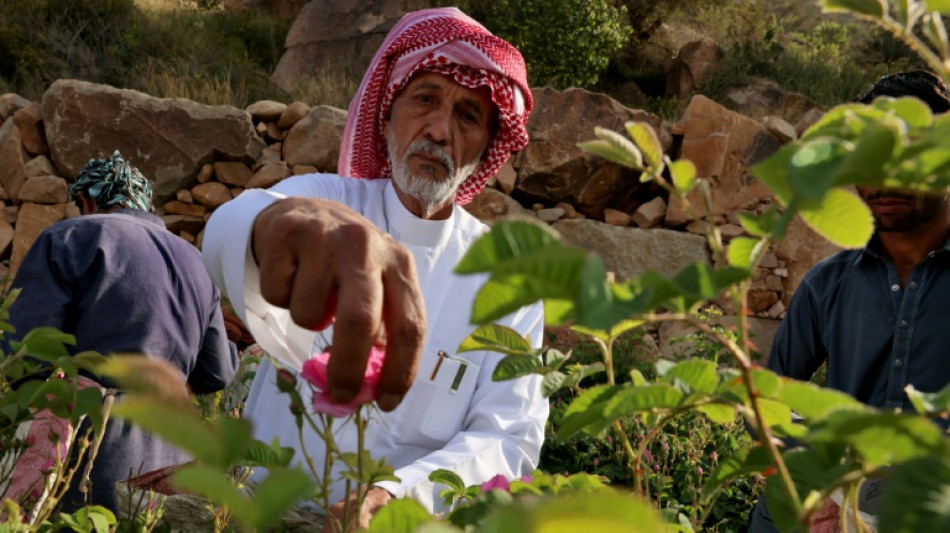
Saudi 'city of roses' offers fragrant reminder of desert's beauty / Photo: Fayez Nureldine - AFP

 Indians living in Japan on stand-by to house Asian Games athletes

 Trump signs bill authorizing sweeping Russia sanctions

 Protesters form human chain at Kennedy Center after Trump threat

 Death toll from attack at police HQ in Pakistan rises to 31

 Trump says Denmark to give US 'permanent control' over Greenland security

 Kennedy Center: future unclear for iconic Washington arts hub

 Trump claims 'infinite' Greenland security deal with Denmark

 Helicopters battle wildfire threatening Ecuador's capital

 Brentford batter Chelsea to undo Alonso's promising start

 Kane hits Bundesliga century as Bayern rout Union

 Trump says CNN, MS NOW, Politico banned from White House

 Hushing and hedging: US companies retreat on climate

 Springboks to face Fiji before 2027 Rugby World Cup

 Nigeria miners struggled to breathe in cell before 37 died: survivors

 McIlroy on the charge at PGA Championship as Reed withdraws

 McIlroy on the charge at PGA Championship

 Crisis-wracked Volkswagen warns of 10-bn-euro hit to profits

 Costa Rica's Grynspan tops third informal poll for UN chief: diplomat

 Stock markets retreat after central bank rate hikes

 Russia labels director of Cannes Grand Prix winner a 'foreign agent'

 Macron warns of Russian 'hybrid' threat after meeting presidential hopefuls

 UN holds third informal poll for new chief

 Kulusevski return can spark Spurs: De Zerbi

 Shakira to cap off world tour with Madrid 12-gig run

 Isolated Syrian-Druze city blames Damascus for shortages

After decades spent pruning thorny bushes and working arduous harvests, Khalaf Allah al-Talhi has perfected the art of capturing the fragrant aroma of the desert rose in a bottle.
"I love roses and take care of them more than I care for my own children," the 80-year-old told AFP from his flower farm in western Saudi Arabia's Taif.
Known as "the city of roses", the hills of Taif produce around 300 million of the area's signature pink roses annually at 800 flower farms.
By his own estimates, Talhi grows around five to six million of those.
The arrival of spring's mild climate is met with the blooming of roses that carpet the vast, rolling desert landscapes with vibrant shades of pink.
The blooms are then hand-picked from daybreak to late in the evening by an army of labourers.
The petals are soaked and boiled for hours in vats, where the rose's scent is extracted through an intricate process capturing the steam that is then distilled into aromatic oil.
The flowers have long been used to make rose water to wash the walls of the Kaaba at the Grand Mosque in Mecca, and perfumes made from Taif roses are popular with pilgrims visiting the kingdom.
- 'Many rose lovers' -
"The quantity of Taif roses is small, so only limited amounts are exported because it's not enough to meet local demand. Here in Saudi Arabia, we have many rose lovers who only prefer rose perfume," Talhi said.
A modest quantity of oil is exported to craft perfumes or to be added to cosmetic products such as moisturisers and soaps.
According to the economic database TrendEconomy, Saudi Arabia in 2023 exported just $141 million worth of perfume products, which includes rosewater.
At harvest time, workers on Talhi's farm pick tens of thousands of flowers daily.
"We were born on farms and have always worked in agriculture," said Talhi, wearing a white robe and a red checkered headscarf.
But now the greater frequency of erratic weather -- including searing summer heat, frigid winters and unexpected flooding -- presents a potent threat to Taif's famed roses.
- 'My soul' -
Climate scientists have issued regular warnings that every fraction of a degree of global warming increases the intensity and frequency of extreme weather events such as heatwaves, heavy rainfall and droughts.
Saudi Arabia, with its arid climate and vast deserts, is particularly vulnerable.
"Climate change accelerates soil degradation in processes such as salinisation, erosion, and desertification, which diminishes the quality and productivity of arable land in Saudi Arabia," read a report published by the Atlantic Council.
The think tank estimated that wheat yields were expected to decline by 20 to 30 percent by 2050 in Saudi Arabia because of heat stress and not enough irrigation water, while reductions are also expected for date palms and other staple crops.
The weather in the deserts around Taif has been no exception, according to Talhi.
"Last year and the year before, it was extremely cold. Some farmers didn't harvest a single flower from their fields."
Thankfully, this season has been more forgiving.
"There are weather changes, but this year the conditions have been very mild," he said.
While the weather may now be less reliable, Talhi himself has proven to be a source of stability.
Despite his advancing years, the octogenarian rises every day before sunrise to work the fields alongside his staff, and he often labours away until late into the night.
"This farm is my soul and beating heart," he told AFP.
"God willing, nothing will separate me from it, except death."
F.Ferraz--PC



