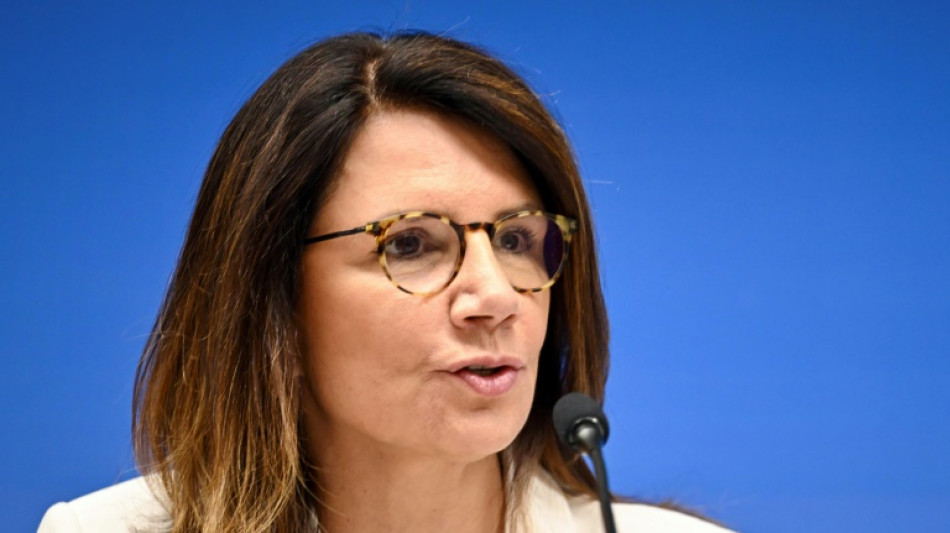
Don't make 'disappointing' retreat on climate, COP30 CEO urges EU / Photo: EVARISTO SA - AFP

 Ed Sheeran returns to stage after Palestinian controversy

 Asian Games to open in Japan after troubled build-up

 Drone owners rush to offload devices ahead of Beijing ban

 Trump's beef policies irk Texas ranchers, testing their loyalty

 Nvidia, OpenAI CEOs to attend Xi dinner at White House

 Anthropic picks Accenture for in-house AI safety evaluation

 Balogun returns as Monaco beat Lens to continue strong Ligue 1 start

 'Pause' on overt repression in Venezuela, but reforms still needed: HRW

 Global stocks mixed as yen falls despite Bank of Japan rate hike

 Cuba hit with seventh major blackout of the year

 Murray out with concussion so Wentz will start for Vikings

 UN chief 'deeply regrets' US visa refusal to Abbas for annual meeting

 England quick Carse to face no charges over alleged nightclub assault

 Mancini brings nine newcomers into the first squad of his Italy comeback

 Czechs level Davis Cup tie against USA as South Korea eye Finals

 New France boss Zidane confirms Mbappe as captain after naming first squad

 California governor signs order to explore AI 'kill switch'

 Head leads run spree as Australia win Zimbabwe ODI series

 In-form Raphinha wants to finish career at Barcelona

 Warren Buffett steps down as Berkshire Hathaway chairman

 Carrick confident Man Utd can 'work through' tough time

 Mbappe ends Nike partnership to join Swiss brand On

 Liverpool boss Iraola puts Bournemouth love affair on hold

 'A disaster' if Man City do not win says Maresca after flawless start

 Kerry James Marshall: American 'blackness' painter celebrated in Europe

Europe is "absolutely vital" to the fight against global warming and its leadership must not waver as climate ambition backslides elsewhere, the CEO of November's COP30 summit in Brazil told AFP.
In an interview in Paris, Ana Toni urged the European Union to unite around a strong emissions reduction target as the 27-nation bloc squabbles over its level of climate ambition.
The European Commission has proposed cutting emissions by 90 percent by 2040 compared to 1990 levels but some member states argue the figure is too high, delaying its approval.
Brussels is pushing to revamp its economic and defence competitiveness in the aftermath of Donald Trump's election, and climate advocates fear the EU's green goals could suffer as priorities are realigned.
The debate is being closely watched as countries finalise their own climate plans, known as nationally determined contributions (NDCs), which are supposed to be submitted to the UN before the COP30 conference in the Amazonian city of Belem.
A: "The EU needs to lead. We really need the EU to lead. If they can't, we shouldn't then be disappointed that other developing countries -- major countries like India, China -- will also be rethinking how ambitious they need to be."
A: "I obviously understand the pressure. We feel the same pressure, the political pressure at home. If you were to ask (Brazilian) President Lula (Luiz Inacio Lula da Silva) when he decided to agree on a NDC that is decarbonising by 67 percent, there's no lack of pressure also from the different economic sectors that we have in Brazil."
Q:
A: "Yes, Brazil could sell a lot of carbon credits. Brazil is obviously well positioned because of our energy sector, because of reforestation, to sell carbon credit with integrity to any market."
A: "It's really sad that the federal government from the US decided to withdraw again... But we should remember that the US is not just the federal government. You have the private sector in the US, you have the national governments. They say that around 60 percent of the laws related to climate is in the hands of state governors, not of the federal government.
"Climate needs stability. You need planning. I think we need to all rethink what we call a country being a risky country, because most of the time everybody thought of the US as a very stable, low risk country. And some countries in the South were (considered) very high risk."
Q:
A: "I don't think China first wants to take the place because China believes on collective leadership. I think that idea of individual countries' leadership is something that's very Western, that everybody's looking for a saviour, like the leader.
"I don't think that's the Chinese culture or Brazilian culture. We like collective leadership. And yes, we can see that the Southern countries are playing a collective leadership role.
"That's why again, coming back to Europe, it is fundamental that Europe, together with Brazil, China, South Africa, India and other countries can play that collective leadership role."
A: "No type of wars is good for climate. They are anti-ecologic, any type of war -- be it military wars or trade wars. Trade can play a positive role in the decarbonisation process if we are trading low carbon goods, if we are helping each other to achieve our goals. So that's a very important message. We need to keep free trade, organise free trade, of low carbon technologies."
E.Ramalho--PC