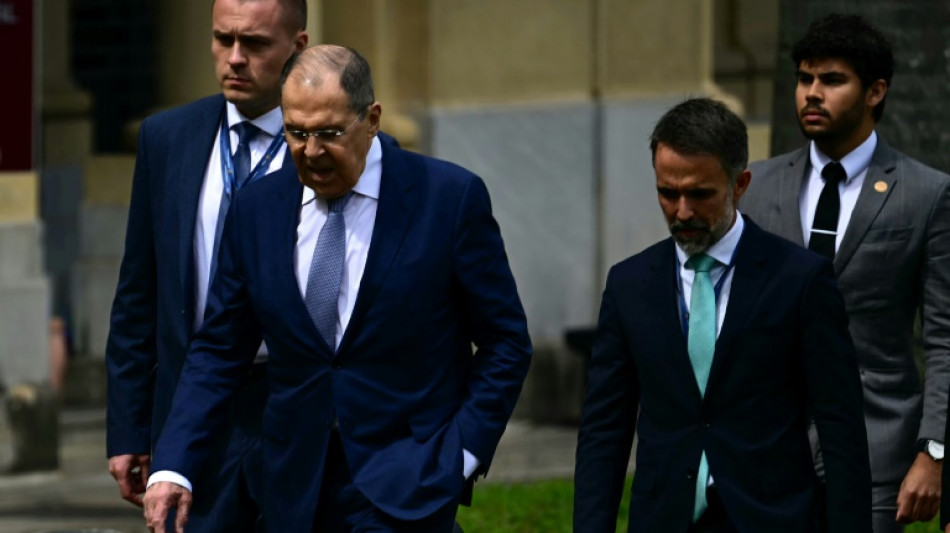
Trump trade war dominates BRICS meeting in Brazil / Photo: Pablo PORCIUNCULA - AFP

 Greenland parliament approves security agreement with United States

 Qatar envoy meets incoming UN General Assembly president

 Trump Signals Willingness to Work With Democrats After Midterm Defeat

 Galloway accuser could not foresee publishing-sector fallout, lawyer argues

 New York City Center revives In the Heights as a timely community story

 Godzilla Minus Zero shifts focus toward postwar human drama
 Mehbooba Mufti urges dialogue and renewed Central Asia links for Kashmir

 Seacliff Healthcare Seeks Specialist GP in Thirroul

 US stocks fall before midterm Election Day as technology shares weaken

 BLS Polymers makes strong market debut at ₹248 per share

 Petrol and diesel prices remain broadly steady across major Indian cities

 Reliance shares remain in focus after near-12% surge

 2026 Arizona Midterms: Key Races, Ballot Measures, and Voter Deadlines

 Coal India prepares possible $1 billion Mahanadi Coalfields listing
The foreign ministers of Brazil, China, Russia and other BRICS members began two days of talks in Rio de Janeiro Monday aimed at forging a united front to US President Donald Trump's aggressive trade policies.
The meeting comes at a critical moment for the world economy after the International Monetary Fund slashed growth forecasts over the impact of the US leader's sweeping new tariffs.
Top diplomats from the 11-member bloc -- which includes Egypt, Ethiopia, India, Indonesia, Iran, Saudi Arabia, South Africa and the United Arab Emirates -- met to hone their agenda ahead of a July leaders summit.
Brazilian Foreign Minister Mauro Vieira stressed the importance of dialogue at a time of "humanitarian crises, armed conflicts, political instability and the erosion of multilateralism."
BRICS's "role as a group is more important than ever," he said.
Trump, since returning to the White House in January, has hit dozens of countries with a blanket 10 percent tariff, but China faces levies of up to 145 percent on many products.
Beijing has responded with duties of 125 percent on US goods.
Senior Chinese economic planner Zhao Chenxin said in Beijing Monday the country was on the "right side of history" in the face of what he called Washington's "unilateralism and bullying."
BRICS has expanded significantly since its 2009 inception as a group of four powers -- Brazil, Russia, India and China -- seeking an alternative platform to Western-led international organizations such as the G7.
It now makes up nearly half of the global population, 39 percent of global GDP and weighs in on issues from Ukraine to Gaza to global trade.
Vieira opened the talks with a call for a "complete withdrawal" of Israeli forces from Gaza, terming Israel's more than 50-day aid blockade of the territory "unacceptable."
The group has had generally less to say about the war in Ukraine, issuing general calls for peace while steering clear of condemning Russia's invasion.
And Vieira on Monday called for a "diplomatic solution" which respects the "principles and objectives" of the UN charter.
- Russian ceasefire -
The meeting comes at the start of what the United States has called a "critical week" for talks on ending the Ukraine war.
Trump appeared to turn against Putin at the weekend after a meeting with Ukrainian President Volodymyr Zelensky at Pope Francis's funeral, saying he felt the Russian leader was "just tapping me along."
Russian President Vladimir Putin responded by announcing a three-day ceasefire from May 8-10.
The White House, however, suggested the pause was not sufficient, saying Trump had "made it clear he wants to see a permanent ceasefire first."
At the same time the US president has been piling pressure on Kyiv to give up hopes of reclaiming Russian-annexed Crimea.
A BRICS challenge to the hegemony of the dollar is expected to feature high on the agenda.
At a summit last year, BRICS members discussed boosting non-dollar transactions, eliciting a swift rebuke from Trump who threatened them with 100 percent tariffs if they undercut the US currency.
Speaking to Brazil's O Globo newspaper ahead of the meeting, Russian Foreign Minister Sergei Lavrov said BRICS nations planned to "increase the share of national currencies in transactions" between member states but said talk of transitioning towards a unified BRICS currency was "premature."
Vieira, whose country has so far been spared the worst of Trump's trade ire -- Brazilian imports to the US are subject to 10 percent tariffs, a fraction of those imposed on China -- also denied any plans to create a new currency.
The BRICS will be joined for discussions on Tuesday by nine other "partner" countries, including several former Soviet states, as well as Cuba, Malaysia, Thailand, Uganda and Nigeria.
T.Vitorino--PC



