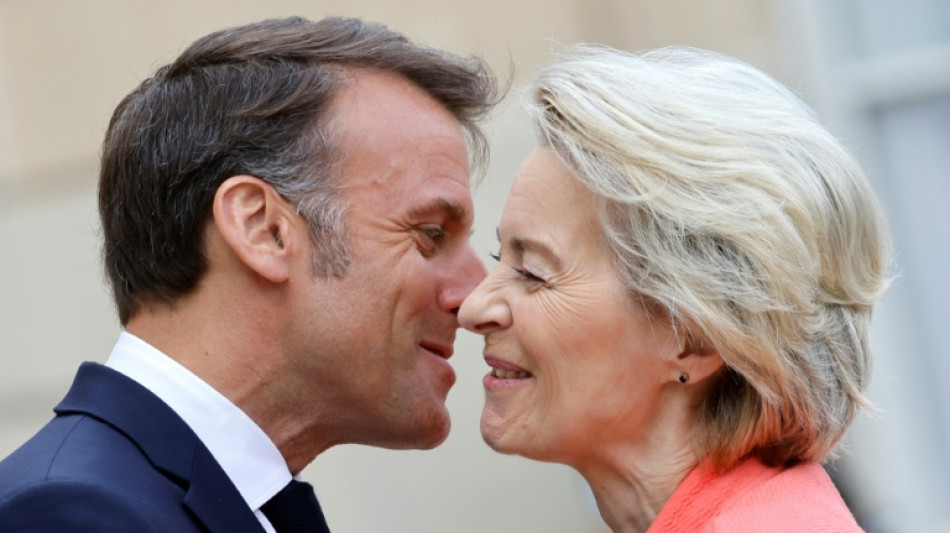
France, EU take aim at Trump's assault on science, seek to lure US researchers / Photo: Ludovic MARIN - AFP

 Ed Sheeran returns to stage after Palestinian controversy

 Asian Games to open in Japan after troubled build-up

 Drone owners rush to offload devices ahead of Beijing ban

 Trump's beef policies irk Texas ranchers, testing their loyalty

 Nvidia, OpenAI CEOs to attend Xi dinner at White House

 Anthropic picks Accenture for in-house AI safety evaluation

 Balogun returns as Monaco beat Lens to continue strong Ligue 1 start

 'Pause' on overt repression in Venezuela, but reforms still needed: HRW

 Global stocks mixed as yen falls despite Bank of Japan rate hike

 Cuba hit with seventh major blackout of the year

 Murray out with concussion so Wentz will start for Vikings

 UN chief 'deeply regrets' US visa refusal to Abbas for annual meeting

 England quick Carse to face no charges over alleged nightclub assault

 Mancini brings nine newcomers into the first squad of his Italy comeback

 Czechs level Davis Cup tie against USA as South Korea eye Finals

 New France boss Zidane confirms Mbappe as captain after naming first squad

 California governor signs order to explore AI 'kill switch'

 Head leads run spree as Australia win Zimbabwe ODI series

 In-form Raphinha wants to finish career at Barcelona

 Warren Buffett steps down as Berkshire Hathaway chairman

 Carrick confident Man Utd can 'work through' tough time

 Mbappe ends Nike partnership to join Swiss brand On

 Liverpool boss Iraola puts Bournemouth love affair on hold

 'A disaster' if Man City do not win says Maresca after flawless start

 Kerry James Marshall: American 'blackness' painter celebrated in Europe

French President Emmanuel Macron and European Commission head Ursula von der Leyen took aim at Donald Trump's policies on science on Monday, as the European Union seeks to encourage disgruntled US researchers to relocate to Europe.
Von der Leyen told a conference at Paris's Sorbonne university that the EU would launch a new incentives package worth 500 million euros ($567 million) to make the 27-nation bloc "a magnet for researchers".
"We have to offer the right incentives," she said.
Without mentioning Trump directly, von der Leyen told the "Choose Europe for Science" conference that the role of science was being put in question "in today's world" and condemned such views as "a gigantic miscalculation".
Universities and research facilities in the United States have come under increasing political and financial pressure under Trump, including with threats of massive federal funding cuts.
"Nobody could have imagined that this great global democracy, whose economic model depends so heavily on free science,.. was going to commit such an error," Macron said.
He added: "We refuse a diktat consisting of any government being able to say you cannot research this or that."
- 'A sanctuary' -
In the context of "threats" against independent research and "global apprehension", Macron said, "Europe must become a sanctuary."
In the United States, research programmes face closure, tens of thousands of federal workers have been fired and foreign students fear possible deportation for their political views.
European commissioners, scientists, academics and ministers for research from EU member countries took part in Monday's conference, as did representatives from non-EU members Norway, Britain and Switzerland.
The French president has already appealed to foreign, notably US, researchers to "choose France".
Last month he unveiled plans for a funding programme to help universities and other research bodies cover the cost of bringing foreign scientists to the country.
Aix Marseille University in the south of France announced in March it would open its doors to US scientists threatened by cuts.
It says its "Safe Place for Science" scheme has already received a flood of applicants.
Last week, France's flagship scientific research centre, the CNRS, launched another initiative aimed at attracting foreign researchers whose work is threatened.
- Bridging the pay gap -
It is also seeking to tempt back French researchers working abroad, some of whom "don't want to live and raise their children in Trump's United States", according to CNRS President Antoine Petit.
An official in Macron's office said Monday's conference came "at a time when academic freedoms are retreating and under threat in a number of cases".
One obstacle, experts say, is the fact that while EU countries can offer competitive research infrastructure and a high quality of life, research funding and researchers' remuneration both lag far behind US levels.
But the CNRS's Petit said last week he hoped the pay gap would seem less significant once the lower cost of education and health, and more generous social benefits were taken into account.
Macron's office said France and the European Union were targeting researchers in a number of specific sectors, including health, climate, biodiversity, artificial intelligence and space.
Macron said his government would earmark "an additional" 100 million euros to help attract foreign talent.
The French government could finance up to 50 percent of selected research projects, an official in the presidential office said, while assistance could also be offered in the form of tax incentives.
burs-jh/ekf/gil
J.Oliveira--PC



