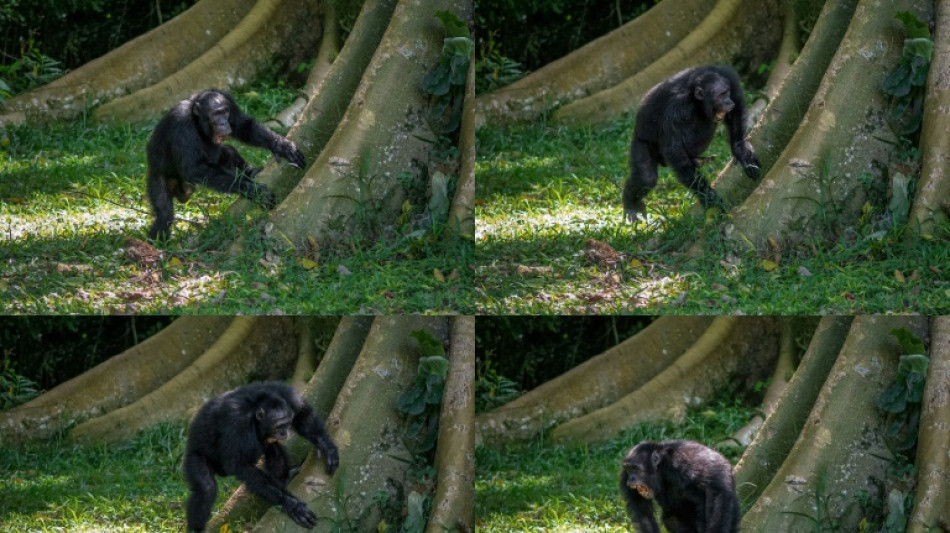
Jungle music: Chimp drumming reveals building blocks of human rhythm / Photo: Adrian Soldati - University of St Andrews/AFP/File

 Ed Sheeran returns to stage after Palestinian controversy

 Asian Games to open in Japan after troubled build-up

 Drone owners rush to offload devices ahead of Beijing ban

 Trump's beef policies irk Texas ranchers, testing their loyalty

 Nvidia, OpenAI CEOs to attend Xi dinner at White House

 Anthropic picks Accenture for in-house AI safety evaluation

 Balogun returns as Monaco beat Lens to continue strong Ligue 1 start

 'Pause' on overt repression in Venezuela, but reforms still needed: HRW

 Global stocks mixed as yen falls despite Bank of Japan rate hike

 Cuba hit with seventh major blackout of the year

 Murray out with concussion so Wentz will start for Vikings

 UN chief 'deeply regrets' US visa refusal to Abbas for annual meeting

 England quick Carse to face no charges over alleged nightclub assault

 Mancini brings nine newcomers into the first squad of his Italy comeback

 Czechs level Davis Cup tie against USA as South Korea eye Finals

 New France boss Zidane confirms Mbappe as captain after naming first squad

 California governor signs order to explore AI 'kill switch'

 Head leads run spree as Australia win Zimbabwe ODI series

 In-form Raphinha wants to finish career at Barcelona

 Warren Buffett steps down as Berkshire Hathaway chairman

 Carrick confident Man Utd can 'work through' tough time

 Mbappe ends Nike partnership to join Swiss brand On

 Liverpool boss Iraola puts Bournemouth love affair on hold

 'A disaster' if Man City do not win says Maresca after flawless start

 Kerry James Marshall: American 'blackness' painter celebrated in Europe

Out west, they groove with fast, evenly spaced beats. In the east, it's more free-form and fluid.
Like humans, chimpanzees drum with distinct rhythms -- and two subspecies living on opposite sides of Africa have their own signature styles, according to a study published Friday in Current Biology.
The idea that ape drumming might hold clues to the origins of human musicality has long fascinated scientists, but collecting enough clean data amid the cacophony of the jungle had, until now, proven elusive.
"Finally we've been able to quantify that chimps drum rhythmically -- they don't just randomly drum," lead author Vesta Eleuteri of the University of Vienna told AFP.
The findings lend fresh weight to the theory that the raw ingredients of human music were present before our evolutionary split from chimpanzees six million years ago.
Previous work showed chimpanzees pound the huge flared buttress roots of rainforest trees to broadcast low‑frequency booms through dense foliage. Scientists believe these rhythmic signals help transmit information across both short and long distances.
For the new study, Eleuteri and colleagues -- including senior authors Catherine Hobaiter of the University of St. Andrews in the UK and Andrea Ravignani of Sapienza University in Rome -- compiled more than a century's worth of observational data.
After cutting through the noise, the team focused on 371 high-quality drumming bouts recorded from 11 chimpanzee communities across six populations living in both rainforest and savannah-woodland habitats across eastern and western Africa.
Their analysis showed that chimpanzees drum with definitive rhythmic intent -- the timing of their strikes is not random.
Distinct differences also emerged between subspecies: western chimpanzees tended to produce more evenly timed beats, while eastern chimpanzees more frequently alternated between shorter and longer intervals.
Western chimps also drummed more frequently, kept a quicker tempo, and began drumming earlier in their signature chimp calls, made up of rapid pants and hoots.
The researchers do not yet know what is driving the differences -- but they propose that it might signify differences in social dynamics.
The western chimps' faster, predictable pulse might promote or be evidence of greater social cohesion, the authors argue, noting that western groups are generally less aggressive toward outsiders.
By contrast, the eastern apes' variable rhythms could carry extra nuance -- handy for locating or signalling companions when their parties are more widely dispersed.
Next, Hobaiter says she would like to study the data further to understand whether there are intergenerational differences between rhythms within the same groups.
"Music is not only a difference between different musical styles, but a musical style like rock or jazz, is itself going to evolve over time," she said.
"We're actually going to have to find a way to tease apart group and intergenerational differences to get at that question of whether or not it is socially learned," she said.
"Do you have one guy that comes in with a new style and the next generation picks it up?"
E.Paulino--PC



