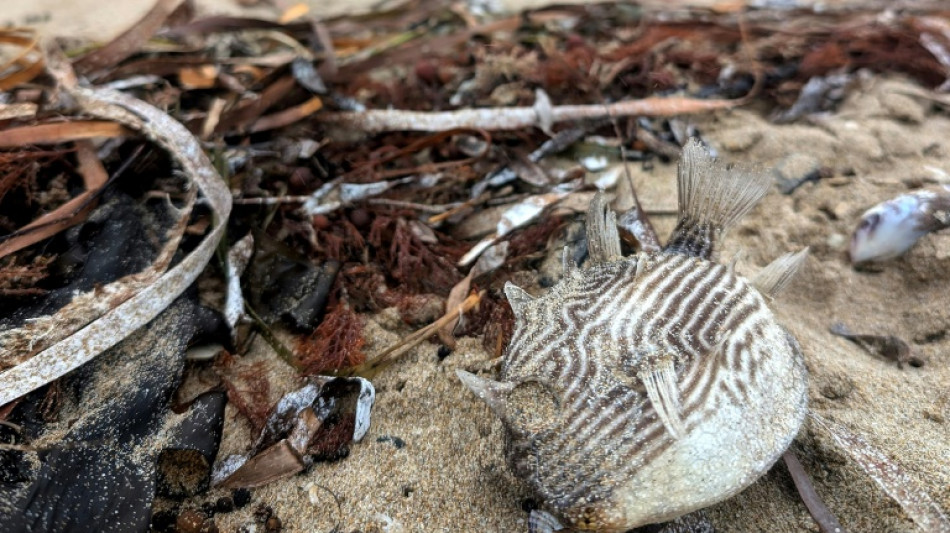
Toxic algae killing marine life off Australian coast / Photo: Brad MARTIN - OZFISH/AFP

 Greenland parliament approves security agreement with United States

 Qatar envoy meets incoming UN General Assembly president

 Trump Signals Willingness to Work With Democrats After Midterm Defeat

 Galloway accuser could not foresee publishing-sector fallout, lawyer argues

 New York City Center revives In the Heights as a timely community story

 Godzilla Minus Zero shifts focus toward postwar human drama
 Mehbooba Mufti urges dialogue and renewed Central Asia links for Kashmir

 Seacliff Healthcare Seeks Specialist GP in Thirroul

 US stocks fall before midterm Election Day as technology shares weaken

 BLS Polymers makes strong market debut at ₹248 per share

 Petrol and diesel prices remain broadly steady across major Indian cities

 Reliance shares remain in focus after near-12% surge

 2026 Arizona Midterms: Key Races, Ballot Measures, and Voter Deadlines

 Coal India prepares possible $1 billion Mahanadi Coalfields listing

A vast bloom of toxic algae is killing more than 200 species of marine life off the southern coast of Australia, scientists and conservation groups say.
The algae -- Karenia mikimotoi -- appeared in waters around South Australia state in March, causing mass deaths in species including sharks, rays, crabs and octopuses.
"There are carcasses littering beaches," said Brad Martin, a manager of the non-profit fish conservation group Ozfish.
"It is common for our volunteers to say: 'We walked for one kilometre along the beach and saw 100 dead rays and other marine life'," he told AFP.
Beaches on wildlife-rich tourist draws such as Kangaroo Island, Yorke Peninsula and Fleurieu Peninsula have been affected.
The bloom stretches across 4,400 square kilometres (1,700 square miles), Martin said -- an area larger than Japan or Germany.
Karenia mikimotoi has been detected around the world since the 1930s, including off Japan, Norway, the United States and China where it has disrupted local tourism and fishery industries, causing millions of dollars worth of damage.
But Martin said South Australia had not previously experienced a toxic algae bloom of this scale or duration.
The South Australian government said the event is thought to have been driven by a marine heatwave, as well as relatively calm marine conditions.
Marine biologist Shauna Murray, who identified the algae species for the authorities, said it damages the gills of fish and prevents them from breathing.
"It is not pleasant," said Murray, from the University of Technology Sydney.
"It will probably take some time for the ecosystem to recuperate."
While conditions usually ease towards the end of April, there had been no relief yet, South Australian Environment Minister Susan Close said this month.
"We need a big change in weather to break this thing up -- there is nothing we can do to precipitate this," she told national broadcaster ABC.
In the meantime, South Australian authorities have urged beachgoers to avoid swimming in water that is discoloured or foamy, warning that it can irritate the skin and affect breathing.
Climate change has led to an increase in the frequency and duration of marine heatwaves across Australia, which significantly affects marine ecosystems.
A.Silveira--PC



