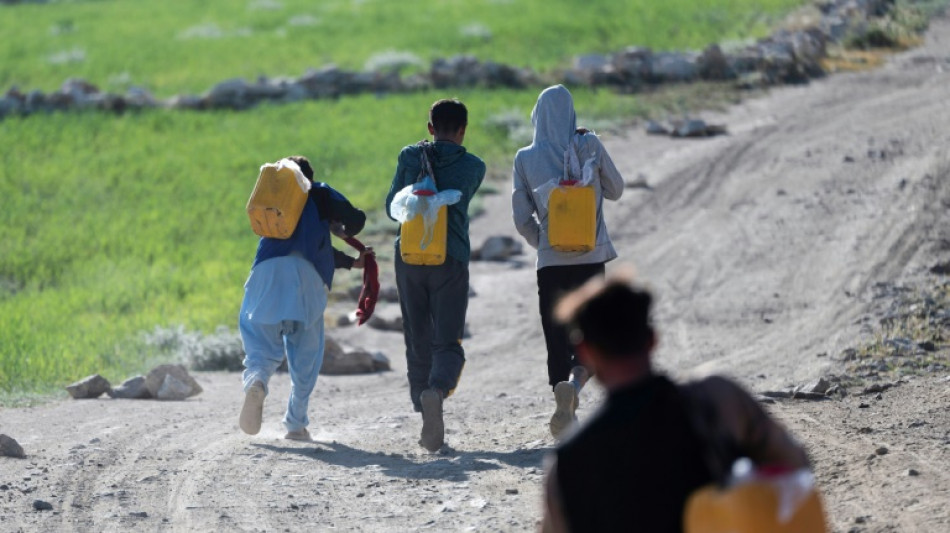
'Serious problem': Afghan capital losing race against water shortages / Photo: Wakil KOHSAR - AFP

 Ed Sheeran returns to stage after Palestinian controversy

 Asian Games to open in Japan after troubled build-up

 Drone owners rush to offload devices ahead of Beijing ban

 Trump's beef policies irk Texas ranchers, testing their loyalty

 Nvidia, OpenAI CEOs to attend Xi dinner at White House

 Anthropic picks Accenture for in-house AI safety evaluation

 Balogun returns as Monaco beat Lens to continue strong Ligue 1 start

 'Pause' on overt repression in Venezuela, but reforms still needed: HRW

 Global stocks mixed as yen falls despite Bank of Japan rate hike

 Cuba hit with seventh major blackout of the year

 Murray out with concussion so Wentz will start for Vikings

 UN chief 'deeply regrets' US visa refusal to Abbas for annual meeting

 England quick Carse to face no charges over alleged nightclub assault

 Mancini brings nine newcomers into the first squad of his Italy comeback

 Czechs level Davis Cup tie against USA as South Korea eye Finals

 New France boss Zidane confirms Mbappe as captain after naming first squad

 California governor signs order to explore AI 'kill switch'

 Head leads run spree as Australia win Zimbabwe ODI series

 In-form Raphinha wants to finish career at Barcelona

 Warren Buffett steps down as Berkshire Hathaway chairman

 Carrick confident Man Utd can 'work through' tough time

 Mbappe ends Nike partnership to join Swiss brand On

 Liverpool boss Iraola puts Bournemouth love affair on hold

 'A disaster' if Man City do not win says Maresca after flawless start

 Kerry James Marshall: American 'blackness' painter celebrated in Europe

Every week, Bibi Jan scrapes together some of her husband's meagre daily wage to buy precious water from rickshaw-drawn tankers that supply residents of Afghanistan's increasingly parched capital.
Kabul faces a looming water crisis, driven by unruly and rapid urbanisation, mismanagement over years of conflict, and climate change, meaning people like Bibi Jan are sometimes forced to choose between food and water.
"When my children have only tea for a few days, they say, 'You bought water and nothing for us'," the 45-year-old housewife told AFP, describing reusing her supplies for bathing, dishes and laundry.
Experts have long sounded the alarm over Kabul's water problems, which are worsening even as many international players have backed off big infrastructure projects and slashed funding to Afghanistan since the Taliban government took power in 2021.
"There could be no ground water in Kabul by 2030" without urgent action, the UN children's agency UNICEF warned last year.
Other experts are more cautious, citing limited consistent and reliable data, but say the situation is clearly deteriorating.
A 2030 cliff is a "worst-case scenario", said water resources management expert Assem Mayar.
But even if slated development projects are completed in a few years, it "doesn't mean the situation would become better than now", Mayar said.
"As time goes on, the problems are only increasing," he added, as population growth outstrips urban planning and climate change drives below-average precipitation.
- 'Decreasing day by day' -
The Taliban authorities have launched projects ranging from recycling water to building hundreds of small dams across the country, but larger interventions remain hampered by financing and technical capacity.
They remain unrecognised by any country since they ousted the Western-backed government and imposed their severe interpretation of Islamic law, with restrictions on women a major sticking point.
They have repeatedly called for non-governmental groups to reboot stalled projects on water and climate change, as Afghanistan faces "some of the harshest effects" in the region, according to the United Nations.
The water and energy ministry wants to divert water from the Panjshir river to the capital, but needs $300 million to $400 million. A dam project near Kabul would ease pressures but was delayed after the Taliban takeover.
For now, Kabul's primary drinking water source is groundwater, as much as 80 percent of which is contaminated, according to a May report by Mercy Corps.
It is tapped by more than 100,000 unregulated wells across the city that are regularly deepened or run dry, the NGO said.
Groundwater can be recharged, but more is drawn each year than is replenished in Kabul, with an estimated annual 76-million-cubic-metre (20-billion-gallon) deficit, experts say.
"It's a very serious problem... Water is decreasing day by day in the city," said Shafiullah Zahidi, who heads central Kabul operations for the state-owned water company UWASS.
Water systems designed decades ago serve just 20 percent of the city's population, which has exploded to around six million over the past 20 years, said Zahidi.
- 'Use less water' -
At one of Kabul's 15 pumping stations, maintenance manager Mohammad Ehsan said the seven-year-old well is already producing less water. Two others nearby sit dry.
"The places with shallower water levels are dried out now," said 53-year-old Ehsan, who has worked in water management for two decades, as he stood over an old well.
It once produced water from a depth of 70 metres (230 feet), but a newer well had to be bored more than twice as deep to reach groundwater.
At one of the two large stations in the city, the International Committee of the Red Cross (ICRC) recently procured four new pumps where only one had been functioning.
"If that pump collapsed for any reason, that means stopping the service for 25,000 beneficiary households," which now have uninterrupted water, said Baraa Afeh, ICRC's deputy water and habitat coordinator.
Everyone in Kabul "should have 24-hour service", said Zahidi, from the state water company.
But in reality, Bibi Jan and many other Kabulis are forced to lug water in heavy jugs from wells or buy it from tankers.
These suppliers charge at least twice as much as the state-owned utility, with potable water even more pricy in a country where 85 percent of the population lives on less than a dollar a day.
Bibi Jan said she has to police her family's water use carefully.
"I tell them, 'I'm not a miser but use less water.' Because if the water runs out then what would we do?"
F.Santana--PC



