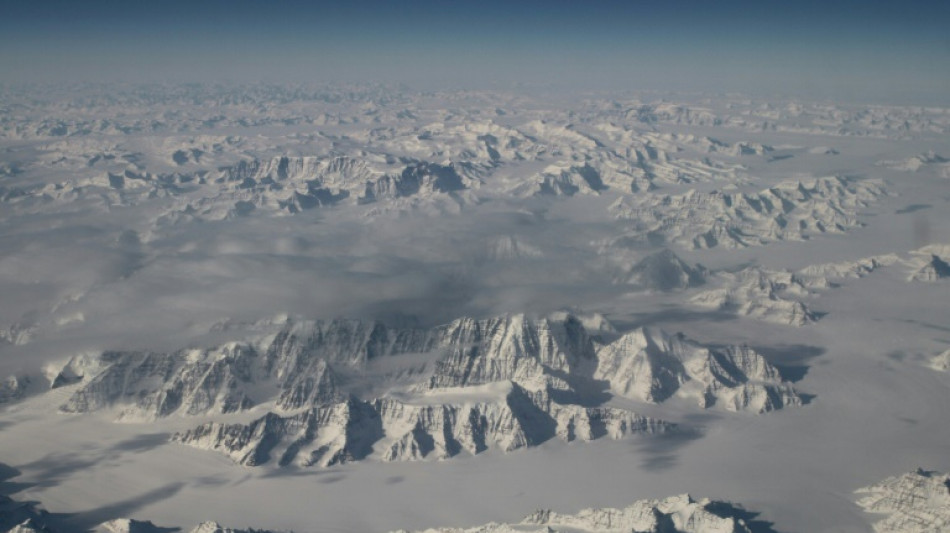
Dire sea level rise likely even in a 1.5C world: study / Photo: Handout - NASA/AFP

 Ed Sheeran returns to stage after Palestinian controversy

 Asian Games to open in Japan after troubled build-up

 Drone owners rush to offload devices ahead of Beijing ban

 Trump's beef policies irk Texas ranchers, testing their loyalty

 Nvidia, OpenAI CEOs to attend Xi dinner at White House

 Anthropic picks Accenture for in-house AI safety evaluation

 Balogun returns as Monaco beat Lens to continue strong Ligue 1 start

 'Pause' on overt repression in Venezuela, but reforms still needed: HRW

 Global stocks mixed as yen falls despite Bank of Japan rate hike

 Cuba hit with seventh major blackout of the year

 Murray out with concussion so Wentz will start for Vikings

 UN chief 'deeply regrets' US visa refusal to Abbas for annual meeting

 England quick Carse to face no charges over alleged nightclub assault

 Mancini brings nine newcomers into the first squad of his Italy comeback

 Czechs level Davis Cup tie against USA as South Korea eye Finals

 New France boss Zidane confirms Mbappe as captain after naming first squad

 California governor signs order to explore AI 'kill switch'

 Head leads run spree as Australia win Zimbabwe ODI series

 In-form Raphinha wants to finish career at Barcelona

 Warren Buffett steps down as Berkshire Hathaway chairman

 Carrick confident Man Utd can 'work through' tough time

 Mbappe ends Nike partnership to join Swiss brand On

 Liverpool boss Iraola puts Bournemouth love affair on hold

 'A disaster' if Man City do not win says Maresca after flawless start

 Kerry James Marshall: American 'blackness' painter celebrated in Europe

Rising seas will severely test humanity's resilience in the second half of the 21st century and beyond, even if nations defy the odds and cap global warming at the ambitious 1.5 degrees Celsius target, researchers said Tuesday.
The pace at which global oceans are rising has doubled in three decades, and on current trends will double again by 2100 to about one centimetre per year, they reported in a study.
"Limiting global warming to 1.5C would be a major achievement" and avoid many dire climate impacts, lead author Chris Stokes, a professor at Durham University in England, told AFP.
"But even if this target is met," he added, "sea level rise is likely to accelerate to rates that are very difficult to adapt to."
Absent protective measures such as sea walls, an additional 20 centimetres (7.8 inches) of sea level rise -- the width of a letter-size sheet of paper -- by 2050 would cause some $1 trillion in flood damage annually in the world's 136 largest coastal cities, earlier research has shown.
Some 230 million people live on land within one metre (3.2 feet) of sea level, and more than a billion reside within 10 metres.
Sea level rise is driven in roughly equal measure by the disintegration of ice sheets and mountain glaciers, as well as the expansion of warming oceans, which absorb more than 90 percent of the excess heat due to climate change.
Averaged across 20 years, Earth's surface temperature is currently 1.2C above pre-industrial levels, already enough to lift the ocean watermark by several metres over the coming centuries, Stokes and colleagues noted in the journal Communications Earth & Environment.
The world is on track to see temperatures rise 2.7C above that benchmark by the end of the century.
- Tipping points -
In a review of scientific literature since the last major climate assessment by the UN-mandated Intergovernmental Panel on Climate Change (IPCC), Stokes and his team focused on the growing contribution of ice sheets to rising seas.
In 2021, the IPCC projected "likely" sea level rise of 40 to 80 centimetres by 2100, depending on how how quickly humanity draws down greenhouse gas emissions, but left ice sheets out of their calculations due to uncertainty.
The picture has become alarmingly more clear since then.
"We are probably heading for the higher numbers within that range, possibly higher," said Stokes.
The scientist and his team looked at three baskets of evidence, starting with what has been observed and measured to date.
Satellite data has revealed that ice sheets with enough frozen water to lift oceans some 65 metres are far more sensitive to climate change than previously suspected.
The amount of ice melting or breaking off into the ocean from Greenland and West Antarctica, now averaging about 400 billion tonnes a year, has quadrupled over the last three decades, eclipsing runoff from mountain glaciers.
Estimates of how much global warming it would take to push dwindling ice sheets past a point of no return, known as tipping points, have also shifted.
"We used to think that Greenland wouldn't do anything until the world warmed 3C," said Stokes. "Now the consensus for tipping points for Greenland and West Antarctica is about 1.5C."
The 2015 Paris climate treaty calls for capping global warming at "well below" 2C, and 1.5C if possible.
The scientists also looked at fresh evidence from the three most recent periods in Earth's history with comparable temperatures and atmospheric levels of CO2, the main driver of global warming.
About 125,000 years ago during the previous "interglacial" between ice ages, sea levels were two to nine metres higher than today despite a slightly lower average global temperature and significantly less CO2 in the air -- 287 parts per million, compared to 424 ppm today.
A slightly warmer period 400,000 ago with CO2 concentrations at about 286 ppm saw oceans 6-to-13 metres higher.
And if we go back to the last moment in Earth's history with CO2 levels like today, some three million years ago, sea levels were 10-to-20 metres higher.
Finally, scientists reviewed recent projections of how ice sheets will behave in the future.
"If you want to slow sea level rise from ice sheets, you clearly have to cool back from present-day temperatures," Stokes told AFP.
"To slow sea level rise from ice sheets to a manageable level requires a long-term temperature goal that is close to +1C, or possibly lower."
L.Carrico--PC



