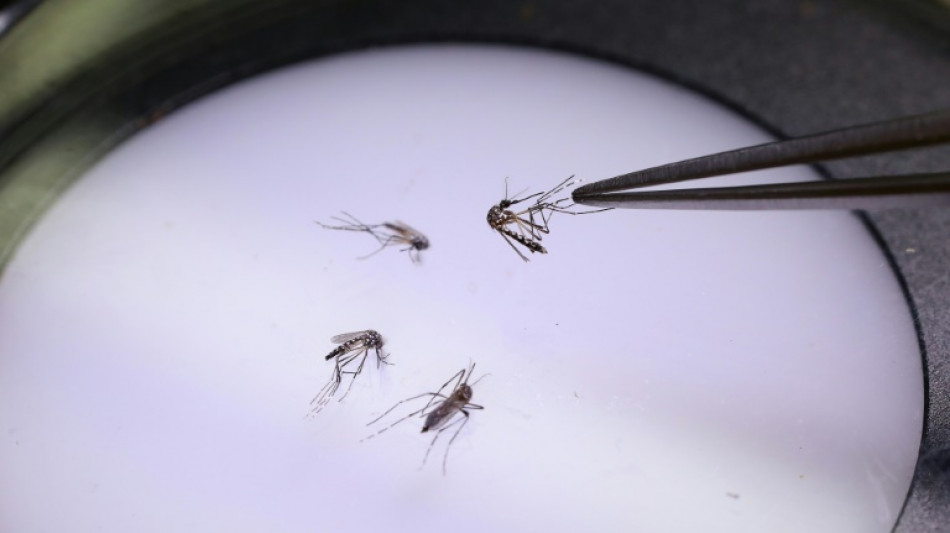
Invasive species cost trillions in damages: study / Photo: JAIME SALDARRIAGA - AFP/File

 Ed Sheeran returns to stage after Palestinian controversy

 Asian Games to open in Japan after troubled build-up

 Drone owners rush to offload devices ahead of Beijing ban

 Trump's beef policies irk Texas ranchers, testing their loyalty

 Nvidia, OpenAI CEOs to attend Xi dinner at White House

 Anthropic picks Accenture for in-house AI safety evaluation

 Balogun returns as Monaco beat Lens to continue strong Ligue 1 start

 'Pause' on overt repression in Venezuela, but reforms still needed: HRW

 Global stocks mixed as yen falls despite Bank of Japan rate hike

 Cuba hit with seventh major blackout of the year

 Murray out with concussion so Wentz will start for Vikings

 UN chief 'deeply regrets' US visa refusal to Abbas for annual meeting

 England quick Carse to face no charges over alleged nightclub assault

 Mancini brings nine newcomers into the first squad of his Italy comeback

 Czechs level Davis Cup tie against USA as South Korea eye Finals

 New France boss Zidane confirms Mbappe as captain after naming first squad

 California governor signs order to explore AI 'kill switch'

 Head leads run spree as Australia win Zimbabwe ODI series

 In-form Raphinha wants to finish career at Barcelona

 Warren Buffett steps down as Berkshire Hathaway chairman

 Carrick confident Man Utd can 'work through' tough time

 Mbappe ends Nike partnership to join Swiss brand On

 Liverpool boss Iraola puts Bournemouth love affair on hold

 'A disaster' if Man City do not win says Maresca after flawless start

 Kerry James Marshall: American 'blackness' painter celebrated in Europe

From river-clogging plants to disease-carrying insects, the direct economic cost of invasive species worldwide has averaged about $35 billion a year for decades, researchers said Monday.
Since 1960, damage from non-native plants and animals expanding into new territory has cost society more than $2.2 trillion, 17 times higher than previous estimates, they reported in the journal Nature Ecology & Evolution.
The accelerating spread of invasive species -- from mosquitoes to wild boar to tough-to-eradicate plants -- blights agriculture, spreads disease and drives the growing pace of species extinction.
Earlier calculations based on highly incomplete data were already known to fall far short of reality.
To piece together a more accurate picture, an international team of researchers led by Ismael Soto, a scientist at the University of South Bohemia in the Czech Republic, compiled data on 162 invasive species whose costs have been well documented in at least a handful of countries.
They then modelled the economic impact for 78 other countries such as Bangladesh and Costa Rica, for which no data was previously available.
"We expected an underestimation of invasion costs, but the magnitude was striking," Soto told AFP.
Due mainly to high volumes of trade and travel, tens of thousands of animal and plant species have taken root, sometimes literally, far from their places of origin.
Europe is by far the continent most affected by the phenomenon, followed by North America and Asia.
"Plants were the most economically damaging group, both for damage and management," Soto said. "Cost hotspots include urban coastal areas, notably in Europe, eastern China, and the US."
Animals can cause devastating damage too.
Wild boar, for example, destroy crops, cornfields and vineyards, while mosquitoes -- with expanding ranges due to global warming -- impose direct costs to human health by spreading diseases such as dengue and malaria.
Another example is Japanese knotweed, an invasive plant that is very common in Europe and requires costly eradication programmes.
"Our study is based on only 162 species," Soto noted. "Our figure is probably still an underestimate of a wider problem, and therefore the real economic costs could be even higher."
Using a broader definition -- including indirect costs such as lost income -- the UN's biodiversity expert group, IPBES, has calculated the total cost to society of invasive species at about $400 billion annually.
A.Seabra--PC



