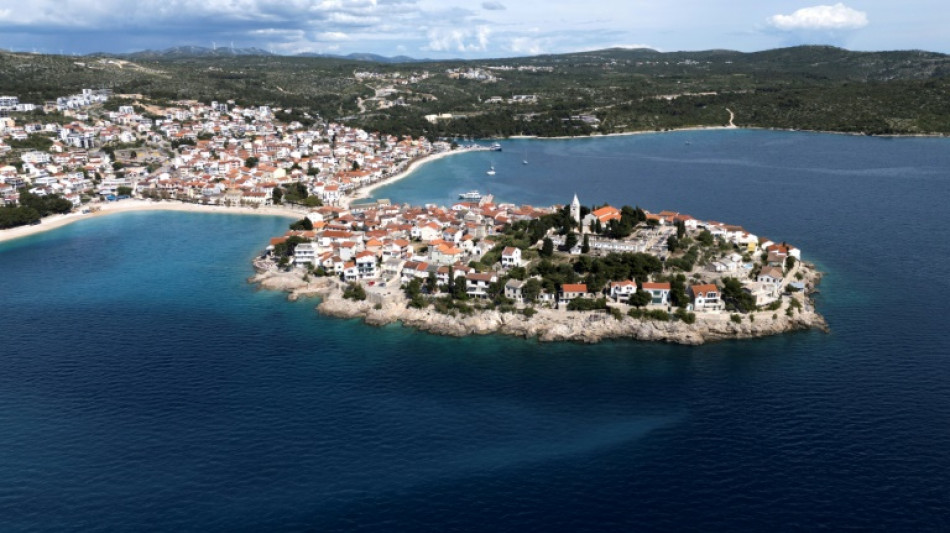
Booming tourism takes its toll on Croatia's coast / Photo: ELVIS BARUKCIC - AFP

 Ed Sheeran returns to stage after Palestinian controversy

 Asian Games to open in Japan after troubled build-up

 Drone owners rush to offload devices ahead of Beijing ban

 Trump's beef policies irk Texas ranchers, testing their loyalty

 Nvidia, OpenAI CEOs to attend Xi dinner at White House

 Anthropic picks Accenture for in-house AI safety evaluation

 Balogun returns as Monaco beat Lens to continue strong Ligue 1 start

 'Pause' on overt repression in Venezuela, but reforms still needed: HRW

 Global stocks mixed as yen falls despite Bank of Japan rate hike

 Cuba hit with seventh major blackout of the year

 Murray out with concussion so Wentz will start for Vikings

 UN chief 'deeply regrets' US visa refusal to Abbas for annual meeting

 England quick Carse to face no charges over alleged nightclub assault

 Mancini brings nine newcomers into the first squad of his Italy comeback

 Czechs level Davis Cup tie against USA as South Korea eye Finals

 New France boss Zidane confirms Mbappe as captain after naming first squad

 California governor signs order to explore AI 'kill switch'

 Head leads run spree as Australia win Zimbabwe ODI series

 In-form Raphinha wants to finish career at Barcelona

 Warren Buffett steps down as Berkshire Hathaway chairman

 Carrick confident Man Utd can 'work through' tough time

 Mbappe ends Nike partnership to join Swiss brand On

 Liverpool boss Iraola puts Bournemouth love affair on hold

 'A disaster' if Man City do not win says Maresca after flawless start

 Kerry James Marshall: American 'blackness' painter celebrated in Europe

With its rugged coastline, pristine waters and more than a thousand inlets and islands, Croatia has seen a tourist boom in recent years. Last year alone, more than 20 million visited the Balkan nation, much of which stretches along the Adriatic Sea.
But the environmental impact of tourism on the nearly 6,000-kilometre (3,720-mile) coastline and marine life is troubling experts -- and prompting calls for action.
Sakarun beach on Dugi Otok island is often called "Croatia's Caribbean". Tourist boats drop anchor in the turquoise waters of the bay and head for its white sands.
Some visitors complained, however, about unsightly swathes of Posidonia or dark Mediterranean seagrass on the shore, which led to its removal.
The heavy machinery involved also removed sediment, resulting in the gradual disappearance of the sandy beach over the last decade.
Croatia only has only a small number of sandy and pebble beaches, while the rest are rocky.
"We don't have many sandy beaches so it's important that the sand we have is protected," said geologist Kristina Pikelj, from Zagreb University Faculty of Science.
In 2021, she launched a project to monitor Sakarun, and to educate locals and tourists about the vital role played by the so-called "lungs of the sea".
Posidonia -- a key store of carbon and producer of oxygen -- is critical to slowing the effects of climate change, as well as being vital for marine habitats and providing an erosion buffer for the beaches.
For the past three years Posidonia, which was once used as a vineyard fertiliser, has been left on the beach, spread apart in piles.
"We understand the tourist aspect, to show them the sand, this bay is beautiful and people really enjoy it," said Pikelj.
Marija Meklav, one of three students participating in the fieldwork at Sakarun, added: "We are trying to raise public awareness and achieve something directly through field and laboratory work.
"Our generation can achieve something in this regard," the 24-year-old said.
- Artificial beaches -
With tourist numbers growing, local authorities have been expanding beach capacity for tourists in search of sun, sea and sand.
At some locations so-called beach nourishment -- adding sediment to repair natural erosion -- has been carried out.
But the technique has also been used to cover natural rocky parts with gravel or even concrete. During winter, the sea carries it away, meaning the costly process has to be repeated every season
Dalibor Carevic, from Zagreb University Faculty of Civil Engineering said in places like Primosten, often called "the town of beaches" on the central coast north of Split, the practice has gone too far.
Experts repeatedly warned against the removal of hundreds of metres of rocks along one of its central beaches.
The rocks were ground and mixed with quarry stones to make an artificial pebble beach that opened in 2011, with the process repeated every year.
In less than a decade the coastline at the Mala Raduca beach has shifted by some 20 metres towards the sea, satellite pictures show.
Primosten's veteran mayor Stipe Petrina, though, said beach nourishment was essential for a town dependent entirely on tourism.
"One cannot have a capacity for 15,000 people and beaches for 2,000," he told AFP comparing it with a ski resort that hosts thousands of skiers but only offers a few hundred metres of slopes.
When tourism started to take off in the 1960s, locals ground rocks to make access to the sea easier.
"Once there were vineyards here that could have remained but we would have all emigrated. The question is what is better," said Petrina.
"In another Primosten bay there are rocks but I cannot see many tourists there," Petrina said.
The town of 2,800 people hosted nearly 90,000 tourists last year, mostly between July and August.
In early May, German tourist Karin Hoggermann watched trucks bringing new gravel to prepare the beach for the season.
"For swimming and going in the sea, for kids, it's better that they repair the beach. Tourists would not come if they would not do that," she said.
- 'Conquest of the sea' -
Unlike in Italy, Spain, the Netherlands or France, which also use beach nourishment, few rivers flow into the Adriatic Sea off Croatia, making its ecosystem more vulnerable as it is less accustomed to additional sediment input.
Excessive construction even in protected marine areas, concreting, non-compliance with regulations and huge fleets of charter boats also take their toll.
The number of car parks, marinas, ports and roads are also growing.
One long-term solution is to raise awareness among locals and authorities as well as education, experts said, urging consultation for more sustainable solutions.
"That conquest of the sea is not good and should be discouraged," said Carevic.
P.Queiroz--PC



