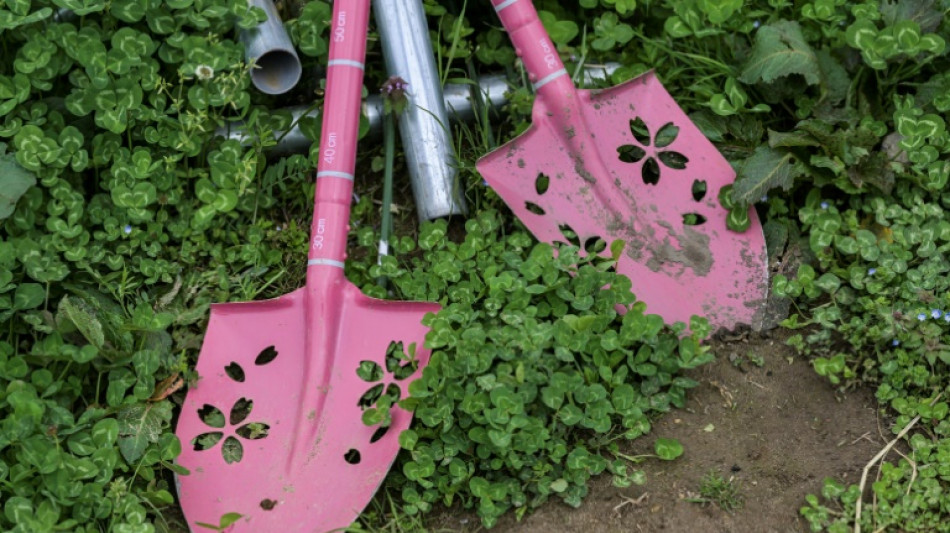
Recycling contaminated soil from Fukushima: Japan's dilemma / Photo: Richard A. Brooks - AFP

 Ed Sheeran returns to stage after Palestinian controversy

 Asian Games to open in Japan after troubled build-up

 Drone owners rush to offload devices ahead of Beijing ban

 Trump's beef policies irk Texas ranchers, testing their loyalty

 Nvidia, OpenAI CEOs to attend Xi dinner at White House

 Anthropic picks Accenture for in-house AI safety evaluation

 Balogun returns as Monaco beat Lens to continue strong Ligue 1 start

 'Pause' on overt repression in Venezuela, but reforms still needed: HRW

 Global stocks mixed as yen falls despite Bank of Japan rate hike

 Cuba hit with seventh major blackout of the year

 Murray out with concussion so Wentz will start for Vikings

 UN chief 'deeply regrets' US visa refusal to Abbas for annual meeting

 England quick Carse to face no charges over alleged nightclub assault

 Mancini brings nine newcomers into the first squad of his Italy comeback

 Czechs level Davis Cup tie against USA as South Korea eye Finals

 New France boss Zidane confirms Mbappe as captain after naming first squad

 California governor signs order to explore AI 'kill switch'

 Head leads run spree as Australia win Zimbabwe ODI series

 In-form Raphinha wants to finish career at Barcelona

 Warren Buffett steps down as Berkshire Hathaway chairman

 Carrick confident Man Utd can 'work through' tough time

 Mbappe ends Nike partnership to join Swiss brand On

 Liverpool boss Iraola puts Bournemouth love affair on hold

 'A disaster' if Man City do not win says Maresca after flawless start

 Kerry James Marshall: American 'blackness' painter celebrated in Europe

To reduce radiation across Japan's northern Fukushima region after the 2011 nuclear disaster, authorities scraped a layer of contaminated soil from swathes of land.
Now, as young farmers seek to bring life back to the region once known for its delicious fruit, authorities are deliberating what to do with the mass of removed soil -- enough to fill more than 10 baseball stadiums.
Here are some key things to know:
- Why was the soil removed? -
On March 11, 2011, Japan's strongest earthquake on record triggered a huge tsunami that hit the Fukushima Daiichi nuclear plant, causing a devastating meltdown.
Topsoil was collected as part of large-scale decontamination efforts that also included blasting buildings and roads with high-pressure jets of water.
Almost all areas of Fukushima have gradually been declared safe, but many evacuees have been reluctant to return because they remain worried about radiation, or have fully resettled elsewhere.
Fukushima has, however, welcomed new residents such as 25-year-old kiwi farmer Takuya Haraguchi.
"I want people to become interested in and learn about what Fukushima is really like these days," he told AFP.
- Where is the soil being stored? -
A vast quantity of soil -- 14 million cubic metres -- is being stored at interim storage facilities near the Fukushima Daiichi plant.
The government has promised residents of Fukushima region that it will find permanent storage for the soil elsewhere in the country by 2045.
For now, the huge mounds are kept inside guarded grounds, protected by layers of clean soil and a manmade sheet to prevent runoff into the environment.
- What will Japan do with it? -
The government wants to use the soil for building road and railway embankments among other projects.
It has vowed to do this outside Fukushima to avoid further burdening the region, where the crippled nuclear plant generated electricity not for local residents, but for Tokyo and its surrounding urban areas.
So far few takers have been found in other parts of Japan, and some local officials suggest that realistically, a portion of the soil may need to stay in Fukushima.
The prime minister's office recently said it would symbolically recycle some of the soil to show it is safe, with reports saying it will be used in flower beds.
- How safe is the soil? -
Around 75 percent of the stored soil has a radioactivity level equivalent to or less than one X-ray per year for people who directly stand on or work with it, according to the environment ministry.
Asphalt, farm soil or layers of other materials should be used to seal in the radioactivity, said Akira Asakawa, a ministry official working on the Fukushima soil project.
In a test, the government has constructed roads and fields in Fukushima by using the contaminated soil as filling material.
Those locations did not show elevated levels of radioactivity, and there was no runoff of radioactive material to surrounding areas, Asakawa said.
- What pushback has there been? -
In 2022, local communities reacted angrily to plans floated by the national government to bring the Fukushima soil to a popular park in Tokyo and other areas near the capital.
That plan has not moved forward and other locations have not yet been secured, despite public sympathy for the people of Fukushima.
The environment ministry says it will step up efforts to explain the safety of its plan to the public from this year.
E.Paulino--PC



