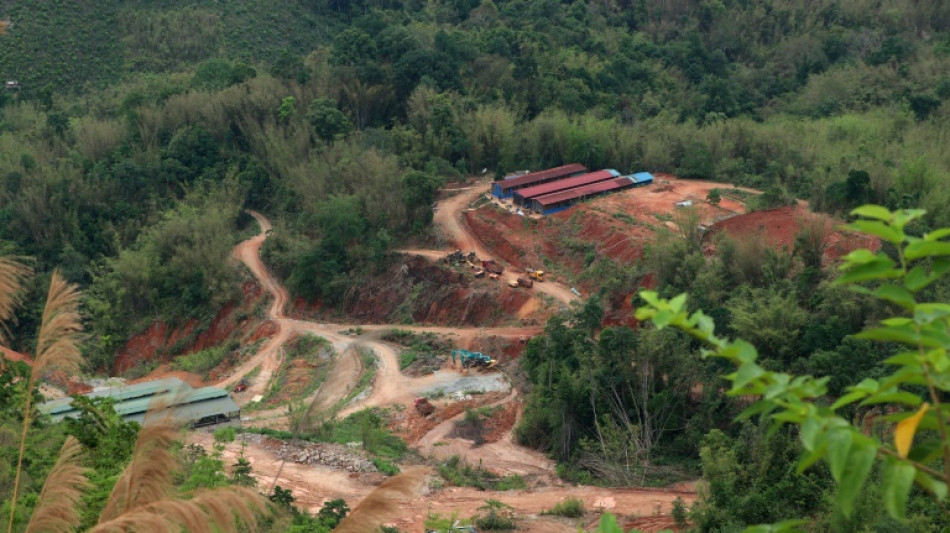
China lead mine plan weighs heavily on Myanmar tribe / Photo: STR - AFP

 Ed Sheeran returns to stage after Palestinian controversy

 Asian Games to open in Japan after troubled build-up

 Drone owners rush to offload devices ahead of Beijing ban

 Trump's beef policies irk Texas ranchers, testing their loyalty

 Nvidia, OpenAI CEOs to attend Xi dinner at White House

 Anthropic picks Accenture for in-house AI safety evaluation

 Balogun returns as Monaco beat Lens to continue strong Ligue 1 start

 'Pause' on overt repression in Venezuela, but reforms still needed: HRW

 Global stocks mixed as yen falls despite Bank of Japan rate hike

 Cuba hit with seventh major blackout of the year

 Murray out with concussion so Wentz will start for Vikings

 UN chief 'deeply regrets' US visa refusal to Abbas for annual meeting

 England quick Carse to face no charges over alleged nightclub assault

 Mancini brings nine newcomers into the first squad of his Italy comeback

 Czechs level Davis Cup tie against USA as South Korea eye Finals

 New France boss Zidane confirms Mbappe as captain after naming first squad

 California governor signs order to explore AI 'kill switch'

 Head leads run spree as Australia win Zimbabwe ODI series

 In-form Raphinha wants to finish career at Barcelona

 Warren Buffett steps down as Berkshire Hathaway chairman

 Carrick confident Man Utd can 'work through' tough time

 Mbappe ends Nike partnership to join Swiss brand On

 Liverpool boss Iraola puts Bournemouth love affair on hold

 'A disaster' if Man City do not win says Maresca after flawless start

 Kerry James Marshall: American 'blackness' painter celebrated in Europe

Hundreds of protesting Myanmar tribespeople march up a hillside to a cavernous facility where a Chinese joint venture's giant milling machines stand ready to grind up the rocks of their ancestral homeland for lead ore.
Demand for the heavy metal is forecast to rise, driven by its use in the batteries needed for the global energy transition.
But its extraction can pollute the environment and the Pradawng tribespeople carry banners reading: "No transparency, no responsibility".
"We don't have any plan to exchange this inheritance from our ancestors for money or riches," said 24-year-old protest leader Khun Khine Min Naing.
"This land is the dignity of our tribe."
Since a 2021 coup, Myanmar has been riven by civil war and shattered into a patchwork of loosely governed territories ripe for exploitation by unregulated miners.
And neighbouring China is keen to scoop up the minerals and metals Myanmar can supply.
The Pradawng -- a little-known subtribe of the Kayan ethnic group -- claim around 3,000 members and a 381-year lineage in Shan state, in Myanmar's east.
They say Myanmar firm Four Star Company and a Chinese partner have planned a mega-project mining lead upriver from their village, Thi Kyeik, in Pekon township.
Heavy machinery began to be installed in February, but the tribe say they were not consulted on the scheme and fear it will taint the area with hazardous chemicals.
Locals have blockaded roads to turn back vehicles, and threatened to seize mining equipment, defying possible violent backlash in a country where the right to assemble often depends on the whims of armed guards.
"We are only asking for Indigenous rights that we should own," Khun Khine Min Naing told AFP, demanding mine plans are rolled back until the war is over and they can be scrutinised by a civilian government.
- Natural resources -
Lead is a toxic metal, most commonly mined for use in lead-acid batteries.
Extracting it can pollute local soil and water supplies, with children particularly vulnerable to exposure, according to the World Health Organization (WHO).
"We don't want to leave this land environmentally damaged for the next generation," said Khun Khine Min Naing. "We don't want to be regarded as historical criminals."
The Pradawng say Four Star Company has been active locally for two decades and is linked to the local ruling Kayan New Land Party, whose armed wing maintains a ceasefire with Myanmar's military.
The firm could not be reached for comment.
Their Chinese partner company is harder to identify, and locals say its involvement was only revealed when its representatives attended a joint event with Four Star Company intended to address community backlash.
China shares a 2,100-kilometre (1,300-mile) border with Myanmar and has long been a lucrative market for the country's natural resources, including jade, gemstones, teak logs and metal ores.
It accounts for nearly 98 percent of Myanmar's lead ore and concentrate exports, according to 2023 World Bank data.
The figures say 49,000 tonnes worth $20 million were exported to China that year, but that is likely far short of the true amount.
The lack of a central authority means tracking the real scale of mining operations across Myanmar is difficult.
But satellite imagery analysis of one hotspot on the Myanmar-China border by the Britain-based Centre for Information Resilience showed the expanse of mining operations there nearly doubled in size between 2018 and 2024.
- 'Only stones for our children' -
Rechargeable lead-acid batteries are widely used in vehicles, including EVs where they provide auxiliary power, as well as for storing power generated by renewable technologies such as wind and solar.
The metal -- identified by the WHO as "one of 10 chemicals of major public health concern" -- sells for around $2,000 per refined tonne on the global market.
But the Pradawng people suspect they will see none of the profits.
Along with health risks, locals fear environmental damage, with villagers saying increased mining in recent years has led to more flooding and mudslides that carried off entire homes.
Mu Ju July, 19, ekes out a living picking through mine slag heaps for scraps of lead to sell.
A flurry of prospecting could be a windfall for her, but she worries it will squander the livelihoods and homes of future generations.
"If we allow them, we will be okay for only one or two years," she said.
"It will leave only stones when the time comes for our children."
F.Cardoso--PC



