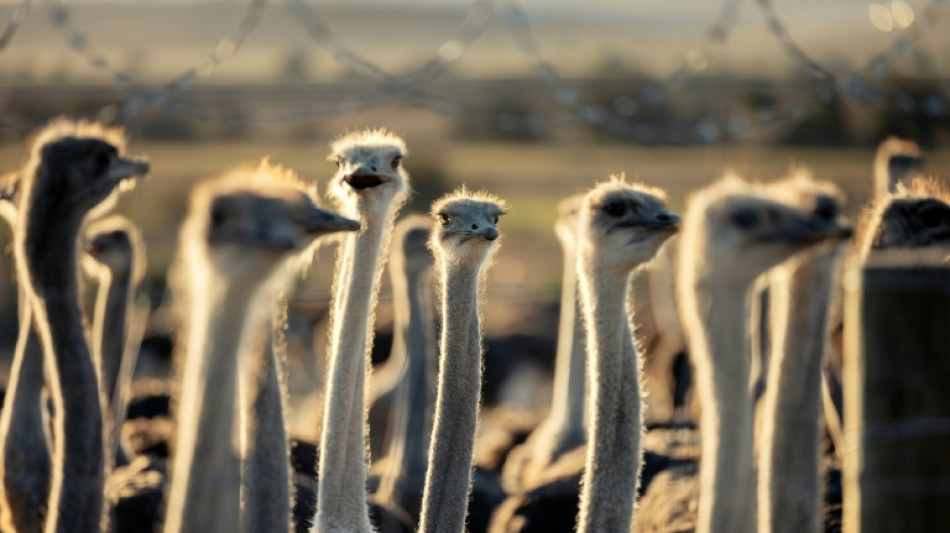
South African ostriches plucked alive for luxury fashion: report / Photo: GIANLUIGI GUERCIA - AFP/File

 South Africa arrests three more suspects, after nine women murdered

 Carse needs time away from England, says captain Brook

 NOWPayments Releases Cross-Chain Payout Data Revealing Key Performance Benchmarks Across TRON, BNB Chain, and Solana

 British Museum bans photos of Bayeux Tapestry as crowds linger

 COP31 host says AI climate footprint to be a summit priority

 Berlin's far-left vote winners reject anti-semitism charges

 Mancini eager for 'new adventure' on Italy return

 Mbappe says having Zidane as France coach 'like a film'

 Palmer, Rice out of England Nations League squad

 German auto workers stage mass protests in bid to save jobs

 Embattled Merz vows to keep ruling for 'democratic future' of Germany

 Merz vows to keep ruling coalition together for 'democratic future' of Germany

 Spain coach De la Fuente gets new deal after World Cup success

 Pressure grows on Germany's Merz after election defeats

 China's Zhang beats Japan rivals to Asian Games gymnastics gold

 Samlingen Haupt: Vad pengar avslöjar om oss människor

 Tens of thousands of German auto workers protest to save jobs

 हॉप्त् कलेक्शन: पैसा हमारे बारे में एक इंसान के रूप में क्या प्रकट करता है

 Συλλογή Haupt: Τι αποκαλύπτει το χρήμα για εμάς τους ανθρώπους

 TradersYard Shifts Focus to Futures Trading

 ハウプト・コレクション:お金が人間について明かすこと

 하우프트 컬렉션: 돈이 우리 인간에 대해 드러내는 것

 Indonesia doing 'everything' but struggling to curb fires

 Sbírka Haupt: Co o nás lidech prozrazují peníze

 North and South Korea fight out draw in niggly Asian Games clash

South African ostrich farms are using mechanical pluckers to remove feathers from living birds destined for major luxury fashion brands in techniques that are cruel and painful, animal welfare group World Animal Protection said on Monday.
The organisation said a new investigation, conducted with Collective Fashion Justice, documented ostriches being cornered by workers who put bags over their heads and then cut and pulled out their feathers without administering pain relief.
The footage forms part of a report entitled "Blood Feathers", examining conditions on commercial ostrich farms and at feather-processing facilities in South Africa.
South Africa accounts for about 75 percent of the global ostrich market. The industry produces meat, leather and feathers.
The investigation said farms and feather-processing facilities in South Africa supplied feathers to luxury brands including YSL, Louis Vuitton, Dior and Chanel, as well as to fast-fashion giant Shein.
Some farms cut feathers above the bloodline -- which means they are still growing and supplied with blood -- before pulling them from the animals' skin with pliers, a process that was repeated on some birds every six months, the charity said.
Blood is often found in the shaft of these feathers which led to the term "blood feathers".
"While this may seem like an alternative to live plucking, this investigation uncovered evidence showing that the process is extremely distressing for the ostriches involved," it said.
The investigation also reported seeing injured birds, including ostriches, that appeared unable to stand and others with wounds from pecking at each other's eyes and feathers.
- Suffering -
"Feathers are the new fur –- it's the same cruelty just with a different animal," Olivia Charlton, campaign manager at World Animal Protection, said in a statement.
"There's nothing natural about pulling out a bird's feathers with pliers. It's time fashion took its head out of the sand."
Emma Hakansson, founding director of Collective Fashion Justice, said it was "utterly inconsistent" for fashion brands to reject fur while embracing ostrich feathers "which also come from a slaughtering industry full of suffering".
"With so many innovative fabric manipulation techniques and bio-materials available to create the same lightness, volume and movement consumers admire in feathers, there is no justification for this cruelty," she said.
World Animal Protection said the findings challenge claims that ostrich feathers used in fashion are simply collected during the birds' natural moult.
It said more than 150 tonnes of ostrich feathers were exported from South Africa during the 2024-25 season, while about 150,000 ostriches were slaughtered for the feather, meat and skin trades, citing data obtained from the South African government.
South Africa has a long history with the feather trade.
In the early 1900s, ostrich feathers were South Africa's fourth-largest export after gold, diamonds and wool, with the fashion industry's appetite for plumes helped to drive an early-20th-century boom.
T.Resende--PC