'Nobody else knew': Allied prisoners of war held in Taiwan / Photo: I-Hwa Cheng - AFP

 Huge crowds cheer Pope Leo along Champs-Elysees ahead of Paris mass
 Putellas wants to bring 'winning culture and mentality' to London City

 Rare Italian opera returns to Moscow after nearly 120-year hiatus

 Pope to celebrate giant Paris mass after 'peace' appeal
 Homes flooded, roads submerged: Bangkok declares disaster over heavy rains

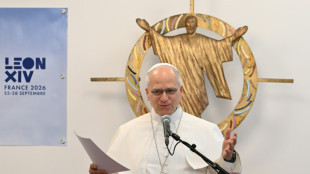 Ahead of Paris mass, pope urges life together in 'dignity and peace'
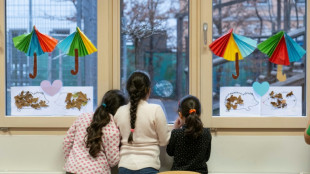 Austria 'ghetto' language classes leave children to repeat school
 S.African women runners arm themselves after string of killings
 'I felt embarrassed': Japan eSports whizz-kid, 11, wins Games gold
 Indonesia fires threatens critically-endangered orangutan: IUCN

 Bangkok declares flood disaster across city
 'World records not enough': North Korea weightlifters target Olympic gold rush

 Iran proposes Hormuz plan, Trump reportedly refuses
 El Nino rewrites the menu in the world's top restaurants
 Pope to hold giant mass on Champs-Elysees

 TikTok to pay Alabama $100 mn under pre-trial settlement

 Internationals take 7-3 Presidents Cup lead after foursomes sweep
 Brazil team returns to Colombian site of doomed jet crash

 Mbappe injured as Zidane wins on France debut, Italy lose on Mancini return

 Senegal draw in Vieira debut, Nigeria survive scare as Cape Verde crash
 U2 performs surprise 50th anniversary gigs in Dublin

 Pope calls worshippers 'saints of France' after AI warning

 US court sides with Pentagon in Anthropic AI ban

 Wall Street stocks rise, greeting optimism over possible US-Iran deal
 NFL players chief raises concerns over pitch for Maracana game

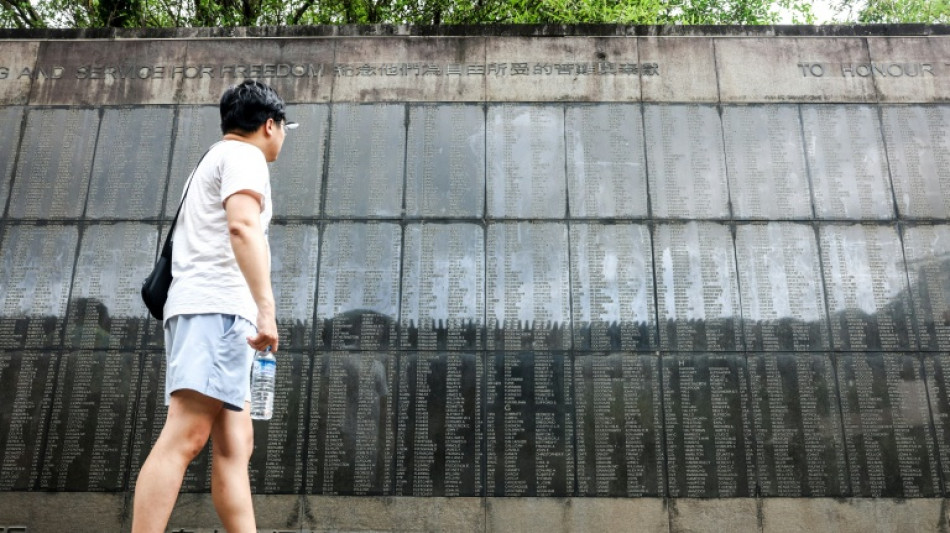
In a small urban park in Taiwan, more than 4,000 names are etched into a granite wall -- most of them British and American servicemen held by the Japanese during World War II.
The sombre memorial sits on the site of Kinkaseki, a brutal prisoner of war camp near Taipei and one of more than a dozen run by Japan on the island it ruled from 1895 until its defeat in 1945.
For decades, little was known of the PoW camps, said Michael Hurst, a Canadian amateur military historian in Taipei, who has spent years researching them.
Many survivors had refused to talk about their experiences, while PoWs held elsewhere in Asia had been unaware of "the horrors" in Taiwan, and museums and academics had glossed over them, Hurst told AFP.
After learning of Kinkaseki in 1996, Hurst spearheaded efforts to locate other camps in Taiwan, build memorials for the veterans, and raise public awareness about their bravery and suffering.
Starting in 1942, more than 4,300 Allied servicemen captured on battlefields across Southeast Asia were sent to Taiwan in Japanese "hell ships".
Most of the PoWs were British or American, but Australian, Dutch, Canadian and some New Zealand servicemen were also among them.
By the time the war ended, 430 men had died from malnutrition, disease, overwork and torture.
The harsh conditions of Taiwan's camps were long overshadowed by Japan's notorious "Death Railway" between Myanmar and Thailand, Hurst said.
More than 60,000 Allied PoWs worked as slave labourers on the line, with about 13,000 dying during construction, along with up to 100,000 civilians, mostly forced labour from the region.
Their experiences were later captured in the 1950s war movie "The Bridge on the River Kwai".
But as stories of Kinkaseki slowly emerged, it became "known as one of the worst PoW camps in all of Asia", Hurst said.
- 'Starving and overworked' -
Canadian filmmaker Anne Wheeler's physician father was among the more than 1,100 prisoners of war held in Kinkaseki.
Wheeler said she and her three older brothers "grew up knowing nothing" about their father's ordeal in the camp, where the men were forced to toil in a copper mine.
After her father's death in 1963, Wheeler discovered his diaries recording his experience as a doctor during the war, including Taiwan, and turned them into a documentary.
"A War Story" recounts Ben Wheeler's harrowing journey from Japan-occupied Singapore to Taiwan in 1942.
By the time her father arrived in Kinkaseki, Wheeler said the men there "were already starving and being overworked and were having a lot of mining injuries".
They were also falling ill with "beriberi, malaria, dysentery, and the death count was going up quickly," Wheeler, 78, told AFP in a Zoom interview.
Trained in tropical medicine, the doctor had to be "inventive" with the rudimentary resources at hand to treat his fellow PoWs, who affectionately called him "the man sent from God", she said.
Inflamed appendices and tonsils, for example, had to be removed without anesthesia using a razor blade because "that was all he had", she said.
- 'They kept it to themselves' -
Taiwan was a key staging ground for Japan's operations during the war. Many Taiwanese fought for Japan, while people on the island endured deadly US aerial bombings and food shortages.
Eighty years after Japan's surrender, the former PoWs held in Taiwan are all dead and little physical evidence remains of the camps.
At 77, Hurst is still trying to keep their stories alive through the Taiwan POW Camps Memorial Society and private tours.
His book "Never Forgotten" is based on interviews with more than 500 veterans, diaries kept by PoWs and correspondence.
A gate post and section of wall are all that remain of Kinkaseki, set in a residential neighbourhood of Jinguashi town, surrounded by lush, rolling hills.
On the day AFP visited, a Taiwanese woman taking a tour with Hurst said she had "never" studied this part of World War II history at school.
"It's very important because it's one of Taiwan's stories," the 40-year-old said.
Hurst said he still receives several emails a week from families of PoWs wanting to know what happened to their loved ones in Taiwan.
"For all these years, maybe 50 years, they just kept it to themselves," Hurst said.
"They knew what they'd suffered, and they knew that nobody else knew."
A.P.Maia--PC