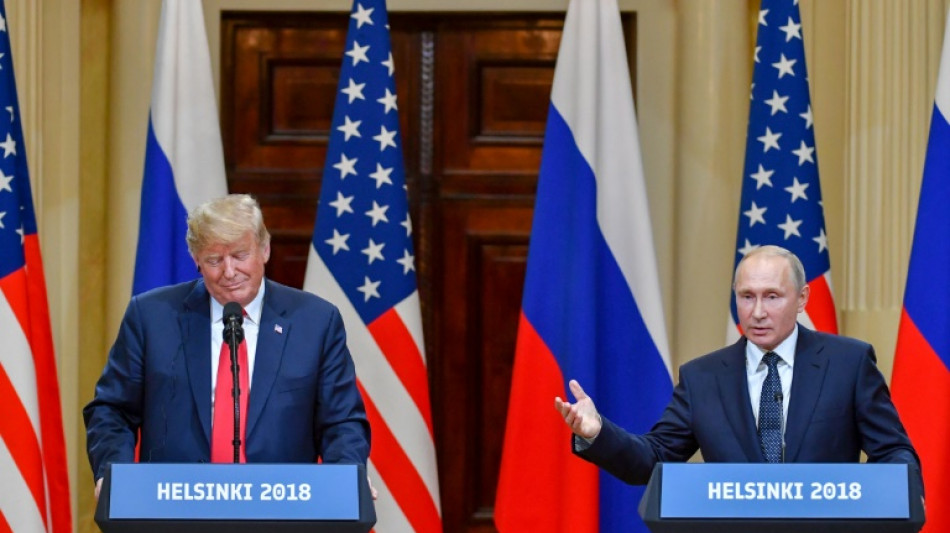
For Trump, Putin summit presents the ultimate test of dealmaking / Photo: Yuri KADOBNOV - AFP/File

 Geri Halliwell-Horner Embraces Queen Camilla at Commonwealth Writing Competition
 Meta Quest 3 and 3S Gain Access to Over 150 3D Movies

 Sarah Bajada Shares Message on Pregnancy Loss

 ALIX LASERS shareholders remove Michael Sobitsch as managing director in view of the circumstances

 Euroseas Q3 Net Profit Falls to $91.4 Million Amid Fleet Reduction

 Daily Horoscope November 20, 2026: Astrological Predictions for All Signs

 Tosca's 2026 Sustainability Report Makes the Case for Packaging as Critical Supply Chain Infrastructure

Among the constants in Donald Trump's turbulent career have been a flair for drama and a belief in his dealmaking powers. In inviting Vladimir Putin, Trump will have plenty of the first -- and put the second to the ultimate test.
Trump will speak to his Russian counterpart about the Ukraine war on Friday in Alaska, the two presidents' first standalone summit since a 2018 meeting in Helsinki where Trump's cowed appearance haunted him long afterward.
US officials said that Putin himself suggested the meeting. Trump agreed to invite him despite publicly saying how frustrated he has been with Putin's refusal to accept any proposal to halt the war.
Trump's invitation to Putin, who is under indictment by the International Criminal Court, effectively ends the West's shunning of the Russian president since the February 2022 invasion of Ukraine, whose leader Volodymyr Zelensky has called the Alaska trip a "personal victory" for Putin.
Trump and his aides have quickly tried to play down the significance.
Secretary of State Marco Rubio said in a radio interview that a meeting "is not a concession" and that Trump wants to "look at this guy across the table" and see if he is serious.
Trump, voicing uncharacteristic humility about his diplomacy, said it was a "feel-out meeting" that would not in itself lead to a deal on Ukraine.
He said he would speak immediately after the summit with Zelensky and other European leaders, who have all insisted that Ukraine not be excluded from talks on its fate.
"European leaders, in the past, had the experience that whoever talks to Donald Trump last makes the most important impressions," said Liana Fix, a fellow at the Council on Foreign Relations.
There is "a very strong urge in Donald Trump to be the one who brings peace to Ukraine -- even for a fleeting moment of time, to have the picture of him agreeing with Vladimir Putin to a ceasefire," she said.
- Latest swing in strategy -
Trump had vowed to end the war, which has killed tens of thousands, within 24 hours of returning to the White House. But he has found the path difficult -- and his tactics have swung drastically.
Trump berated Zelensky during a heated on-camera meeting at the White House where Vice President JD Vance accused Ukraine of ingratitude for US support, which Trump briefly shut down.
Ukraine quickly realized it had to stomach Trump's approach and signed on to his ceasefire bid.
When Putin did not, Trump threatened sanctions on Russia, only to agree to meet Putin.
"The mere fact of holding such a summit will be a victory for Putin," Russian political analyst Konstantin Kalachev said.
"Putin has not offered Trump anything significant, and Trump is already inviting him to Alaska," he added, also calling the lack of new US sanctions by Trump an "unconditional victory" for Russia.
Trump has rejected criticism that he is soft, noting that he ramped up tariffs on India, a key buyer of Russian oil.
But Trump has also pushed for concessions from Zelensky, who has refused to surrender any land that Russia seized by force.
George Beebe, the former director of Russia analysis at the CIA who is now director of grand strategy at the Quincy Institute, which supports military restraint, said that Trump could begin to work out the outlines of a deal to end the war.
Russia could begrudgingly accept eventual European Union membership for Ukraine if it in turn, stays out of NATO, the transatlantic military alliance, Beebe said.
"As long as that relationship is limited to political and economic ties rather than military commitments, I think that's something that they can live with," Beebe said of Russia.
But he said that such a short-notice summit at the presidential level raised expectations that may not be met.
"Trump is tackling an issue that is fraught with political danger, and there's absolutely no guarantee that this is going to be a success," Beebe said.
F.Moura--PC