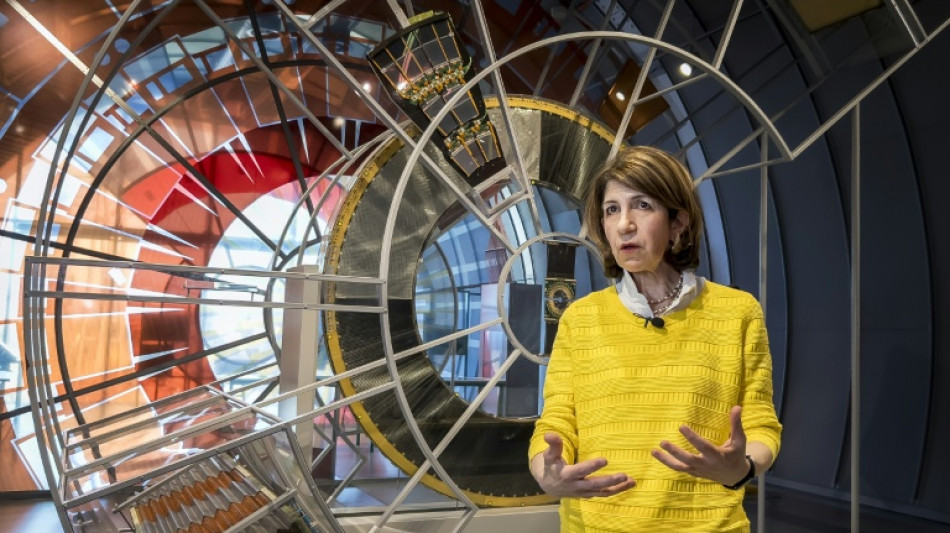
CERN upbeat as China halts particle accelerator mega-project / Photo: Elodie LE MAOU - AFP/File

 Iran airlines cancel flights as US sanctions hit

 Meta launches camera-free AI glasses amid privacy pushback

 Australian PM says OpenAI hacked government health website

 Xi arrives in US to personal Trump welcome

 Morocco elects new parliament amid social frustration, youth discontent

 Scheffler and Burns to face Im and Lee in Presidents Cup opener

 Crushing wins for Lyon and Barca in women's Champions League

 Rio breaks record for rainiest September amid powerful El Nino

 At UN, tech chiefs urge caution in AI development

 Russian strikes kill seven in Ukraine, Zelensky vows winter campaign

 Venezuelan shot by ICE needs urgent medical care, mother tells AFP

 Zelensky says Putin using fighters from 47 countries in Ukraine war

 Klopp calls on Germany to 'rise above ourselves' as new era begins

 Russian strikes kill seven in Ukraine as Russia vows no 'pause' to war

 ArcPoint Expands Globally with Institutional Intelligence Platform for Modern Investors

 Ronaldo focussing on 'present' ahead of Wales test

 Outgoing UN chief makes final climate push at New York summit

 Grief and pain flow at hearing for Canadian suicide poison vendor

 Ireland boss Hallgrimsson says timing of Israel remarks 'not clever'

 Weinstein resentenced to 15 years in prison for 2006 sex assault

 Fendi brings disco bling, Italian style, to Milan Fashion Week

 French court confirms rape trial for PSG and Morocco star Hakimi

 President tells Trump that Iran will never 'bend at the knee'

 أليكس بودي والبروفيسور الدكتور شتيفان هاوبت يتفقان على التعاون من أجل مجموعة فنية أسطورية في رومانيا

 U2 at 50: Irish rockers reveal anniversary album

The chief of the CERN physics laboratory says China's decision to pause its major particle accelerator project presents an "opportunity" to ensure Europe's rival plan goes ahead.
Ten years ago, China announced its intention to build the Circular Electron Positron Collider (CEPC), which at 100 kilometres (62 miles) long would be the world's largest particle accelerator.
But Beijing recently put the project on ice, CERN's director-general Fabiola Gianotti told a small group of journalists at a recent briefing.
China's CEPC would be way bigger than CERN's Large Hadron Collider (LHC) -- currently the world's largest, whizzing particles into each other at phenomenal speeds.
The 27-kilometre proton-smashing ring running about 100 metres (330 feet) below the border between France and Switzerland, has, among other things, been used to prove the existence of the Higgs boson.
Dubbed the God particle, its discovery in 2012 broadened science's understanding of how particles acquire mass.
CERN, the European Organization for Nuclear Research whose main offices also straddle the border near Geneva, seeks to unravel what the universe is made of and how it works.
The LHC is expected to have fully run its course by around 2040, and CERN is considering building a far larger collider to allow scientists to keep pushing the boundaries of knowledge.
- Search for dark matter -
The planned Future Circular Collider (FCC) would be a ring with a circumference of 91 km and an average depth of 200 metres.
Scientists believe that ordinary matter -- such as stars, gases, dust, planets and everything on them -- accounts for just five percent of the universe.
The FCC will try to reveal what makes up the other 95 percent of the energy and matter in the universe -- so-called dark matter and dark energy, which scientists have yet to observe directly.
The gigantic project, costing around $17 billion, has not yet received the green light from CERN's 25 member states.
But the CERN Council, its decision-making body, "issued a very positive opinion on November 7" regarding the feasibility study, which includes geological, territorial, technological, scientific, and financial aspects, announced Gianotti.
"If all goes well, the project could be approved in 2028," she added.
The FCC, which could become operational by the end of the 2040s, is considered excessive by its opponents, especially if China was doing similar research in a similar-sized ring at a cheaper price.
But China's halt gives CERN a clear run.
- Window of opportunity -
"The Chinese Academy of Sciences, which filters projects, has decided to give the green light to a smaller, lower-energy collider, rather than the larger CEPC, which is in direct competition with CERN," said Gianotti.
In China, Wang Yifang, head of the Institute of High Energy Physics at the Chinese Academy of Sciences, confirmed to AFP that the CEPC was not included in the next five-year plan.
"We plan to submit CEPC for consideration again in 2030, unless FCC is officially approved before then, in which case we will seek to join FCC, and give up CEPC," he said.
For Gianotti, "this is an opportunity: firstly, because if the Chinese project had been approved, it would likely have started much sooner than the FCC."
"It's also interesting to know that, if the FCC is approved, the Chinese would abandon their project to come and work with us," added the Italian, whose five-year term finishes at the end of December.
Gianotti will be succeeded by British physicist Mark Thomson.
But China's decision has provided an argument for the Co-cernes collective, which brings together local opponents of the FCC who fear the effects of the massive digging project.
If a super collider was of "real scientific interest, China would undoubtedly not have abandoned it," it says.
J.V.Jacinto--PC