
-
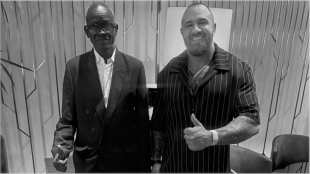 ALEX BODI AND AMBASSADOR GUM DOMINIC MATIOK OF THE REPUBLIC OF SOUTH SUDAN MEET IN BERLIN TO DISCUSS THE POSSIBILITY OF AN HONORARY CONSULATE IN BUCHAREST
-
Dodgers step up World Series three-peat bid with 5-3 win over Braves

-
 Lula, Bolsonaro wrap up campaigns ahead of Brazil's knife-edge vote
-
Spain break down Czechs as England outclass Croatia in Nations League

-
 Toulouse edge Castres in Top 14 derby
-
Yamal on target as Spain hold off Czech Republic

-
 Murakami homer propels White Sox to MLB playoff win over Guardians
-
Latvian exit polls suggest pro-European choice

-
 Israel targets top Hamas leader in deadly Gaza strike on anniversary
-
Lula, Bolsonaro wrap up campaigns ahead of knife-edge election

-
 Houthis say struck oil facility near Riyadh, as Saudis hit Sanaa
-
Tuchel hails 'complete' England after Croatia demolition

-
 AI needs safety layers like nuclear plants: ex-OpenAI engineer
-
Fury to invite Trump to lead ring walk before Joshua showdown

-
 MVP Judge will miss Yankees' MLB playoff series against Rays
-
Fashion industry in 'precarious moment', says Vivienne Westwood supremo

-
 New lizard species discovered in Peru
-
Seventh heaven for England in Nations League rout of Croatia

-
 Fernandes hails Portugal's 'greatest symbol' Ronaldo, calls for unity
-
Storms, flooding cause chaos on Greek holiday island of Crete

-
 Grandidier-Nkanang double takes Pau to Top 14 summit despite Vannes fightback
-
#IAmJaneDoe: online support campaign in US university rape case

-
 Trainer Scott gets perfect Arc boost with top notch double
-
Brazil shine on Selecao's first visit to India

-
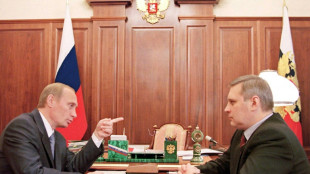 Ex-PM says Putin cannot admit 'mistake' over Ukraine
-
Zverev sets up Djokovic quarter-final at China Open, Rybakina out

-
 Houthis say Saudi Arabia launches dozens of strikes on Yemen capital
-
Happier at home, Bordeaux hammer Lyon in Top 14

-
 Qatar and Abu Dhabi F1 Grand Prix to go ahead - F1 boss
-
Lula, Bolsonaro in final push for votes ahead of knife-edge election

-
 South Korea lift gloom with smash-and-grab Games football gold
-
Boisterous fashion week barnstorms 'sleepy' Nigerian capital

-
 Ireland news conference before Israel game cut short amid tensions
-
UAE investigators say flydubai co-pilot was planning 'terrorist act'

-
 Protests over housing flare in Spain after relief measures rejected
-
Rahul smacks century in India v Windies ODI

-
 Zverev thrashes Shang to set up Djokovic quarter-final at China Open
-
Daryz seeks to join exclusive club of dual Arc winners

-
 Turkey football ref chief jailed pending trial for graft
-
Russia warns diplomats to leave Kyiv over new strikes threat
-
 North Korea says test of intermediate-range strategic missile included use of AI
-
Olympic champ Zheng rebukes rowdy home crowd at China Open

-
 Rampant Sayers leads Hong Kong to third men's rugby gold in a row
-
World No.1 Sinner pulls out of Shanghai Masters to delay return

-
 Ethiopia's Tigray rebels abandon regional capital as govt advances
-
Red Bull's Verstappen grabs pole position for Bahrain GP

-
 Bulgaria's Tsar Samuel returns 'home' after 1,000 years
-
India beat Pakistan in blockbuster as golfer Kim wins 'crazy' gold

-
 'Glad it's over': Kim powers to Games gold and military exemption
-
India beat arch-rivals Pakistan to win Asian Games cricket gold

NASA journeys to the metal-rich asteroid Psyche
It's a world like no other: a metal-rich asteroid that could be the remnants of a small planet, or perhaps an entirely new type of celestial body unknown to science.
A NASA spacecraft blasted off from the Kennedy Space Center Friday bound for Psyche, an object 2.2 billion miles (3.6 billion kilometers) away that could offer clues about the interior of planets like Earth.
"We're going to learn all kinds of new things, how these things fly through the solar system, and they hit each other and they cause the evolution of what we have today, our solar system," NASA chief Bill Nelson said shortly before lift off at 10:19 am Eastern Time (1419 GMT) on a reusable SpaceX Falcon Heavy rocket.
"We've visited either in person or robotically worlds made of rock, worlds made of ice and worlds made of gas... but this will be our first time visiting a world that has a metal surface," lead scientist Lindy Elkins-Tanton told reporters during a briefing this week.
Trailing a blue glow from its next-generation electric propulsion system and flanked by two large solar arrays, the van-sized probe should arrive at its destination in the Asteroid Belt, between Mars and Jupiter, in July 2029.
- Studying cores of rocky planets -
Over the course of two years, it will deploy its suite of advanced instruments to probe Psyche for evidence of an ancient magnetic field and to study its chemical and mineral composition, as well as topography.
Scientists think Psyche, named after the goddess of the soul in Greek mythology, could be part of the iron-nickel core of a "planetesimal," a building block of all rocky planets, that was left exposed after an ancient collision blasted off the exterior.
It could also be something else -- a primordial solar system object that's never been documented before.
"This is our one way to see a core," said Elkins-Tanton. "We say tongue in cheek that we're going to outer space to explore inner space."
Psyche is thought to have an irregular, potato-like shape, measuring 173 miles (280 kilometers) across at its widest point -- though it's never actually been seen up close.
Until recently, scientists thought it was overwhelmingly composed of metal -- but analyses based on reflected radar and light now indicate that metal probably comprises between 30-60 percent, with the rest being rock.
- Solar electric propulsion -
The mission will include several technological innovations.
The Psyche spacecraft, named after the asteroid, will test out next generation communications based on lasers -- a step NASA compares to upgrading old telephone lines on Earth to fiber optics.
Deep Space Optical Communications, as the system is called, "was designed to demonstrate 10 to 100 times the data-return capacity of state-of-the-art radio systems used in space today," said Abi Biswas of NASA's Jet Propulsion Laboratory in a statement.
Psyche also uses a special kind of propulsion system called "Hall-effect thrusters" that harnesses the energy from solar panels to create electric and magnetic fields that, in turn, expel charged atoms of xenon gas.
The thrust it exerts is roughly equal to the weight of an AA battery in your hand. But in the void of space, the spacecraft will accelerate continuously to tens of thousands of miles per hour.
Such systems avoid the need to carry thousands of pounds of chemical fuel into space, and Psyche will be the first time they are used beyond lunar orbit.
X.Matos--PC



