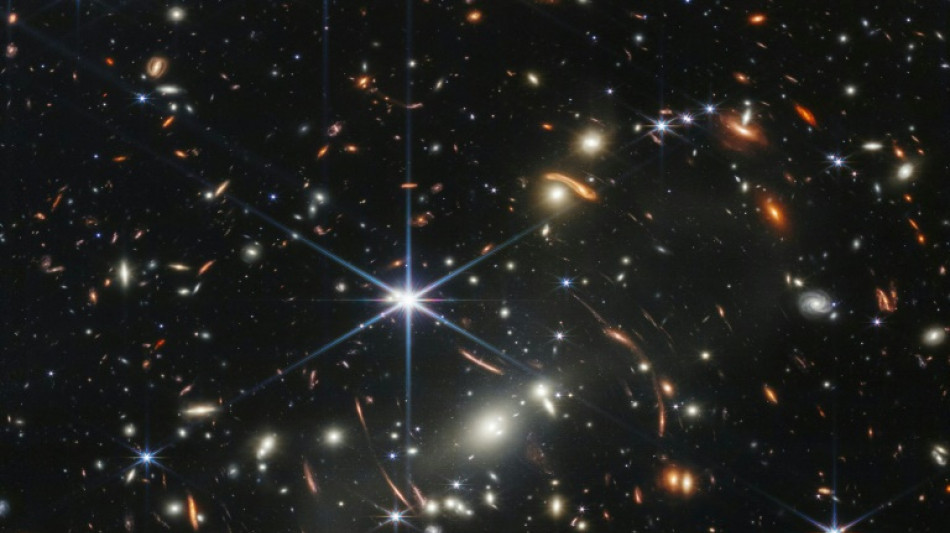
'Mind-blowing': Astronomers spot most distant radio burst yet / Photo: Handout - NASA/AFP/File

 ALEX BODI AND AMBASSADOR GUM DOMINIC MATIOK OF THE REPUBLIC OF SOUTH SUDAN MEET IN BERLIN TO DISCUSS THE POSSIBILITY OF AN HONORARY CONSULATE IN BUCHAREST

 Lula, Bolsonaro wrap up campaigns ahead of Brazil's knife-edge vote

 Toulouse edge Castres in Top 14 derby

 Murakami homer propels White Sox to MLB playoff win over Guardians

 Israel targets top Hamas leader in deadly Gaza strike on anniversary

 Houthis say struck oil facility near Riyadh, as Saudis hit Sanaa

 AI needs safety layers like nuclear plants: ex-OpenAI engineer

 MVP Judge will miss Yankees' MLB playoff series against Rays

 New lizard species discovered in Peru

 Fernandes hails Portugal's 'greatest symbol' Ronaldo, calls for unity

 Grandidier-Nkanang double takes Pau to Top 14 summit despite Vannes fightback

 Trainer Scott gets perfect Arc boost with top notch double

 Ex-PM says Putin cannot admit 'mistake' over Ukraine

 Houthis say Saudi Arabia launches dozens of strikes on Yemen capital

 Qatar and Abu Dhabi F1 Grand Prix to go ahead - F1 boss

 South Korea lift gloom with smash-and-grab Games football gold

 Ireland news conference before Israel game cut short amid tensions

 Protests over housing flare in Spain after relief measures rejected

 Zverev thrashes Shang to set up Djokovic quarter-final at China Open

 Turkey football ref chief jailed pending trial for graft

 North Korea says test of intermediate-range strategic missile included use of AI

 Rampant Sayers leads Hong Kong to third men's rugby gold in a row

 Ethiopia's Tigray rebels abandon regional capital as govt advances

 Bulgaria's Tsar Samuel returns 'home' after 1,000 years

 'Glad it's over': Kim powers to Games gold and military exemption

Eight billion years ago, something happened in a distant galaxy that sent an incredibly powerful blast of radio waves hurtling through the universe.
It finally arrived at Earth on June 10 last year and -- though it lasted less than a thousandth of a second -- a radio telescope in Australia managed to pick up the signal.
This flash from the cosmos was a fast radio burst (FRB), a little-understood phenomenon first discovered in 2007.
Astronomers revealed on Thursday that this particular FRB was more powerful and came from much farther away than any previously recorded, having travelled eight billion light years from when the universe was less than half its current age.
Exactly what causes FRBs has become one of astronomy's great mysteries. There was early speculation that they could be radio communication beamed from some kind of extraterrestrial, particularly because some of the signals repeat.
However scientists believe the prime suspects are distant dead stars called magnetars, which are the most magnetic objects in the universe.
Ryan Shannon, an astrophysicist at Australia's Swinburne University, told AFP it was "mind-blowing" that the ASKAP radio telescope in Western Australia had spotted the radio burst last year.
- 'Lucky' -
"We were lucky to be looking at that little spot in the sky for that one millisecond after the eight billion years the pulse had travelled to catch it," said Shannon, co-author of a study describing the find in the journal Science.
The FRB easily beat the previous record holder, which was from around five billion light years away, he added.
The pulse was so powerful that -- in under a millisecond -- it released as much energy as the Sun emits over 30 years.
Shannon said that there could be hundreds of thousands of FRBs flashing in the sky every day.
But around a thousand have been detected so far, and scientists have only been able to work out where just 50 came from -- which is crucial to understanding them.
To find out where the latest radio burst -- dubbed FRB 20220610A -- came from, the researchers turned to the Very Large Telescope in Chile.
It found that the signal originated from a particularly clumpy galaxy that may have been merging with one or two other galaxies, which could in turn have created the bizarre magnetar.
Shannon emphasised that this was just the team's "best hunch".
FRBs have been detected coming from unexpected places, including from within our own Milky Way galaxy, so "the jury's still out" on what causes them, he said.
Aside from trying to uncover the secrets of FRBs, scientists hope to use them as a tool to shed light on another of the universe's mysteries.
- Where's the matter? -
Just five percent of the universe is made up of normal matter -- what everything you can see is made out of -- while the rest is thought to be composed of the little understood dark matter and dark energy.
But when astronomers count up all the stars and galaxies in the universe, more than half of that five percent of normal matter is "missing", Shannon said.
Scientists believe this missing matter is spread out in thin filaments connecting galaxies called the cosmic web, however it is so diffuse current telescopes cannot see it.
That's where fast radio bursts come in.
They are "imprinted with the signature of all the gas they travel through", Shannon said.
Some FRB wavelengths are slightly slowed down when travelling through this matter, giving scientists a way to measure it.
This could allow them work out how much matter is in the cosmic web -- and therefore, the total weight of the universe.
For the record-breaking FRB, Shannon said the team had noticed signals of "extra materials" the burst had passed through on its journey through the universe.
But to use this information to get a proper measurement of the universe's weight, hundreds more FRBs will likely need to be observed, he added.
With much more advanced radio telescopes expected to go online soon, astronomers hope that will happen relatively quickly.
Liam Connor, an astrophysicist at the California Institute of Technology not involved in the research, told AFP that future radio telescopes will find tens of thousands of FRBs, allowing scientists to weigh all the matter "across cosmic epochs".
A.S.Diogo--PC



