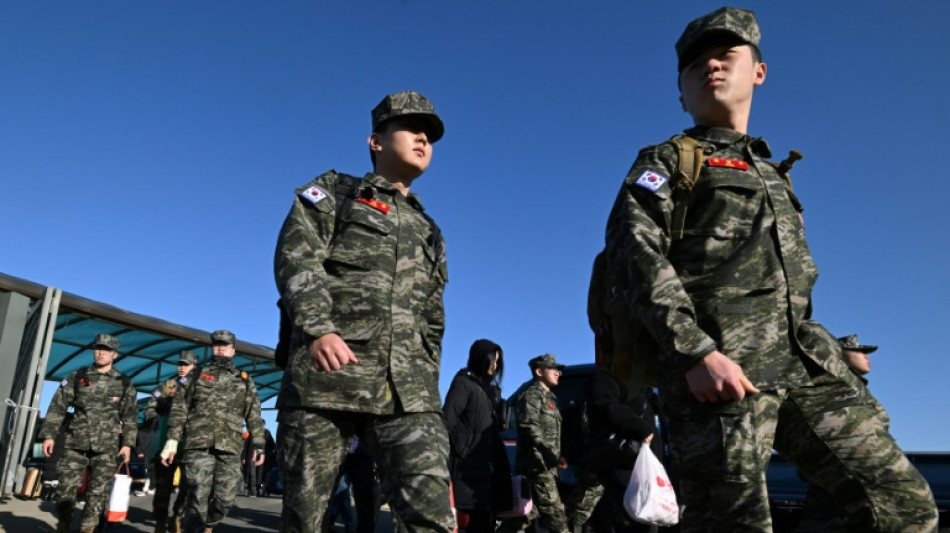
Life on the frontline: fear, camaraderie on S. Korean border island / Photo: Jung Yeon-je - AFP

 Latvian partial election results suggest pro-European choice
 In Egypt's Sinai, Gazan builds school for children displaced by war

 Trump tariffs a mixed bag for US auto industry

 Yemen government forces say struck Houthi targets

 Music links past, present for Pedro Pascal's cellist in 'Behemoth!'
 ALEX BODI ȘI AMBASADORUL REPUBLICII SUDANUL DE SUD, GUM DOMINIC MATIOK, DISCUTĂ LA BERLIN DESPRE POSIBILITATEA ÎNFIINȚĂRII UNUI CONSULAT ONORIFIC LA BUCUREȘTI

 Dodgers step up World Series three-peat bid with 5-3 win over Braves

 Spain break down Czechs as England outclass Croatia in Nations League

 Yamal on target as Spain hold off Czech Republic

 Latvian exit polls suggest pro-European choice
 Lula, Bolsonaro wrap up campaigns ahead of knife-edge election
 Tuchel hails 'complete' England after Croatia demolition

 Fury to invite Trump to lead ring walk before Joshua showdown

 Fashion industry in 'precarious moment', says Vivienne Westwood supremo
 Seventh heaven for England in Nations League rout of Croatia

 Storms, flooding cause chaos on Greek holiday island of Crete

 #IAmJaneDoe: online support campaign in US university rape case

 Brazil shine on Selecao's first visit to India

 Zverev sets up Djokovic quarter-final at China Open, Rybakina out
 Happier at home, Bordeaux hammer Lyon in Top 14

 Lula, Bolsonaro in final push for votes ahead of knife-edge election

 Boisterous fashion week barnstorms 'sleepy' Nigerian capital

 UAE investigators say flydubai co-pilot was planning 'terrorist act'

 Rahul smacks century in India v Windies ODI

 Daryz seeks to join exclusive club of dual Arc winners

When a North Korean artillery shell slammed into his house and burned it to the ground in 2010, Jung Chang-kuan thought that war had broken out again.
That attack was a North Korean artillery barrage on Jung's home, the remote South Korean border island of Yeongpeong, which killed four people in the first such incident since the 1950-53 Korean War.
And on Friday, that previous attack was on Jung's mind as he fled to a shelter with his family after North Korea fired artillery shells near his island, prompting a South Korean live-fire exercise in response.
"There wasn't that much fear inside the shelter. Rather, all the residents came and it was just a chatting atmosphere because they had not seen each other in a long time," he said of the Friday evacuation.
In contrast, in 2010, Jung said his family was unable to salvage any of their belongings from their burning house and had no choice but to run.
"The shells rained down, smoke billowed, and everything was engulfed in flames and destroyed, there was no time to think about anything else," he told AFP.
Having to flee again on Friday, 70-year-old Jung said it felt both strange and "reminiscent" of the 2010 incident.
But "I wasn't too shocked," he said.
"I've even experienced (my house) being directly hit by artillery fire before."
On Saturday, North Korea fired another 60 artillery shells in the area, Seoul's military said, urging Pyongyang to immediately cease "actions that increase tension" along the maritime border.
- Shelters always open -
Yeonpyeong is extremely close -- less than two kilometres (1.5 miles) -- to the de facto maritime border between the two Koreas known as the Northern Limit Line (NLL).
Although it is controlled by Seoul and on the southern side of the de facto maritime border, the sparsely populated island is much closer to North Korea.
It is only around 42 kilometres away from the North Korean city of Haeju, while being situated about 115 kilometres west of the South Korean capital Seoul.
On a clear day in autumn months, the train station in Haeju, as well as the plumes of smoke rising from the city's factories, can be seen from a hilltop on Yeonpyeong.
Yeonpyeong operates around 10 shelters across the island equipped with medical beds, children's books and gas masks, among other materials.
"We always keep the shelter doors open," an official from the Yeonpyeong district office told AFP at one of the shelters where around 200 residents stayed on Friday.
"Our aim is to ensure that people can seek refuge here whenever necessary."
- Compassion for North Koreans -
The streets and residents of Yeonpyeong remained peaceful early on Saturday, with military soldiers visiting hair salons and people enjoying bike rides on quiet roads.
"I always have this understanding in my mind that... (Yeonpyeong Island) is a tense place in the West Sea," a hairdresser and island resident, who asked not to be named, told AFP.
"If we're told to go to a shelter, we should follow the instructions, since we live in this place.
"There's no need to worry excessively. Tomorrow is tomorrow, and today is today."
But resident Kim Na-yeon, 69, said she suffered from trauma stemming from the 2010 incident, and said many elderly women on the island were deeply shaken and filled with fear -- both on Friday and during the 2010 shelling.
Fourteen years ago, Kim said that people sought refuge in a poorly built, rudimentary shelter where they could see dead mice, anxiously awaiting private and public ferries to evacuate them from the area.
On Friday, "I was anxious and didn't know if I should go to sleep or not, so I left a bag by the door without even unpacking it", she told AFP.
Due to its location, around 30 percent of the island's residents are war refugees who hail from Hwanghae Province in North Korea.
"I long to step on the land of my hometown, where my mother rests," reads a sculpture erected on the island in remembrance of the families separated by the Korean War.
For such reasons, resident Jung said he harbours no personal grudge against North Koreans, despite having his house destroyed by Pyongyang's shells.
"Even now, I feel compassion towards the North Korean people."
"I even have this willingness to help them."
A.Aguiar--PC



