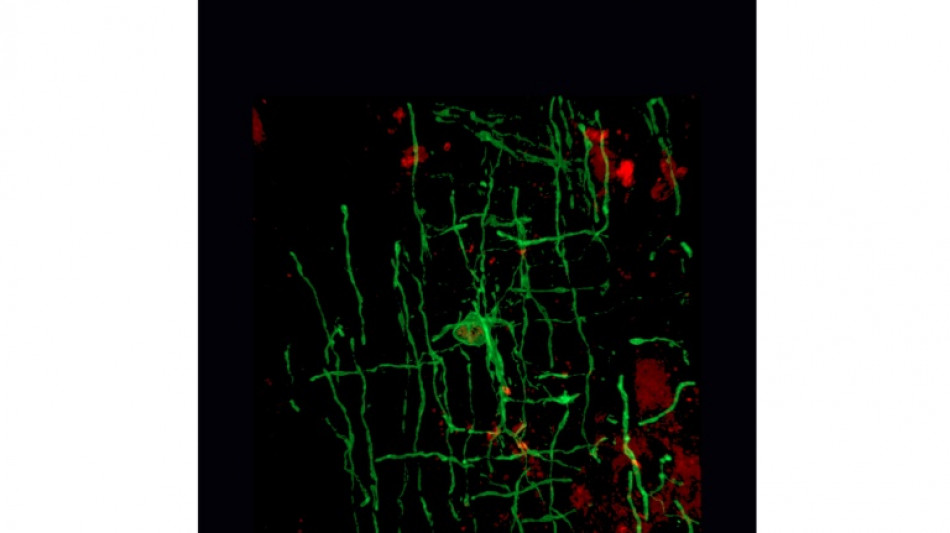
Ancient viruses responsible for our big brains and bodies: study / Photo: Peggy Assinck - Altos Labs-Cambridge Institute of Science/AFP

 'Act before it's too late': Tokyo residents fight for more trees

 'Disappointing' as South Korea flag mishap sees Games end on sour note

 Pre-COP host Tuvalu at frontline of climate change

 Hungary's dwindling paprika producers battle to save signature spice

 Cornell president vows review in wake of alleged student gang rape

 Latvian partial election results suggest pro-European choice

 In Egypt's Sinai, Gazan builds school for children displaced by war

 Trump tariffs a mixed bag for US auto industry

 Yemen government forces say struck Houthi targets

 Music links past, present for Pedro Pascal's cellist in 'Behemoth!'

 ALEX BODI ȘI AMBASADORUL REPUBLICII SUDANUL DE SUD, GUM DOMINIC MATIOK, DISCUTĂ LA BERLIN DESPRE POSIBILITATEA ÎNFIINȚĂRII UNUI CONSULAT ONORIFIC LA BUCUREȘTI

 Dodgers step up World Series three-peat bid with 5-3 win over Braves

 Spain break down Czechs as England outclass Croatia in Nations League

 Yamal on target as Spain hold off Czech Republic

 Latvian exit polls suggest pro-European choice

 Lula, Bolsonaro wrap up campaigns ahead of knife-edge election

 Tuchel hails 'complete' England after Croatia demolition

 Fury to invite Trump to lead ring walk before Joshua showdown

 Fashion industry in 'precarious moment', says Vivienne Westwood supremo
 Seventh heaven for England in Nations League rout of Croatia

 Storms, flooding cause chaos on Greek holiday island of Crete

 #IAmJaneDoe: online support campaign in US university rape case

 Brazil shine on Selecao's first visit to India

 Zverev sets up Djokovic quarter-final at China Open, Rybakina out

 Happier at home, Bordeaux hammer Lyon in Top 14

Ancient viruses that infected vertebrates hundreds of millions of years ago played a pivotal role in the evolution of our advanced brains and large bodies, a study said Thursday.
The research, published in the journal Cell, examined the origins of myelin, an insulating layer of fatty tissue that forms around nerves and allows electrical impulses to travel faster.
According to the authors, a gene sequence acquired from retroviruses -- viruses that invade their host's DNA -- is crucial for myelin production, and that code is now found in modern mammals, amphibians and fish.
"The thing I find the most remarkable is that all of the diversity of modern vertebrates that we know of, and the size they've achieved: elephants, giraffes, anacondas, bullfrogs, condors wouldn't have happened," senior author and neuroscientist Robin Franklin of Altos Labs-Cambridge Institute of Science told AFP.
In new research led by Tanay Ghosh, a computational biologist and geneticist in Franklin's lab, analysts trawled through genome databases to try to discover the genetics that were likely associated with the cells that produce myelin.
Specifically, he was interested in exploring mysterious "noncoding regions" of the genome that have no obvious function and were once dismissed as junk, but are now recognized as having evolutionary importance.
Ghosh's search landed upon a particular sequence derived from an endogenous retrovirus, long lurking in our genes, which the team dubbed "RetroMyelin."
To test their finding, researchers carried out experiments in which they knocked down the RetroMyelin sequence in rat cells, and found they no longer produced a basic protein required for myelin formation.
- Faster reactions, bigger bodies -
Next, they searched for RetroMyelin-like sequences in the genomes of other species, finding similar code in jawed vertebrates -- fellow mammals, birds, fish, reptiles and amphibians -- but not in jawless vertebrates or invertebrates.
This led them to believe the sequence appeared in the tree of life around the same time as jaws, which first evolved around 360 million years ago in the Devonian period, called the Age of Fishes.
"There's always been an evolutionary pressure to make nerve fibers conduct electrical impulses quicker," said Franklin. "If they do that quicker, then you can act quicker," he added, which is useful for both predators trying to catch things, and prey trying to flee.
Myelin enables rapid impulse conduction without widening the diameter of nerve cells, allowing them to be packed closer together.
It also provides structural support, meaning nerves can grow longer, allowing for longer limbs.
In myelin's absence, invertebrates have found other ways to transmit signals faster -- giant squids for example have evolved wider nerve cells.
Finally, the team wanted to learn whether the retroviral infection happened once, to a single ancestor species, or whether it happened more than once.
- More discoveries await? -
To answer this, they used computational methods to analyze the RetroMyelin sequences of 22 jawed vertebrate species, finding the sequences were more similar within than between species.
The finding suggested multiple waves of infection led to the diversity of vertebrate species we see today, the team said.
"One tends to think of viruses as pathogens, or disease causing agents," said Franklin.
But the reality is more complicated, he said: at various points in history retroviruses have entered the genome and integrated themselves into a species' reproductive cells, allowing them to be passed down to future generations.
One of the most well known examples is the placenta -- one of the defining characteristics of most mammals -- which we acquired from a pathogen embedded in our genome in the deep past.
Ghosh said the myelin finding could be just another step in an emerging field. "There are still a lot of things to understand still in terms of biology about how these sequences are driving different processes of evolution," he said.
F.Moura--PC



