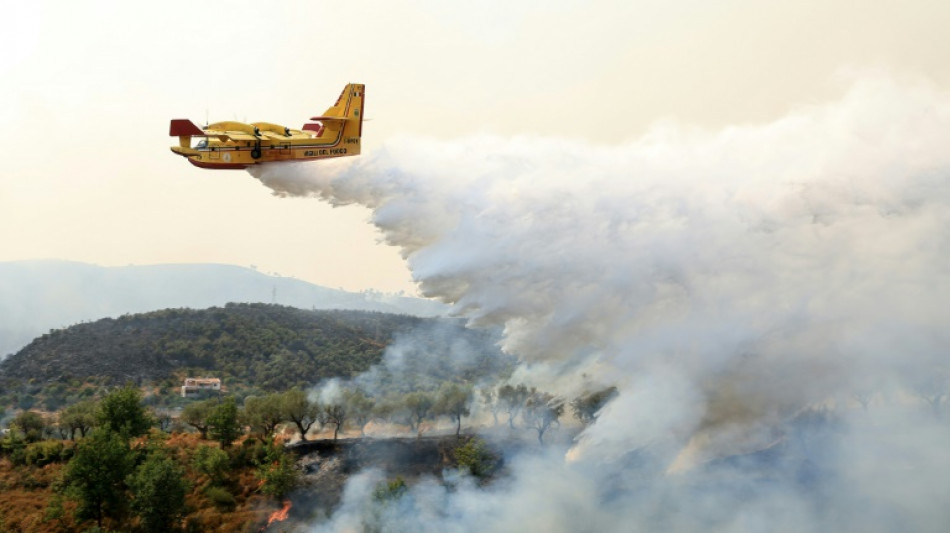
Rising wildfires spur comeback for Canadian water bomber / Photo: Adnan Beci - AFP/File

 Drone owners rush to offload devices ahead of Beijing ban

 Trump's beef policies irk Texas ranchers, testing their loyalty

 Nvidia, OpenAI CEOs to attend Xi dinner at White House

 Anthropic picks Accenture for in-house AI safety evaluation

 Balogun returns as Monaco beat Lens to continue strong Ligue 1 start

 'Pause' on overt repression in Venezuela, but reforms still needed: HRW

 Global stocks mixed as yen falls despite Bank of Japan rate hike

 Cuba hit with seventh major blackout of the year

 Murray out with concussion so Wentz will start for Vikings

 UN chief 'deeply regrets' US visa refusal to Abbas for annual meeting

 England quick Carse to face no charges over alleged nightclub assault

 Mancini brings nine newcomers into the first squad of his Italy comeback

 Czechs level Davis Cup tie against USA as South Korea eye Finals

 New France boss Zidane confirms Mbappe as captain after naming first squad

 California governor signs order to explore AI 'kill switch'

 Head leads run spree as Australia win Zimbabwe ODI series

 In-form Raphinha wants to finish career at Barcelona

 Warren Buffett steps down as Berkshire Hathaway chairman

 Carrick confident Man Utd can 'work through' tough time

 Mbappe ends Nike partnership to join Swiss brand On

 Liverpool boss Iraola puts Bournemouth love affair on hold

 'A disaster' if Man City do not win says Maresca after flawless start

 Kerry James Marshall: American 'blackness' painter celebrated in Europe

 Spain coach De la Fuente offers 'full support' to people of Ceuta

 Russia seizes assets of Nestle, French firms over West's Ukraine support
The Canadair water bomber revolutionized the fight against wildfires after it debuted in the skies decades ago.
Then demand waned and production stopped, but with major blazes intensifying globally, the water-scooping marvel is making a comeback.
At a production site in Calgary, in western Canada, workers building a next-generation version of the aircraft are busy trying to keep up with orders, which have poured in from Europe, as well as across Canada.
The amphibious plane hit the market in the late 1960s. It was the first aircraft specifically designed to scoop up and dump water on flames -- a departure from other planes that had been modified for that purpose.
Through the latter half of the 20th century, it was a pillar of firefighting efforts in many countries.
With about 160 of the aircraft in operation, governments began sharing them. That caused new sales to sag, which led aviation firm Bombardier to stop production in 2015.
The next year, Calgary-based De Havilland Canada acquired the rights to the water bomber program.
"The aircraft are getting older, the summers are getting hotter. There's more demand. So that's why we brought the aircraft back into production," Neil Sweeney, De Havilland's vice president for corporate affairs, told AFP.
France, Italy, Greece, Spain, Croatia and Portugal -- all imperiled by growing wildfire seasons -- ordered 22 next-generation Canadair planes at the Paris Air Show in June.
- Keeping what works -
De Havilland has estimated that global orders could rise to between 250 and 350 planes.
With most of the aircraft's 50,000 parts assembled by hand, producing that number of planes could take up to 10 years.
To expedite production and meet rising demand, De Havilland decided to modernize the existing Canadair design, rather than develop a new model.
"Our strategy was to leave the elements that made the aircraft successful untouched," said Jean-Philippe Cote, vice president of business improvement at De Havilland.
He said the bomber’s silhouette remains unchanged but the cockpit and electronic set-up has been completely redesigned.
John Gradek, a supply chain expert at McGill University, estimated that sustaining production to meet growing demand would likely require millions of dollars in investment.
- 'Tractor of the sky' -
Pierre Boulanger, a Canadair pilot from Quebec who travels to California to fight wildfires every summer, celebrated the resumption of production, calling the model the most "efficient" tanker aircraft on the market.
"It's the tractor of the sky," he said.
Two hydraulically-operated scoops under the fuselage allow the plane to pick up 6,000 liters of water in just 12 seconds without landing, which others must do.
"If the water source is very close, we can make a drop every two minutes," said Boulanger, 35.
He explained that the planes are extremely precise, allowing the pilot to maintain control even at very low speeds.
After the devastating European wildfire season this year and the increasing area burned annually in North America, Boulanger said it seemed as though "we will never have enough Canadairs."
B.Godinho--PC