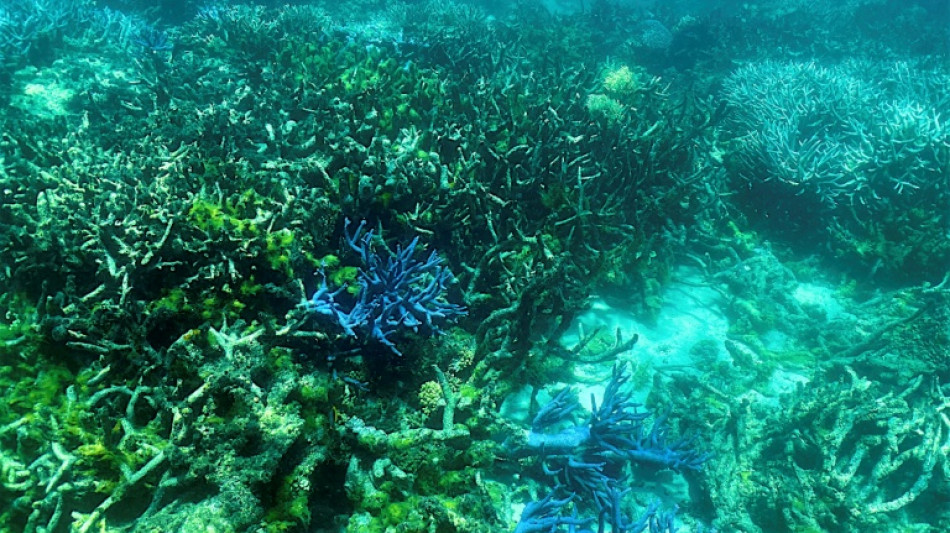
Top nature group to unveil new 'red list' of threatened species / Photo: Glenn NICHOLLS - AFP

 Drone owners rush to offload devices ahead of Beijing ban

 Trump's beef policies irk Texas ranchers, testing their loyalty

 Nvidia, OpenAI CEOs to attend Xi dinner at White House

 Anthropic picks Accenture for in-house AI safety evaluation

 Balogun returns as Monaco beat Lens to continue strong Ligue 1 start

 'Pause' on overt repression in Venezuela, but reforms still needed: HRW

 Global stocks mixed as yen falls despite Bank of Japan rate hike

 Cuba hit with seventh major blackout of the year

 Murray out with concussion so Wentz will start for Vikings

 UN chief 'deeply regrets' US visa refusal to Abbas for annual meeting

 England quick Carse to face no charges over alleged nightclub assault

 Mancini brings nine newcomers into the first squad of his Italy comeback

 Czechs level Davis Cup tie against USA as South Korea eye Finals

 New France boss Zidane confirms Mbappe as captain after naming first squad

 California governor signs order to explore AI 'kill switch'

 Head leads run spree as Australia win Zimbabwe ODI series

 In-form Raphinha wants to finish career at Barcelona

 Warren Buffett steps down as Berkshire Hathaway chairman

 Carrick confident Man Utd can 'work through' tough time

 Mbappe ends Nike partnership to join Swiss brand On

 Liverpool boss Iraola puts Bournemouth love affair on hold

 'A disaster' if Man City do not win says Maresca after flawless start

 Kerry James Marshall: American 'blackness' painter celebrated in Europe

 Spain coach De la Fuente offers 'full support' to people of Ceuta

 Russia seizes assets of Nestle, French firms over West's Ukraine support

The world's top conservation body is holding its world congress starting Thursday in the Emirati capital Abu Dhabi and will unveil its updated "red list" of threatened species.
The International Union for Conservation of Nature (IUCN), whose decisions help set the global agenda on environmental protection, will on Friday publish its list ranking at-risk plant and animal species from "least concern" to "extinct".
The congress, held every four years, sheds light on the dire state of the world's biodiversity. An increasing number of animals suffer from the destruction of their natural habitat, climate change, and water, air and soil pollution.
According to the United Nations's expert scientific panel on biodiversity (IPBES), biodiversity has declined every decade in the past 30 to 50 years.
The IUCN congress last convened in the French city of Marseille in 2021.
In an update to its "red list" last year, the IUCN said that out of the 169,420 species studied, a total of 47,187 were classified as threatened -- more than a quarter.
The most impacted species were corals and amphibians, with more than 40 percent of each group under threat.
- 'Urgency' -
"The Congress programme reflects the urgency and ambition of our time," said Shaikha Salem Al Dhaheri, Secretary General of the Environment Agency-Abu Dhabi and IUCN councillor from the West Asia region.
IUCN Director General Grethel Aguilar of Costa Rica said the upcoming announcements "reflect the scale of ambition and the real possibility of delivering the solutions we need to build a planet where people and nature thrive together".
The IUCN congress votes on adopting resolutions.
Though not legally binding, they can "shape the international agenda" and "accelerate" work on treaties under discussion, an IUCN source told AFP, requesting anonymity to discuss the event freely.
- Synthetic biology debate -
The most closely watched vote revolves around two competing motions on synthetic biology -- a controversial technique widely used in the pharmaceutical industry and agribusiness.
It enables scientists to redesign organisms by engineering them to have new abilities.
One motion calls for a moratorium on the technology because "genetic engineering of wild species in natural ecosystems, including in protected areas, is not compatible with the practices, values and principles of nature conservation".
A competing motion argues that synthetic biology could complement conservation efforts, and says IUCN policy "should not be interpreted as supporting or opposing synthetic biology, per se".
Organisers expect 10,000 delegates and 5,000 civil society attendees.
The IUCN congress describes itself as "world's largest and most inclusive nature conservation forum".
Its voting members include government agencies, national and international NGOs, and Indigenous groups.
H.Portela--PC