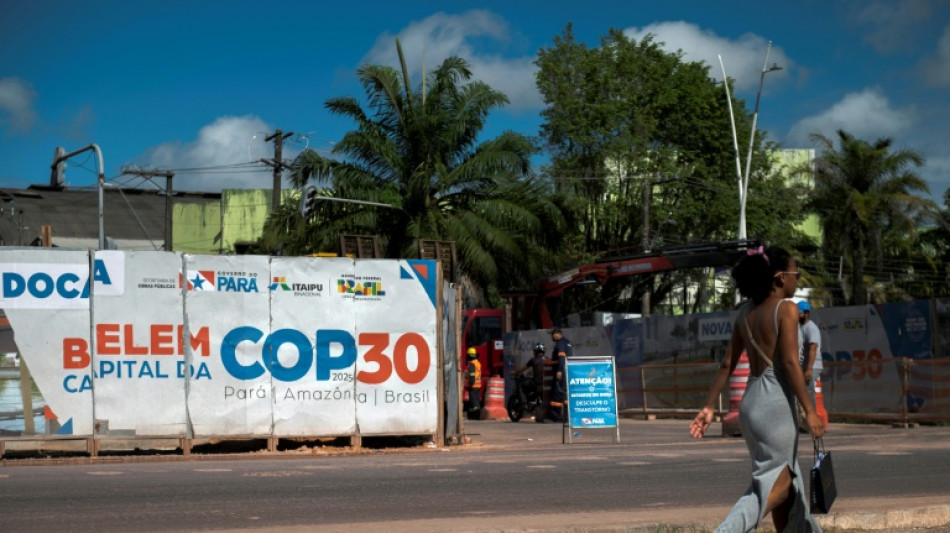
Trees, targets and trillions: what's on the agenda at COP30? / Photo: Carlos Fabal - AFP

 Drone owners rush to offload devices ahead of Beijing ban

 Trump's beef policies irk Texas ranchers, testing their loyalty

 Nvidia, OpenAI CEOs to attend Xi dinner at White House

 Anthropic picks Accenture for in-house AI safety evaluation

 Balogun returns as Monaco beat Lens to continue strong Ligue 1 start

 'Pause' on overt repression in Venezuela, but reforms still needed: HRW

 Global stocks mixed as yen falls despite Bank of Japan rate hike

 Cuba hit with seventh major blackout of the year

 Murray out with concussion so Wentz will start for Vikings

 UN chief 'deeply regrets' US visa refusal to Abbas for annual meeting

 England quick Carse to face no charges over alleged nightclub assault

 Mancini brings nine newcomers into the first squad of his Italy comeback

 Czechs level Davis Cup tie against USA as South Korea eye Finals

 New France boss Zidane confirms Mbappe as captain after naming first squad

 California governor signs order to explore AI 'kill switch'

 Head leads run spree as Australia win Zimbabwe ODI series

 In-form Raphinha wants to finish career at Barcelona

 Warren Buffett steps down as Berkshire Hathaway chairman

 Carrick confident Man Utd can 'work through' tough time

 Mbappe ends Nike partnership to join Swiss brand On

 Liverpool boss Iraola puts Bournemouth love affair on hold

 'A disaster' if Man City do not win says Maresca after flawless start

 Kerry James Marshall: American 'blackness' painter celebrated in Europe

 Spain coach De la Fuente offers 'full support' to people of Ceuta

 Russia seizes assets of Nestle, French firms over West's Ukraine support

This year's United Nations climate summit promises to be symbolic, marking a decade since the Paris Agreement and taking place in the environmentally vulnerable Amazon. But what is actually on the agenda?
The marathon negotiations gather nearly every country to confront a challenge that affects them all, but unlike recent editions, this "COP" has no single theme or objective.
That does not mean big polluters will get off easy, with climate-vulnerable nations frustrated at their level of ambition and financial assistance to those most impacted by a warming planet.
Here are the big issues to look for when the two-week COP30 conference starts on November 10 in the Brazilian city of Belem:
- Emissions -
The world is not cutting emissions fast enough to meet the goals of the Paris Agreement, and no amount of pomp and pageantry at COP30 will be able to sugarcoat that uncomfortable reality.
Under the climate accord, signatory nations are required every five years to submit stronger targets for cutting greenhouse gas emissions, thereby steadily raising the collective effort to reduce global warming over time.
The latest round of pledges for 2035 were due in February to give the UN time before COP30 to assess the quality of these commitments.
Most nations missed that deadline, but by early October, about 60 had turned in their revised plans. Few have impressed, and China's target in particular fell well below expectations.
The European Union, riven by infighting, cannot agree on its target, while India is another major emitter yet to finalise its pledge.
A reckoning could be coming in Belem. Brazil -- which described the latest round of pledges as "the vision of our shared future" -- is facing pressure to marshall a response.
- Money -
Money -- specifically, how much rich countries give poorer ones to adapt to climate change and shift to a low-carbon future -- is a likely point of conflict in Belem, as in past COPs.
Last year, after a fortnight of acrimonious haggling, COP29 ended unhappily with developed nations agreeing to provide $300 billion a year in climate finance to developing ones by 2035, well below what is needed.
They also set a much less specific target of helping raise $1.3 trillion annually by 2035 from public and private sources. Developing nations will be demanding some actual detail about this at COP30.
Adaptation finance -- for example, to build coastal defences to protect against rising seas -- is on the formal agenda, with a new fundraising target possibly up for negotiation as an old commitment expires.
- Forests -
Brazil chose to host COP30 in Belem because of its proximity to the Amazon, an ideal stage to draw the world's attention to the vital role of the rainforest in fighting climate change.
At COP30, the hosts will launch a new, innovative global fund that proposes rewarding countries with high tropical forest cover that keep trees standing instead of chopping them down.
The Tropical Forests Forever Fund (TFFF) aims to raise up to $25 billion from donor countries and another $100 billion from the private sector, which is invested on financial markets. Brazil has already kicked in $1 billion.
Clement Helary from Greenpeace told AFP the TFFF "could be a step forward in protecting tropical forests" if accompanied by clearer steps at COP30 toward ending deforestation by 2030.
The destruction of tropical primary forest hit a record high in 2024, according to Global Forest Watch, a deforestation monitor. The equivalent of 18 football fields per minute was lost, driven mostly by massive fires.
M.Carneiro--PC