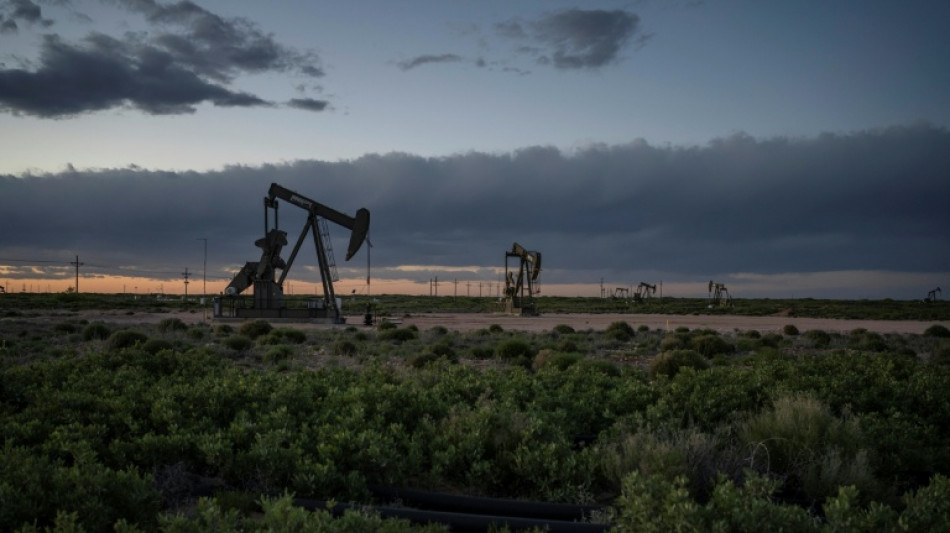
US oil giants produce mainly at home but send more tax dollars overseas / Photo: Paul Ratje - AFP/File

 Drone owners rush to offload devices ahead of Beijing ban

 Trump's beef policies irk Texas ranchers, testing their loyalty

 Nvidia, OpenAI CEOs to attend Xi dinner at White House

 Anthropic picks Accenture for in-house AI safety evaluation

 Balogun returns as Monaco beat Lens to continue strong Ligue 1 start

 'Pause' on overt repression in Venezuela, but reforms still needed: HRW

 Global stocks mixed as yen falls despite Bank of Japan rate hike

 Cuba hit with seventh major blackout of the year

 Murray out with concussion so Wentz will start for Vikings

 UN chief 'deeply regrets' US visa refusal to Abbas for annual meeting

 England quick Carse to face no charges over alleged nightclub assault

 Mancini brings nine newcomers into the first squad of his Italy comeback

 Czechs level Davis Cup tie against USA as South Korea eye Finals

 New France boss Zidane confirms Mbappe as captain after naming first squad

 California governor signs order to explore AI 'kill switch'

 Head leads run spree as Australia win Zimbabwe ODI series

 In-form Raphinha wants to finish career at Barcelona

 Warren Buffett steps down as Berkshire Hathaway chairman

 Carrick confident Man Utd can 'work through' tough time

 Mbappe ends Nike partnership to join Swiss brand On

 Liverpool boss Iraola puts Bournemouth love affair on hold

 'A disaster' if Man City do not win says Maresca after flawless start

 Kerry James Marshall: American 'blackness' painter celebrated in Europe

 Spain coach De la Fuente offers 'full support' to people of Ceuta

 Russia seizes assets of Nestle, French firms over West's Ukraine support

US fossil fuel giants produce most of their oil and gas domestically but pay billions more in taxes overseas than they do at home because of subsidies that have only grown during President Donald Trump's second term, a report said Thursday.
The analysis, titled "America-Last and Planet-Last: How US Tax Policy Subsidizes Oil and Gas Extraction Abroad," looked at disclosures from 11 publicly traded US companies since 2017, finding they paid an effective current-year tax rate of 12.1 percent -- far below the statutory 21 percent corporate tax rate.
In the case of Chevron this fell to 7.9 percent.
The US has assumed the mantle of the world's largest oil and gas producer in recent years. But even though the companies studied produced 51 percent of their output domestically, they owed just 18 percent of their total taxes in the United States.
In one example, American's biggest oil company, ExxonMobil, was found to have paid $11.5 billion to the United Arab Emirates across 2023 and 2024 -- nearly five times the amount it paid to the United States in the same time.
Another leading US giant, ConocoPhillips, paid more than twice as much tax to Libya as it did to the US, despite producing more than 70 percent of its oil and gas domestically.
"The headline finding of our report is that these companies are indeed very lightly taxed. They are under-taxed relative to any kind of number of metrics," author Zorka Milin, of the nonprofit Financial Accountability and Corporate Transparency (FACT) Coalition told AFP.
"These policies make no sense economically, environmentally, or ethically," she added. "It's time for Congress to close these loopholes."
These low rates are driven by a web of industry-specific subsidies and rules that allow companies to offset US taxes with payments to foreign governments, including in countries plagued by corruption or weak oversight.
The oil and gas industry has benefited from tax subsidies dating back more than a century, when the US tax code was in its infancy.
But it has continually pressed for more, including spending $20 million on lobbying efforts in the six months leading to the passage of the "Big Beautiful Bill," which undid corporate tax reform measures put in place under former president Joe Biden.
G.Machado--PC