Smog then floods: Pakistani families 'can't catch a break'
/ Photo: Aamir QURESHI - AFP

 Inside the Venezuelan prison meant to 'drive you insane'

 UK king braces as memoir by Diana's brother goes on sale
 No green light to lift EU sanctions on Russian oligarchs, talks to resume

 UK agrees support for Saudi in struggle with Houthis: reports

 EU foreign policy chief calls for continued sanctions on Russia

 Flights scrapped, evacuations urged as Typhoon Dujuan wallops Japan

 Fonseca to take break from tennis

 A Cuban zoo, and its animals, in epic battle for survival

 Infantino proposes consulting federations to reform FIFA

 El Nino weather pattern enters record territory: scientist
 OpenAI calls for US to lead global effort on AI standards
 South African ostriches plucked alive for luxury fashion: report
 US networks halt Trump coverage in revolt over White House ban

 Paramount settles with US states to clear Warner Bros. mega-merger

 Climate crisis a job for world leaders, not just activists: UK FM

 US networks halt Trump coverage over White House ban

 French singer accuses Miley Cyrus of plagiarism

 EU fines Google 403 mn euros for location data breach

 'Best is yet to come,' says De la Fuente after Spain extension

 Why diesel prices are rising more than crude oil

 COP31 host says AI's climate footprint to be a summit priority

 Renewables hit record in 2025, but world must move faster: report

 US media outlets to sue Trump administration after White House ban

 Global stocks rally on lower oil prices, US-China hopes

 EU proposes energy rating for data centres

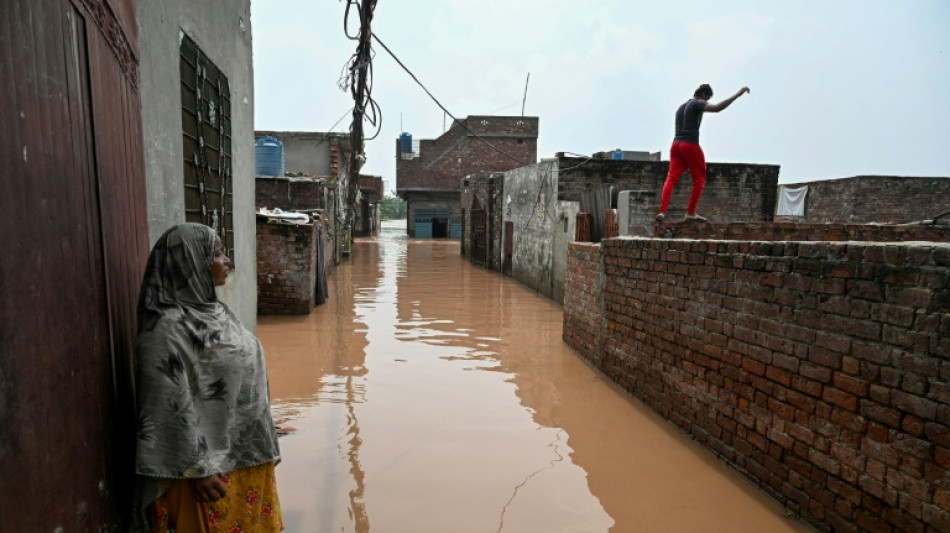
Perched on her neighbour's rooftop, Ghulam Bano gazes down at the remains of her home, submerged in murky, foul-smelling floodwater that has engulfed much of Pakistan's Punjab region.
Monsoon rains this week swelled three transboundary rivers that cut through Pakistan's eastern province, the nation's agricultural heartland and home to nearly half of its 255 million people.
Bano moved to Shahdara town last year, on the outskirts of Lahore, to avoid the choking smog pollution of Pakistan's second-largest city, only to have her new beginning overturned by raging floods.
"My husband had started coughing blood and his condition just kept getting worse when the smog hit," Bano told AFP, walking through muddy streets.
Pakistan regularly ranks among the world's most polluted countries, with Lahore often the most polluted megacity between November and February.
"I thought the smog was bad enough -- I never thought it could be worse with the floods," she said.
Her impoverished neighbourhood is home to thousands of low-lying homes crammed together on narrow streets.
The nearby overflowing Ravi river flooded many of them, forcing dozens of families to take refuge in an elementary school on higher ground, where doctors were treating people for skin infections linked to the flood water.
More heavy rain is predicted over the weekend, including warnings of increased urban flooding in Lahore, which borders India.
With her husband bedridden from tuberculosis, worsened by the relentless smog, Bano became the sole provider in a household struggling to breathe, survive, and endure the floods.
"I ate today after two days. There is no clean water to drink. I left my daughter at a relative's place and stayed back hoping the water recedes," she said.
- No time to pack -
Landslides and floods triggered by heavier-than-usual monsoon rains have killed more than 800 people nationwide since June this year.
While South Asia's seasonal monsoon brings rainfall that farmers depend on, climate change is making the phenomenon more erratic, unpredictable and deadly across the region.
More than 1.4 million people living near the rivers have been affected by the floods, with over 265,000 evacuated, said Azma Bukhari, the provincial information minister.
The latest monsoon downpour has killed at least 13 people, according to the National Disaster Management Authority.
"We just can't get a break," Amir Mehmood, a 32-year-old shopkeeper in the same neighbourhood as Bano, told AFP.
"Children fall ill in the smog because of the extreme cold. Some become sick due to the (everyday) unsanitary conditions," he said, referring to piles of waste that routinely line the streets.
"And now there's a flood. Our homes have collapsed, the walls have fallen, and everything is damaged."
He moved his family to a relative's home on the other side of the town along with his 10 cows and two goats as the water crept closer.
More than 300 relief camps have been set up across the province to shelter those displaced with no family to turn to.
"The women you see here, and me, we had to run for our lives... we did not even get the time to get clothes for our kids," 40-year-old widow Tabassum Suleman told AFP from the school camp.
"We do not know when we will be going back home," she said, looking up at the dark skies.
"But the worst is yet to come."
H.Portela--PC