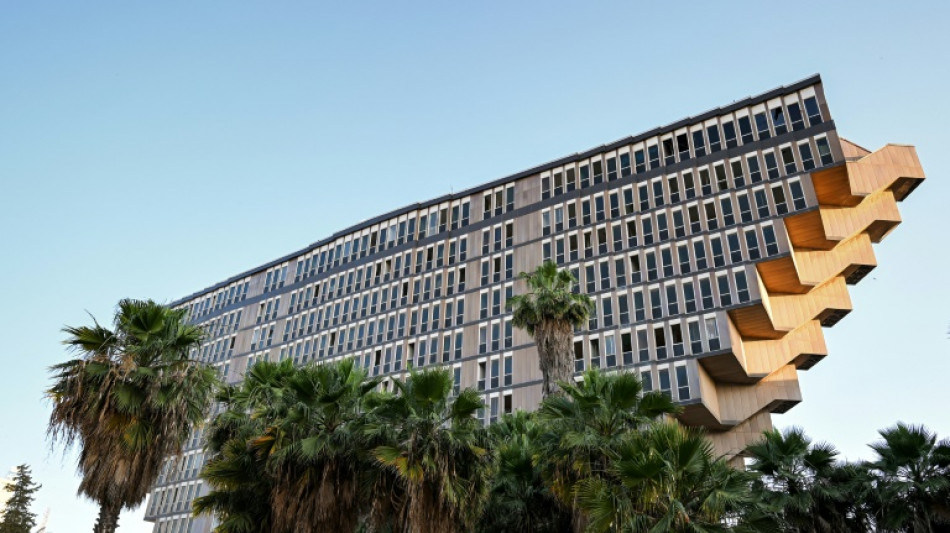
Tunisian brutalist landmark faces wrecking ball, sparking outcry / Photo: FETHI BELAID - AFP

 Braves clinch division title as Red Sox reach MLB playoffs
 Bordeaux-Begles hammer Stade Francais despite Jalibert injury

 Milan and Juventus end blips with home wins

 Bridgeman wins PGA Biltmore title with sizzling 61

 Williams injured as Bears shut down by Vikings

 US warns of rapid escalation in Middle East war

 Germany's far-right AfD celebrates another state election win

 Russia vows revenge for election-day attacks as poll shows ruling party win

 Spaun late shows snatches PGA Championship win

 Conceicao strikes as Juventus beat Atalanta

 Britain, Zverev-inspired Germany, Spain complete Davis Cup finals
 Man Utd salvage Fulham draw as pressure mounts on Carrick

 Spanish civil war drama 'The Black Ball' wins at Toronto festival

 Germany's Merz shaken by far-right and far-left gains in state votes

 Macron welcomes Canada's Carney to French Atlantic territory

 Fiorentina frustrate Napoli with Serie A draw, Como upset

 Five-star Man City top Premier League after Sunderland thriller

 Ukrainian drones hit Moscow on last day of Russian elections
 Multi-Asset Trading Venue Monochrome Exchange Announces IEO of Its Native Token, $MCR
 South Korea break Japan hearts to win Asian Games basketball gold
 Acosta takes first victory at Austrian MotoGP

 PSG president Nasser al-Khelaifi under investigation in France for conflict of interest

 China swim sensation, 13, sets Games record after Japan win early

 Drones hit Moscow as Russians go to the polls

 New England boss Fleming says 'wrong' to ask Stokes to end retirement

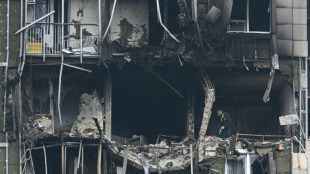
Tunisia's brutalist landmark the Hotel du Lac -- a 1970s postcard icon said to have inspired a desert-roving vehicle in "Star Wars" -- is being demolished, sparking calls from architects, historians and activists to save it.
Built by Italian architect Raffaele Contigiani in central Tunis, the concrete-and-steel inverted pyramid opened in 1973 during a push to boost post-independence Tunisia's tourism industry.
Its daring silhouette has since enraptured brutalism and modernist architecture admirers from across the globe.
But after getting caught up in inheritance disputes and mismanagement, the hotel shut down in 2000, and its 10 floors and 416 rooms have grown decrepit since.
Tunisian historian Adnen El Ghali sees the Hotel du Lac as one of the world's "top 10 brutalism jewels".
Its demolition would mean "a great loss for world heritage", he said.
LAFICO, a Libyan state investment fund that has owned the hotel since 2010, has not made any public announcements about its future.
But earlier this month, its head, Hadi Alfitory, told AFP the fund had "obtained all the necessary permits for demolition".
- 'Must be demolished' -
When construction fences went up around the building in recent weeks, outrage spread.
A petition on Change.org calling to "save the urban landscape" of Tunis and preserve the "brutalist icon" collected more than 6,000 signatures within days, with a protest set to take place in Tunis in September.
Alfitory said the decision to tear down the structure came after "various expert assessments" determined that "the building is a ruin and must be demolished".
Its replacement, a 20-storey luxury hotel and mall, will keep to its "concept and shape", Alfitory said, with the Libyan fund pledging $150 million in investment and 3,000 jobs.
Critics say the plan ignores both the building's engineering achievements and its cultural resonance.
"Investing and modernising does not mean demolishing and erasing collective memory and architectural heritage," said Amel Meddeb, a member of parliament and architect who first raised alarms about the demolition permit this year.
Like many, she said the proposed plan was "totally vague", and therefore difficult to officially challenge.
Safa Cherif, head of Tunisian conservation group Edifices et Memoires, said there was "no official sign explaining the nature of the work underway, nor any indication about the new project".
The Hotel du Lac has survived other close calls.
Between 2010 and 2020, demolition plans were shelved, and in 2022, a wave of media campaigns led by civil society convinced the Culture Ministry to grant it temporary protection.
That safeguard expired in April 2023, and the ministry declined to renew it despite an expert rebuttal maintaining that the building was indeed restorable.
- 'The main symbol' -
Parliament member Meddeb said the refusal was "a 180-degree turn", insisting the hotel was a cultural monument worthy of saving.
To Gabriele Neri, a professor of architectural history at the Polytechnic University of Turin, its loss would be profound.
"These buildings are 50 years old and will soon be 60 or 100," he said. "They are witnesses of important eras."
The Hotel du Lac is "the main symbol in Tunisia" of the independence wave that swept across African nations, when leaders like the country's first president Habib Bourguiba "sought to project a new, modern and international image", he added.
It is an "engineering feat" with its narrow base supporting a wider top using Austrian-imported steel, said Neri, who urged authorities to preserve "as much as possible".
Across the world, he pointed out, nations are learning to embrace late 20th-century architecture rather than discard it.
"In Uzbekistan, where I just returned from, the authorities have undertaken efforts to seek UNESCO recognition for Soviet monuments of the 1970s and 80s," he said.
Brutalism -- a style characterised by its use of exposed concrete -- had "a very powerful era in many places", Gabriele added.
It's now "attracting a growing amount of attention, almost becoming fetishistic", he added, citing books, magazines and movies like 2024's "The Brutalist".
Amid this wave, Hotel du Lac as it stands could "become an attraction for high-level cultural tourism".
A.S.Diogo--PC
