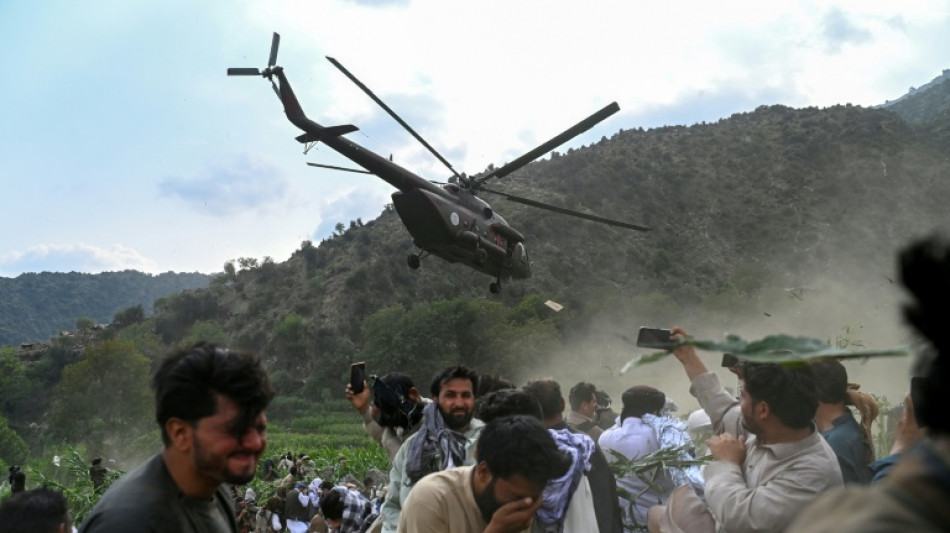
With aid slashed, Afghanistan's quake comes at 'very worst moment' / Photo: Wakil Kohsar - AFP

 Braves clinch division title as Red Sox reach MLB playoffs
 Bordeaux-Begles hammer Stade Francais despite Jalibert injury

 Milan and Juventus end blips with home wins
 Bridgeman wins PGA Biltmore title with sizzling 61

 Williams injured as Bears shut down by Vikings

 US warns of rapid escalation in Middle East war

 Germany's far-right AfD celebrates another state election win
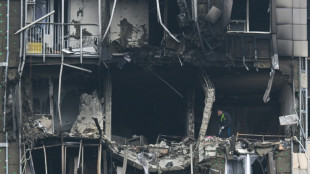 Russia vows revenge for election-day attacks as poll shows ruling party win

 Spaun late shows snatches PGA Championship win

 Conceicao strikes as Juventus beat Atalanta
 Britain, Zverev-inspired Germany, Spain complete Davis Cup finals

 Man Utd salvage Fulham draw as pressure mounts on Carrick

 Spanish civil war drama 'The Black Ball' wins at Toronto festival

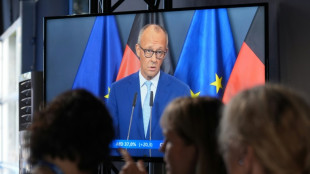 Germany's Merz shaken by far-right and far-left gains in state votes

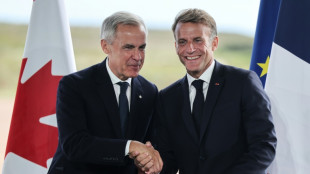
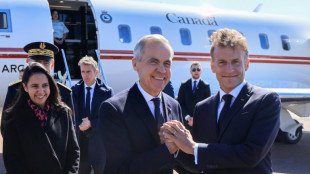 Macron welcomes Canada's Carney to French Atlantic territory

 Fiorentina frustrate Napoli with Serie A draw, Como upset

 Five-star Man City top Premier League after Sunderland thriller

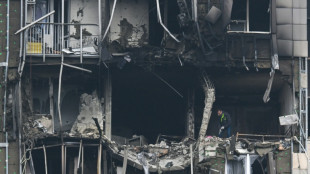 Ukrainian drones hit Moscow on last day of Russian elections
 Multi-Asset Trading Venue Monochrome Exchange Announces IEO of Its Native Token, $MCR
 South Korea break Japan hearts to win Asian Games basketball gold

 Acosta takes first victory at Austrian MotoGP
 PSG president Nasser al-Khelaifi under investigation in France for conflict of interest

 China swim sensation, 13, sets Games record after Japan win early

 Drones hit Moscow as Russians go to the polls

 New England boss Fleming says 'wrong' to ask Stokes to end retirement

Afghanistan was already facing severe crises when it was rocked by another devastating earthquake, but this time there are fewer resources to muster after foreign funding was slashed to the bone this year.
Less international aid "means fewer ambulances, fewer doctors, fewer nurses, fewer midwives" to send into the battered farming communities of Afghanistan's mountainous east, said Arthur Comon, deputy director of operations at the non-governmental group Premiere Urgence Internationale (PUI).
The humanitarian sector has issued repeated calls since the start of the year for help in Afghanistan, which faces soaring poverty, worsening drought and the mass return of migrants expelled from neighbouring countries.
The 6.0-magnitude earthquake that struck around midnight on Sunday killed more than 1,400 people and injured over 3,000, a toll that was still rising.
It hit "in the very worst moment", said Rahmat Nabi Shirzad, communications officer for the UK-based NGO Islamic Relief in Afghanistan.
"The impact of these global cuts to humanitarian aid is very clear," especially in health services for the hardest-hit province of Kunar, said Shirzad, who was also on the ground after deadly earthquakes in Herat province in 2023 and Paktika in 2022.
Compared to the support provided after those disasters, the resources for Kunar are "not at that level".
- 'Already bled dry' -
"This earthquake is a crisis within a crisis," United Nations Resident and Humanitarian Coordinator in Afghanistan Indrika Ratwatte told AFP.
"Survivors now face overcrowded clinics, long waits and severe shortages of doctors and medicines -- just when emergency trauma care is needed most."
Funding cuts forced the closure of 400 health facilities, Ratwatte said.
The United States had been Afghanistan's main donor, providing $3.71 billion in aid since the Taliban takeover in 2021. It cut all but a sliver of funding in January.
"The Americans had put the country on a drip feed, and then pulled it out before the patient was healed," said a source at a French NGO.
"The earthquake is now ravaging a population that was already bled dry."
Beyond Washington, the UN said in June that it was drastically scaling back global humanitarian aid due to the "deepest funding cuts ever".
Afghanistan's aid had already been dwindling as donors hesitated, in part due to the Taliban's restrictions on women.
A senior official in the Taliban's information and culture ministry called on the international community to help.
"We are providing basic services... but the rehabilitation of those impacted and reconstruction of their homes is not in the capacity of the Islamic Emirate alone," said Atiqullah Azizi.
Half of Afghanistan's 48 million people are already in need of humanitarian aid, one in five goes hungry, and 3.5 million children under five are acutely malnourished, according to the UN.
The earthquake is "a key moment to see how donors react", International Rescue Committee's Vice President of Emergencies Bob Kitchen told AFP.
"What comes next will be very different -- we would ordinarily be already on the phone to US government colleagues," working to deploy funding for the earthquake response, he said.
- 'Lost interest in Afghanistan' -
PUI's Comon said it was "unlikely" that new funding would be secured for the post-earthquake response beyond perhaps only "small top-ups to cover the most urgent needs".
The French NGO, which closed 60 health centres and laid off 480 staff this year after the US cuts, has deployed mobile clinics in the quake-hit provinces but fears for the long term.
"It's been a long time since the general public lost interest in Afghanistan," the staff member said, adding that he hopes for aid from the European Union but expects little from the Americans, who are "completely out of the picture".
UN agencies have launched fundraising appeals, and an initial $5 million has been released from the emergency response fund.
But even before the earthquake, the UN estimated it had only $606 million available for its operations across Afghanistan out of the $2.79 billion required.
"With these cuts, we are being forced to make ever-tougher choices, concentrating scarce resources on those most vulnerable, while leaving many needs unmet," Ratwatte said.
S.Caetano--PC
