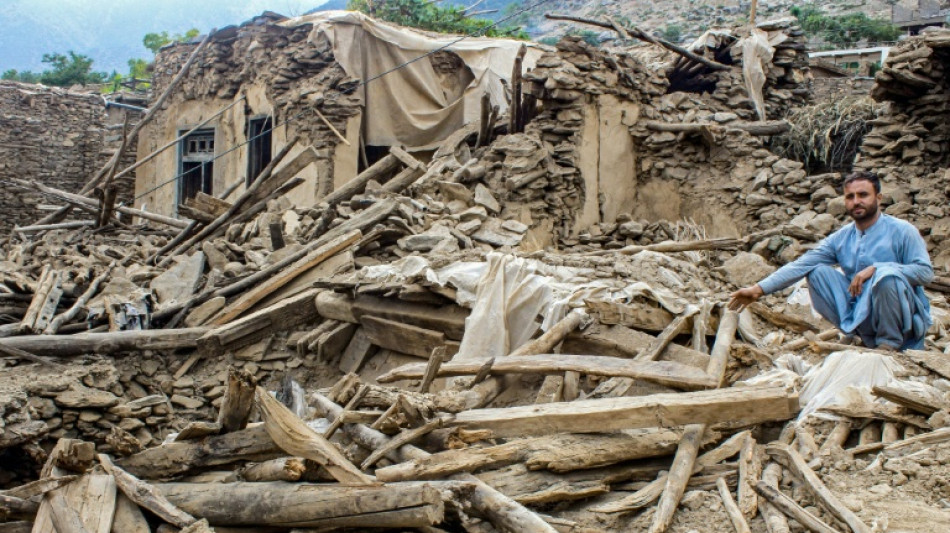
Homeless and fearful, Afghan quake survivors sleep in the open / Photo: - - AFP

 Braves clinch division title as Red Sox reach MLB playoffs
 Bordeaux-Begles hammer Stade Francais despite Jalibert injury

 Milan and Juventus end blips with home wins

 Bridgeman wins PGA Biltmore title with sizzling 61

 Williams injured as Bears shut down by Vikings

 US warns of rapid escalation in Middle East war

 Germany's far-right AfD celebrates another state election win

 Russia vows revenge for election-day attacks as poll shows ruling party win

 Spaun late shows snatches PGA Championship win

 Conceicao strikes as Juventus beat Atalanta

 Britain, Zverev-inspired Germany, Spain complete Davis Cup finals

 Man Utd salvage Fulham draw as pressure mounts on Carrick

 Spanish civil war drama 'The Black Ball' wins at Toronto festival

 Germany's Merz shaken by far-right and far-left gains in state votes

 Macron welcomes Canada's Carney to French Atlantic territory

 Fiorentina frustrate Napoli with Serie A draw, Como upset

 Five-star Man City top Premier League after Sunderland thriller

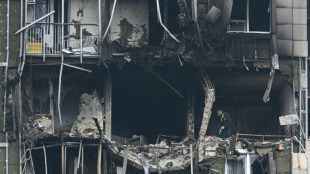
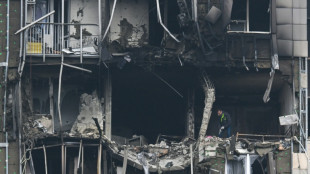 Ukrainian drones hit Moscow on last day of Russian elections
 Multi-Asset Trading Venue Monochrome Exchange Announces IEO of Its Native Token, $MCR
 South Korea break Japan hearts to win Asian Games basketball gold
 Acosta takes first victory at Austrian MotoGP
 PSG president Nasser al-Khelaifi under investigation in France for conflict of interest

 China swim sensation, 13, sets Games record after Japan win early

 Drones hit Moscow as Russians go to the polls

 New England boss Fleming says 'wrong' to ask Stokes to end retirement

Families huddled hungry and homeless days after a deadly earthquake hit eastern Afghanistan, not daring to set foot in the few remaining buildings for fear an aftershock could bring them down.
The initial powerful 6.0-magnitude earthquake struck remote regions along the border with Pakistan, killing more than 1,400 people, with at least six strong aftershocks and countless smaller tremors.
Some farming villages tucked among the green mountainsides were flattened, with people still under the rubble days later.
Elsewhere, some houses were only partially destroyed, but residents preferred to brave the elements than risk being crushed.
Still haunted by the "terrifying night" when the quake destroyed his house in the village of Dar-i-nur in Nangarhar province, Emran Mohammad Aref said he had since slept with four other family members outside on a rough plastic mat.
"There was a tremor yesterday and there was also one this morning," Aref told AFP.
"Now we have no place to live and we are asking everyone for help."
While those with the means fled the village, residents who had no choice but to stay cobbled together makeshift shelters with whatever they could find among the destruction.
Even in Jalalabad, Nangarhar's provincial capital, which suffered no damage but felt the quake and its aftershocks, "we are very afraid", said Fereshta, a 42-year-old doctor.
"Every time I take a step, I feel like the ground is shaking. We don't stay inside the house and we sleep in the garden, constantly thinking there will be another quake," she said.
- 'Give us shelter' -
Similar scenes are playing out across the affected region, some in the isolated areas of hard-hit Kunar province that are still cut off from aid by landslides caused by the quake and aftershocks.
But in fleeing their homes -- often built on high ground -- and taking refuge in low-lying fields, riverbeds or by roadsides, survivors risk being hit by rockfall if aftershocks strike, warned Ijaz Ulhaq Yaad, a senior official in Kunar's Nurgal district.
"The area is very dangerous, you cannot stay there long or even walk through it," said Yaad.
The United Nations said it has 14,000 tents ready for distribution.
The International Federation of Red Cross and Red Crescent Societies (IFRC) told AFP it has at least 700 tents available, but cannot deliver them to survivors because of difficult access to the villages.
"Help us, give us shelter, help my children, we have nothing left," pleaded Sorat, a housewife injured in the quake along with her husband and children.
After being pulled from the ruins of her house by rescuers, she was treated in a regional hospital, then sent back to her village, where nothing awaits her, she told AFP.
While waiting for aid, "we are staying in the valley", she said, sitting in her blue all-enveloping burqa on a traditional simple woven bed surrounded by her three small children.
This earthquake, one of the deadliest in Afghanistan in decades, is "the last thing families with young children need in a country where many don't have enough food, and a large portion of the children are already malnourished", the World Food Programme said, adding the situation "is brutal".
Afghanistan, still fragile after decades of war and a prolonged humanitarian crisis, has been rocked by other severe, deadly quakes in recent years -- one in 2023 in western Herat, on the other side of the country near Iran.
That first 6.3-magnitude tremor was followed by at least eight powerful aftershocks and destroyed entire villages.
E.Borba--PC
