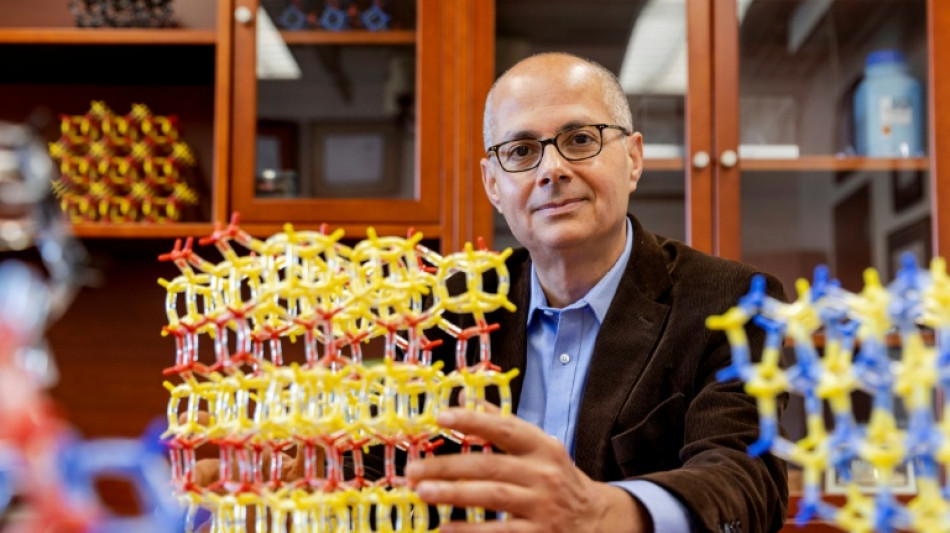
From refugee to Nobel: Yaghi hails science's 'equalising force' / Photo: Brittany Hosea-Small - University of California, Berkeley/AFP

 Grattan Institute Releases Blueprint to Target Specialists Over Excessive Fees

 Arizona Science Center Hosts Girls in STEM Astro Adventures for Students

 New Turkish Cafe, Japanese BBQ, and Korean Restaurants Open Across East Bay

 Knowle Move Four Points Clear at Top After Histon Victory

 Physicians Urge Arizona to Ban Medical Gag Clauses and Enable Private Lawsuits

 New Campaign Highlights Knowledge Gaps on Carbon Monoxide Safety Among Americans

Born into a family of Palestinian refugees in Jordan with little schooling, Nobel chemistry laureate Omar Yaghi on Wednesday paid tribute to science's "equalising force".
Yaghi, a Jordanian-American, won the 2025 prize together with Susumu Kitagawa of Japan and UK-born Richard Robson for their groundbreaking discoveries on metal–organic frameworks (MOFs), whose uses include capturing carbon dioxide and harvesting water from desert air.
"I grew up in a very humble home. We were a dozen of us in one small room, sharing it with the cattle that we used to raise," he told the Nobel Foundation in an interview after learning he had won the prestigious prize.
Their home had no electricity or running water. His father had only finished sixth grade and his mother could neither read nor write.
Born in 1965, he spent his childhood in Amman, in Jordan, before leaving for the United States at the age of 15, on the advice of his stern father.
Yaghi first discovered molecular structures in a book when he was 10 years old, after sneaking into the usually locked school library.
His eyes were drawn to the "unintelligible but captivating" images.
"It's quite a journey," he mused -- and one that science enabled him to make, he said.
"Science is the greatest equalising force in the world," Yaghi said.
"Smart people, talented people, skilled people exist everywhere. That's why we really should focus on unleashing their potential through providing them with opportunity."
His research group succeeded in extracting water from desert air in Arizona.
"I started at Arizona State University, my independent career and my dream was to publish at least one paper that receives 100 citations," he recalled.
"Now my students say that our group has garnered over 250,000 citations."
"The beauty of chemistry is that if you learn how to control matter on the atomic and molecular level, well, the potential is great," he said.
"We opened a gold mine in that way and the field grew," he said.
X.M.Francisco--PC

